Make the railway your route, not your whole day
Short answer: the best first Enoden day is a rail-and-walk plan, not a race to every station. Choose one main stop: Hase for the Great Buddha and temple area, Kamakura for the historic center, the coast around Kamakura-Koko-Mae or Shichirigahama for sea views, or Enoshima for a longer seaside branch.
Last checked: August 28, 2026. Train status, fares, passes, station facilities, temple and shrine rules, crowd conditions, road restrictions, and photography rules can change. Always confirm current details on official Enoden and local visitor pages before you go.
Choose your first Enoden plan
| Plan | Best fit | Check first |
|---|---|---|
| Kamakura to Hase | First-time visitors who want a short rail ride, the Great Buddha, Hase-area temples, and easy walking | Official Enoden station/timetable pages and Kotoku-in visitor rules |
| Kamakura historic center | Travelers who want Tsurugaoka Hachimangu, Komachi-dori, and a less rail-heavy day | Shrine access, crowding, pedestrian manners, and station lockers |
| Coastal Enoden | Rail fans who want sea views and the local-line feeling | Safe public viewpoints, station crowding, road safety, and photo rules |
| Enoshima add-on | Repeat visitors or slower travelers who want a longer coast and island day | Walking time, weather, last return, and official train status |
Why Enoden works for first-time visitors
Enoshima Electric Railway’s official English site frames Enoden as the line linking Fujisawa, Enoshima, and Kamakura. Its access page describes Enoden as a 10km railway connecting Fujisawa and Kamakura, with scenery including tunnels, ocean views, and Enoshima.
That is exactly why the line works well for a first rail walk. You can enjoy the train, but the train also solves a practical problem: it links compact stations, temples, streets, beaches, and seaside viewpoints without needing a car. Treat the line as local transport, not as a private sightseeing ride.
The easiest route: Kamakura to Hase
If you want the simplest plan, start at Kamakura Station and take Enoden to Hase. Kotoku-in’s official English page says visitors coming from Kamakura can use Enoden to Hase Station, then walk to the Great Buddha. It also lists visitor rules, including photography and drone cautions, food and drink restrictions, smoking rules, and accessibility notes.
This route is short enough to leave breathing room. Visit the Great Buddha, add Hase-dera or a nearby walk if your pace allows, then decide whether to continue toward the coast or return to Kamakura. Do not pack every station into the same day just because the map looks small.
Kamakura center: rail fans still need a town plan
Enoden can bring you into Kamakura, but the historic center is often better as a walk. Tsurugaoka Hachimangu’s official access page places the shrine within walking distance of Kamakura Station, and Enoden’s own English site presents the Kamakura area as a place of temples and shrines, including Tsurugaoka Hachimangu and Kenchoji.
For a first visit, choose whether your anchor is rail, temples, food, or the shrine approach. Kamakura can become crowded, and a rail-focused day becomes better when you give sidewalks, station exits, and local shops enough space.
Coastal stations and photo manners
Kamakura-Koko-Mae, Shichirigahama, and nearby coastal sections are popular because they feel very Enoden: trains, sea, narrow streets, and everyday local movement. The official Kamakura-Koko-Mae Station page gives station details and links to current timetable and fare information, which should be checked before you rely on a plan. This route article should not be treated as a live fare or train-status page.
Photo manners matter here. VISIT KAMAKURA’s official guidelines ask visitors not to disturb residents, to be mindful of traffic and pedestrians, to follow photography rules, and not to take photos in dangerous locations or obstruct vehicles. Do not stand in roads, block crossings, enter tracks, lean over barriers, or copy a photo spot if it makes the street worse for residents.
When to add Enoshima
Enoshima is a good add-on when you have a slower day, good weather, and enough energy for walking. Enoden’s English site presents Enoshima as one of the line’s core areas, and the access page links train information with local transport choices.
For a first-time visitor, Enoshima is not mandatory. If you already spent time at Hase and Kamakura, forcing Enoshima into the same afternoon can turn a pleasant rail walk into a checklist. Save it for a longer day if the coast itself is the reason you came.
Simple first itinerary
Start at Kamakura Station, ride Enoden to Hase, visit Kotoku-in, walk the Hase area, then choose one extra branch: return to Kamakura for Tsurugaoka Hachimangu, continue toward the coast for a short sea-view stop, or keep going toward Enoshima if you have time and energy. Check official pages before relying on exact fares, train times, passes, and facility rules.
For the wider transport branch, start with Japan Transport Fan Travel Guide. For similar scenic rail planning, see Scenic Railways in Japan for First-Time Visitors.
Photo credit
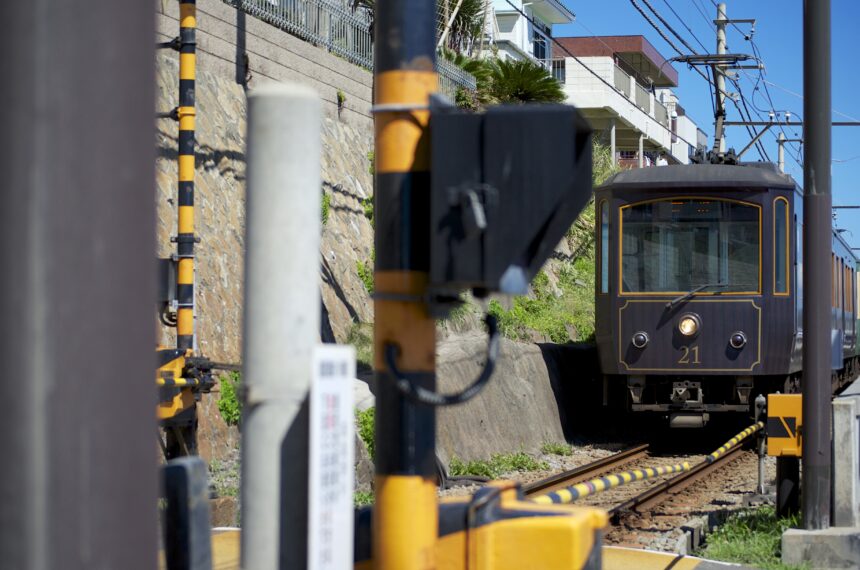
Featured image: Enoden Type 20 retro color.jpg by Yoshikazu TAKADA on Wikimedia Commons, CC BY 2.0. Cropping or resizing may be applied for site display. The image is used in editorial Enoden and Kamakura rail-walk travel-guide context and does not imply endorsement by Enoshima Electric Railway, Wikimedia, Flickr, or the photographer.
Sources
- Enoshima Electric Railway official English site
- Enoshima Electric Railway: access and local transport information
- Enoshima Electric Railway: Kamakura-Koko-Mae Station
- VISIT KAMAKURA: Respect Kamakura Guidelines
- Kotoku-in official English site
- Tsurugaoka Hachimangu official access page
- Wikimedia Commons image file and license record
Editorial disclosure: This is an independent planning guide. It is not affiliated with Enoshima Electric Railway, VISIT KAMAKURA, Kamakura City Tourist Association, Kotoku-in, Tsurugaoka Hachimangu, Wikimedia, Flickr, the photographer, or trademark owners.