Choose airports by route, not just by code
Short answer: Japan has far more useful airports than the first-time visitor usually notices. Tokyo, Kansai, Chubu, Fukuoka, Hokkaido, Okinawa, and many regional airports can shape the trip, but flights, access, observation decks, shops, lounges, and photography rules change often. Use airport choice as a route decision, then confirm details on official airport and transport pages.
Last checked: August 20, 2026. MLIT’s airport list is current as of April 1, 2026. Flight routes, airport access, fares, facility hours, deck rules, security rules, weather disruption, and airline operations can change.
How many airports are we talking about?
The Ministry of Land, Infrastructure, Transport and Tourism lists Japan’s airports by official category. Excluding heliports and non-public airfields, the April 1, 2026 list includes 28 hub or base airports, 54 local management airports, 7 other airports, and 8 joint-use airports. That does not mean every airport is useful for every visitor. It means Japan’s air network is regional, layered, and often useful when a trip goes beyond Tokyo and Osaka.
For travel planning, the better question is not “Which Japanese airport is best?” It is “Which airport saves backtracking, fits my route, and gives me a good first or last day?”
Major airport choices
| Airport choice | Best use | Nearby travel idea |
|---|---|---|
| Haneda Airport | Tokyo arrival, domestic transfers, airport-fan visit | Tokyo Bay, monorail ride, terminal decks when officially open |
| Narita Airport | International arrival, eastern Tokyo or Chiba routes | Narita town, airport museum areas, rail link comparison |
| Kansai International Airport | Osaka, Kyoto, Kobe, Wakayama, and western Japan entry | Rinku area, Osaka first night, Kansai without Tokyo backtracking |
| Chubu Centrair | Nagoya, Ise, Gifu, Takayama, and central Japan routes | Airport island visit, Nagoya base, central Japan rail connection |
| Fukuoka Airport | Kyushu entry with very easy city access | Hakata first meal, Kyushu rail start, compact city arrival |
| New Chitose and Hokkaido airports | Sapporo, ski routes, eastern Hokkaido, national parks | Choose by final region rather than forcing every route through Sapporo |
| Naha and Okinawa island airports | Main-island and island-hopping trips | Use flights as part of the island route, not just as arrival logistics |
Airport-fan planning
For aviation fans, airports can be part of the trip instead of dead time. Observation decks, terminal architecture, airport museums, monorail or rail access, airport buses, and regional aircraft routes can all be interesting. But airport-fan travel needs stricter safety habits than normal sightseeing.
Use official airport pages for deck hours, photography rules, terminal maps, access, and notices. Do not enter restricted areas, service roads, fences, private land, rooftops, construction zones, or roadside locations that are not designed for visitors. If a viewing area is closed, choose a different official spot rather than improvising.
When a regional airport is smarter
JNTO notes that most prefectures have at least one airport and that low-cost air travel can help visitors reach many parts of the country. This is most useful when the destination is far from the main shinkansen corridor, such as Hokkaido, Kyushu, Okinawa, remote islands, parts of Shikoku, and some coastal or mountain regions.
A regional airport can save a full day of train travel, but it can also add risk if flights are infrequent or weather-sensitive. Check the official airport site, airline page, local transport, and backup route before building a tight itinerary around a small airport.
What to check before choosing
- Current flight route and airline operation, not only old route maps
- Access from the airport to your actual hotel area, not just the nearest big station
- First and last train, bus, taxi, rental car, and late-arrival options
- Observation deck hours, photography rules, and weather conditions
- Terminal changes, construction, security notices, and baggage rules
- Backup plan if a regional or island flight is delayed or canceled
Best first-time pattern
If this is a classic first trip, Haneda, Narita, or Kansai International will probably do most of the work. If the trip is aviation-focused, add one deliberate airport visit instead of trying to inspect every terminal while carrying luggage. If the trip is regional, start with the destination and work backward to the airport that reduces backtracking.
Use this guide as the overview. Future airport guides can go deeper into Haneda, Narita, Kansai, regional airports, observation decks, and plane-spotting safety. For now, the win is simple: choose an airport that makes the rest of the itinerary easier, then verify the moving parts officially.
Use This With Related Guides
Use this airport guide with Japan Transport Fan Travel Guide. For a small-airport island route, compare with Chofu Island Flights Guide. If the trip is rail-led, read Vintage Trains and Railway Heritage in Japan.
Photo credit
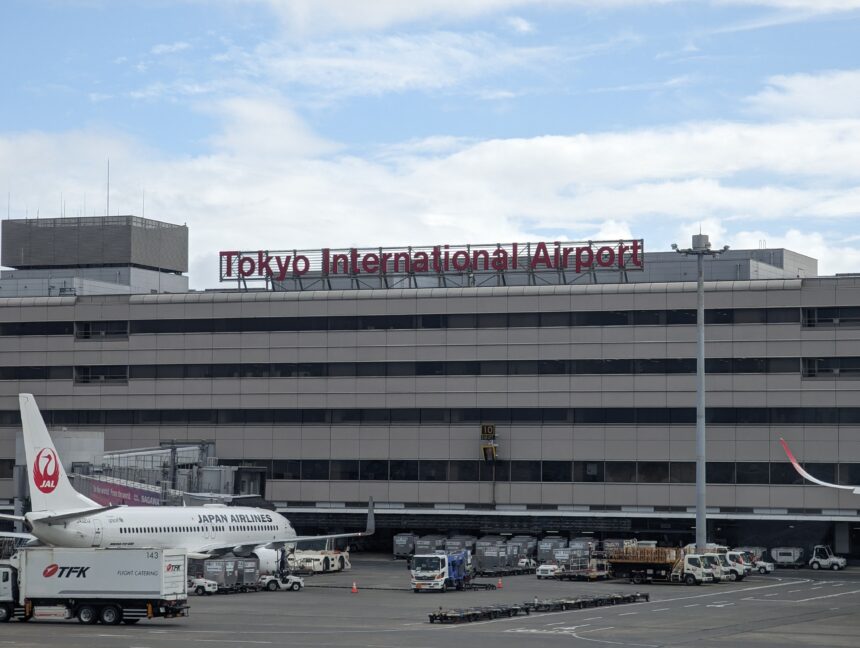
Featured image: Haneda airport by Syced on Wikimedia Commons, CC0. Cropping or resizing may be applied for site display. Visible airport, airline, and service-company marks are shown only in editorial travel-guide context and do not imply endorsement.
Sources
- MLIT: Airport list
- JNTO: Airport Access
- Haneda Airport Passenger Terminal
- Narita International Airport
- Kansai International Airport
- Chubu Centrair International Airport
- Fukuoka Airport
Editorial disclosure: This is an independent planning guide. It is not affiliated with MLIT, JNTO, airport operators, airlines, transport operators, service companies, or trademark owners.