Use Narita as a real airport area
Short answer: Narita Airport can work as more than an arrival or departure point for aviation fans. Start with the official observation decks, add the Museum of Aeronautical Science only when you have enough ground-transport time, and use Narita town or Naritasan Shinsho-ji as a calmer layover option when aircraft viewing is not the whole goal.
Last checked: August 20, 2026. Observation decks, museum hours, access routes, buses, fares, flight activity, security rules, shop hours, weather closures, and local events can change. Always confirm current details on official airport, museum, and transport pages before you go.
Best first plans
| Plan | Best for | Check first |
|---|---|---|
| Terminal deck visit | Short layovers, arrivals, departures, and travelers with luggage | Deck status, terminal, weather, luggage plan, and photography rules |
| Two-terminal airport walk | Visitors who want different deck views without leaving the airport | Terminal movement, walking time, security boundaries, and flight margin |
| Aviation museum extension | Fans with a half day, light luggage, and interest in aircraft exhibits | Museum day, access route, local bus timetable, taxi plan, and return time |
| Narita town fallback | Travelers who want a cultural walk near the airport | JR or Keisei route, luggage storage, walking time, and temple etiquette |
Start with official decks and public areas
Narita Airport’s official Best View Point page describes a Terminal 1 observation deck with runway views and Terminal 2 viewing decks where visitors can see parked aircraft up close. It also warns that decks may close because of weather and that some large photography equipment is restricted on the elevated Mountain Deck section.
The airport’s official tour notice sets the bigger boundary: Narita Airport visits are self-guided public-area visits. Areas such as Immigration, control towers, and maintenance areas are not tour spaces, and visitors are asked not to disturb others. For aviation fans, that is the rule of the day: official decks, public terminals, current airport notices, and ordinary visitor manners.
Choose the right terminal for your day
If you are flying from Narita, the best terminal is usually the one attached to your flight. If you are visiting without a flight, choose the terminal by what you want to do: observation deck, food, shops, airline interest, railway access, or a simple airport walk. Do not treat old aircraft-type tips as guaranteed because runway use, parking positions, weather, and security rules change.
Narita Airport’s rail page says rail access uses the Narita Sky Access line, Keisei line, and JR line. It also explains which airport railway stations connect with Terminal 1 and Terminals 2 and 3. Use the official page or railway operator page before deciding whether a multi-terminal plan is realistic with your luggage and flight time.
Add the aviation museum only with enough time
The Museum of Aeronautical Science is adjacent to Narita Airport in Sky Park Shibayama. Its official site describes Narita Airport views, real aircraft and engine exhibits, cockpit-related displays, simulator-style experiences, an observation restaurant, and outdoor aircraft exhibits. For aviation fans, this can be the strongest Narita-area add-on.
The transport part deserves respect. The museum’s public-transport access page tells visitors to check timetables because buses can be infrequent. If your time is tight, do not force the museum between flights. Make it a deliberate half-day plan, with the return route checked before you leave the airport.
Use Narita town when you want culture, not another deck
JNTO describes Naritasan Shinsho-ji Temple as a major temple complex reached by walking along Narita Omotesando from JR Narita Station or Keisei Narita Station. It also notes the temple’s proximity to Narita International Airport, making it a possible layover addition when time allows.
This is a good fallback when deck weather is poor, museum timing is awkward, or your group includes non-aviation travelers. Keep the plan gentle: station, Omotesando, temple grounds, one meal or snack, then a clear return to the airport. Protect your flight margin before anything else.
What not to do
- Do not enter Immigration areas, control towers, maintenance areas, service roads, fences, private land, rooftops, or restricted zones.
- Do not use stepladders, tripods, drones, large equipment, flash, or reflectors where airport or museum rules prohibit them.
- Do not block decks, terminal walkways, doors, stairs, shops, viewing gaps, bus stops, or other visitors’ sightlines.
- Do not assume a bus, museum, restaurant, or deck is operating because an old guide says it was.
- Do not cut your return to the airport close; security, luggage, trains, buses, and weather can all add friction.
Where this fits the transport branch
If you are comparing airports, start with Japan Airports Guide and Nearby Travel Ideas. If aircraft observation is the main goal, read Plane Spotting in Japan Airports for First-Time Visitors. For the Tokyo-side airport comparison, pair this with Haneda Airport Area Guide for Aviation Fans.
For the parent overview, use Japan Transport Fan Travel Guide. Narita works best when you choose one main object: airport decks, aviation museum, or Narita town. Trying to do all three before a flight is usually less fun than doing one well.
Photo credit
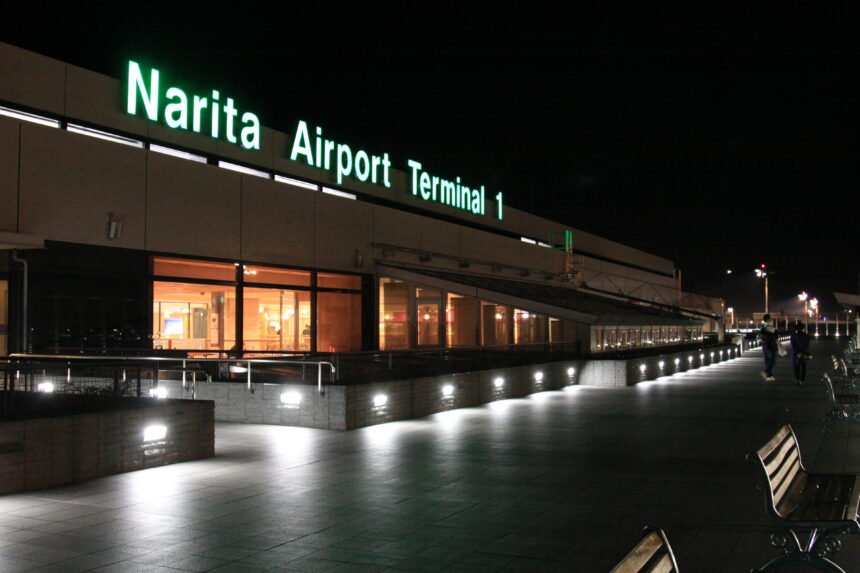
Featured image: Narita Airport at night by Kentaro Iemoto on Wikimedia Commons, CC BY-SA 2.0. Cropping or resizing may be applied for site display. The image is used in editorial airport-area travel-guide context and does not imply endorsement by Narita Airport, NAA, airlines, Wikimedia, Flickr, or the photographer.
Sources
- Narita International Airport: Best View Point
- Narita International Airport: For guests wishing to tour Narita Airport
- Narita International Airport: Rail
- Narita International Airport: Public bus
- Museum of Aeronautical Science
- Museum of Aeronautical Science: Public transport access
- JNTO / Travel Japan: Naritasan Shinsho-ji Temple
- Wikimedia Commons image file and license record
Editorial disclosure: This is an independent planning guide. It is not affiliated with Narita International Airport, Narita International Airport Corporation, the Museum of Aeronautical Science, JNTO, railway or bus operators, airlines, Naritasan Shinsho-ji, Wikimedia, Flickr, or the photographer.