Short answer
Oshima Bus can be the most satisfying way to move around Izu Oshima if you treat it as an island bus, not as a mainland airport shuttle. Start with the official Oshima Bus timetable page, confirm which port your ship uses, then choose the line that actually connects your port, airport stop, or sightseeing stop that day.
Last checked: August 21, 2026. Timetables, ship arrival ports, early-morning connection buses, fares, passes, payment methods, accessible vehicle assignments, app sales, and weather conditions can change. Always confirm current details with Oshima Bus, Tokai Kisen, UMISORA, and official local sources before travel.
What Oshima Bus is good for
Oshima Bus is the island’s practical public-transport layer. It links ferry ports, the airport area, Oshima Park, Habu Port, hot-spring and mountain access points, and everyday stops around the island. For transport fans, the point is not only getting from A to B. The bus also shows how port choice, volcanic terrain, ferry timing, and local life fit together on a Tokyo island far from the mainland rail map.
The official route-bus page checked for this guide showed a timetable period from July 1, 2026 to September 30, 2026. It linked the route-bus timetable and island map, Oshima Park Line summary timetable, Habu Line summary timetable, route map, and fare table. Use those official PDFs as the live layer rather than relying on a copied schedule in a travel article.
The three route ideas most visitors need
| Route idea | Main stops to understand | Why it matters |
|---|---|---|
| Port to park | Motomachi Port, Okata Port, Oshima Park | The Tokyo accessibility guide describes the Oshima Park Line as the main line linking the two ports with Oshima Park. |
| Motomachi to Habu side | Motomachi Port, strata-section area, Habu Port | The Habu Port Line is the useful branch for the south and east side of the island. |
| Port or airport timing | Motomachi Port, Okata Port, Oshima Airport Entrance, Oshima Airport Terminal, Airport North Exit | Oshima Bus stop information lists airport-area stops and both ferry ports, but you must match them to the current timetable. |
Oshima Bus sightseeing information lists Motomachi Port for the Oshima Park Line, Habu Port Line, and Miharayama Line. It lists Okata Port for the Oshima Park Line and Miharayama Line. It also lists Oshima Airport Entrance, Oshima Airport Terminal, and Airport North Exit as airport-area stops. That is enough to plan, but not enough to board without checking the current timetable.
Port first, bus second
Oshima trips often depend on the day’s sea conditions. If your ship uses Okata Port in the morning and Motomachi Port later, your bus plan changes. Before you build an island loop, confirm the arrival or departure port with Tokai Kisen and then open the Oshima Bus official timetable PDFs.
This matters most on ferry days. Oshima Bus says there are connection buses for the large passenger ship’s early-morning arrival around 6:00 a.m., including directions toward Motomachi Port via Gojinka Onsen, Oshima Park via Oshima Onsen Hotel, and Habu Port via Oshima Town Athletic Stadium. The same official guidance says ship arrival time can move, so departure times are not fixed and passengers should go to the bus stop soon after disembarking.
Fare and pass snapshot
As checked on August 21, 2026, the Oshima Bus official fare section listed a one-day pass at 2,500 yen for adults and 1,250 yen for children, and a two-day pass at 3,800 yen for adults and 1,900 yen for children. The official page listed the passes as valid on all routes.
The same page said sales locations include the Oshima office, route buses, departure-port waiting-room bus windows during the morning arrival period, and the Jorudan Norikae Annai app. The FAQ also says one-day and two-day route-bus passes are sold on route buses. Treat these as checked-date facts, because prices and sales methods can change.
Payment basics
The official FAQ says Suica, PASMO, and similar IC cards cannot be used. It says cash and PayPay are accepted. It also says 50 to 500 yen coins and 1,000 yen notes can be changed on the bus.
For international visitors, that means a low-stress plan is simple: carry small yen notes and coins, confirm whether a pass makes sense, and do not build a tight transfer that depends on a payment method you have not used before.
Accessibility and timing
The Tokyo Sightseeing Accessibility Guide says the island route buses mainly include the Oshima Park Line, Habu Port Line, and Miharayama Line. It says the Oshima Park Line and Habu Port Line run about once per hour, while the Miharayama Line has fewer services. It also says route-bus schedules are determined the evening before use.
Oshima Bus says some route buses are non-step or one-step vehicles, and that barrier-free vehicle assignment is decided the evening before use and may change due to vehicle adjustments. If step-free boarding, wheelchair space, stroller space, or a tight connection matters, call ahead rather than assuming the exact bus type.
A simple way to plan your day
- Check Tokai Kisen for the day’s Oshima port, especially if arriving or leaving by ferry.
- Open Oshima Bus’s official route-bus page and the current timetable PDF.
- Use the route map to identify whether you need the Oshima Park Line, Habu Port Line, or Miharayama Line.
- Check whether a one-day or two-day pass beats separate fares.
- Carry cash backup even if you expect to use PayPay or a digital pass.
- For airport or accessibility-dependent moves, confirm the bus stop, bus timing, and vehicle needs before travel.
Useful contact points
Oshima Tourism Association lists Oshima Bus, formally Oshima Passenger Vehicle Corporation, at Motomachi 1-9-6 with phone number 04992-2-1822. UMISORA’s English FAQ also directs travelers who want Oshima bus timetables to Oshima Bus and lists the same phone number.
The Tokyo Bus Association English Oshima route example is useful as a sample, not as a fixed plan. It uses Okata Port, the Oshima Park Line, Oshima Park, Motomachi Port, the Miharayama Line, and Tsubakihana Garden, and warns travelers to check timetables when making their own route.
Where to go next
Use this as the bus-planning branch of the Japan Transport Fan Travel Guide. For airport-to-port transfers, read the Oshima Airport to Ferry Ports Transfer Guide. For ferry-port uncertainty, use the Oshima Ferry Return Port Choice Guide. For a Chofu flight plus jet-ferry day, use the Chofu to Oshima Plane and Jet Ferry Day Trip Guide.
Photo credit
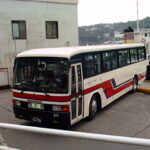
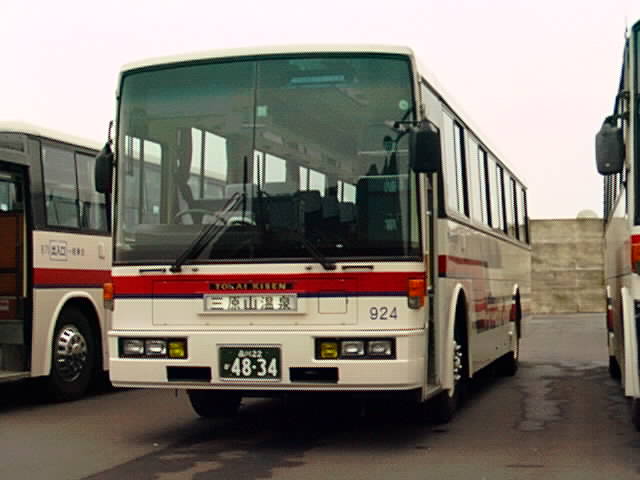
Featured image: Tokai Kisen / Oshima Bus vehicle at Okada Port by Cassiopeia sweet via Wikimedia Commons, public domain. The image may be resized by WordPress for site display; no editorial changes are intended. It is an older bus photo used in editorial transport-guide context and does not imply current vehicle assignment, current bus livery, current stop layout, current service, or endorsement by the creator, Wikimedia, Oshima Bus, Tokai Kisen, Tokyo Metropolitan Government, Tokyo Bus Association, UMISORA, Oshima Tourism Association, or island communities.
Sources
- Oshima Bus official route-bus page
- Oshima Bus route-bus timetable and island map PDF
- Oshima Bus Oshima Park Line summary timetable PDF
- Oshima Bus Habu Line summary timetable PDF
- Oshima Bus route map PDF
- Oshima Bus fare table PDF
- Oshima Bus official FAQ
- Oshima Bus sightseeing and stop information page
- Tokyo Sightseeing Accessibility Guide Oshima traffic page
- Oshima Tourism Association transportation page
- Tokyo Bus Association English Oshima route example
- UMISORA English Oshima bus timetable FAQ
- Wikimedia Commons image file and license record
Editorial disclosure: This is an independent planning guide. It is not affiliated with Oshima Bus, Tokai Kisen, Tokyo Metropolitan Government, Tokyo Bus Association, UMISORA, Oshima Tourism Association, Wikimedia, the image creator, or island communities.