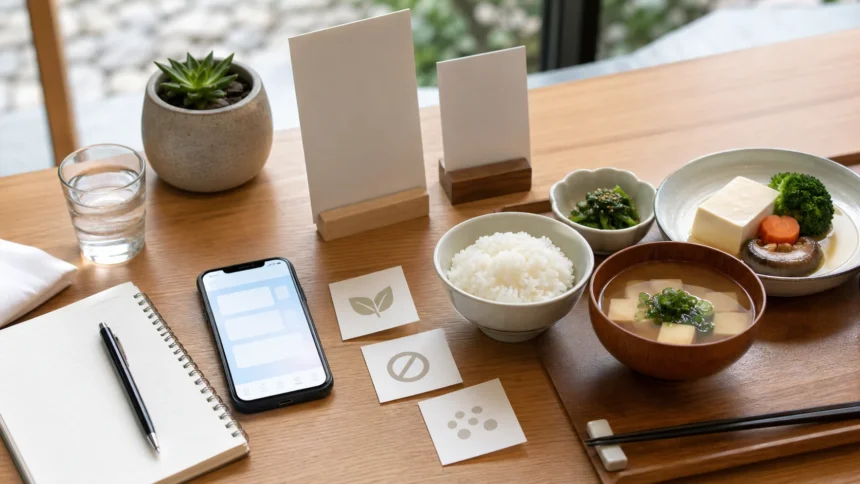
How to book restaurants in Japan with allergies, vegetarian, vegan, or halal needs
Short answer: if allergies, vegetarian, vegan, halal, no-pork, no-alcohol, or another strict food need matters, confirm it before the reservation is accepted or before the cancellation deadline. A booking-form note is a request, not proof that the restaurant can accommodate you. If the venue cannot answer clearly enough, choose a different meal.
For the wider practical planning map, start with Practical Food Guides in Japan. For general booking mechanics, use How to Reserve Restaurants in Japan.
Last checked: August 16, 2026. Reservation rules, cancellation terms, menu policies, supplier information, kitchen procedures, allergy support, vegetarian and vegan accommodation, halal status, and English-language help can change. Confirm the exact restaurant, hotel, tour, or booking channel before relying on it.
Do not wait until arrival
Strict food needs are hardest to solve after you sit down. JNTO notes that some restaurants, especially smaller or specialized places, buy and prepare ingredients based on reservations. Set-menu restaurants may also prepare dishes to match a reservation time. If your requirement changes the ingredients, stock, sauce, utensils, or kitchen process, the right time to ask is before booking or before the cancellation deadline.
Advance notice does not guarantee accommodation. It gives the venue a fair chance to say yes, no, or “we cannot confirm.” A clear no is better than a hopeful meal you cannot safely or comfortably eat.
Separate the requirement type
| Need | Ask about | Do not ask staff to… |
|---|---|---|
| Food allergy | Intentional ingredients, supplier information, shared tools, cross-contact, and whether the kitchen can control the allergen. | Make a medical guarantee or judge your personal risk. |
| Vegetarian | Meat, fish, seafood, dashi, bonito flakes, meat extract, gelatin, and sauces. | Assume “no meat” also means no fish stock. |
| Vegan | All vegetarian checks plus egg, dairy, honey, butter, mayonnaise, noodles, desserts, and shared tools. | Decide from a vegetable photo or English dish name. |
| Halal or Muslim-friendly | Certification, pork, alcohol, mirin, cooking sake, meat source, gelatin, animal fats, utensils, storage, and kitchen separation. | Treat Muslim-friendly, no-pork, seafood, or vegetarian as automatically halal. |
| Other strict need | The exact ingredient, process, or dining condition you require. | Translate a vague label into a safe decision. |
Which meals need early contact?
| Meal type | Contact before booking? | Why |
|---|---|---|
| Kaiseki, omakase, tasting menu, or small counter | Yes | Menus, ingredients, timing, and seat counts may be planned tightly. |
| Ryokan dinner or hotel meal plan | Yes | The meal may be part of the lodging reservation and difficult to change on arrival. |
| Halal, vegan, vegetarian, or allergy-sensitive course | Yes | The venue may need to confirm ingredients, suppliers, utensils, or separate preparation. |
| Izakaya or shared-plate group dinner | Usually yes for strict needs | Shared dishes, sauces, stock, alcohol, and group ordering create ambiguity. |
| Casual ramen, udon, soba, curry, or ticket-machine shop | Often no practical route | Many casual shops cannot customize deeply during rush service; choose a prechecked shop instead. |
| Convenience store or packaged-food backup | No reservation, but precheck | Use labels and known backup items, but do not treat packaged food as restaurant accommodation. |
A booking-stage workflow
- Decide the exact requirement. Write what you cannot eat and whether shared tools, alcohol, cross-contact, or certification matter.
- Check the official route. Use the restaurant, hotel, tour, or booking platform’s current information.
- Send the requirement before confirming when possible. A message field is useful, but it is still a request until answered.
- Ask for a clear yes, no, or cannot confirm. Do not pressure staff into a vague promise.
- Save the confirmation. Keep the reply, booking screen, and cancellation deadline accessible during travel.
- Build a fallback. Choose a nearby hotel meal, food hall, prechecked restaurant, grocery, or packaged-food backup.
What a useful message should contain
Keep the message short and specific. Include the date, time, number of guests, exact requirement, what must be avoided, whether shared tools matter, and whether you can accept a limited menu. Do not send a long medical history, a religious ruling, or a list so broad that the restaurant cannot answer.
If you have an allergy, use the Japan Food Allergy Guide for Travelers before booking. If your need is vegetarian or vegan, use Vegetarian and Vegan Food in Japan for Travelers. If your need is halal, use Halal Food in Japan for Muslim Travelers.
When to choose another restaurant
- The venue cannot confirm ingredients or preparation before the cancellation deadline.
- The reply only says “probably okay” for a strict allergy, vegan, or halal requirement.
- The menu is fixed and the restaurant says substitutions are not possible.
- The booking platform accepts your note but the restaurant has not confirmed it.
- The group has mixed needs that a shared-plate meal cannot handle clearly.
- The meal is too important to leave uncertain.
Make the decision fit the day
How to Book Restaurants in Japan with Allergies, Vegetarian, Vegan, or Halal Needs is most useful when it solves one concrete travel decision. Start with pre-contact, translation, cross-contact questions, booking evidence, and fallback choices; then choose the option that fits the route already on the calendar. A famous format is not automatically the best choice if it adds a long detour, a hard reservation, or a new problem for the group.
Before leaving for How to Book Restaurants in Japan with Allergies, Vegetarian, Vegan, or Halal Needs, set the route anchor, the latest acceptable meal time, and one trigger for changing plans. For this topic, the trigger may be a sold-out slot, a long queue, bad weather, luggage, a dietary boundary, a tired child, or a train that cannot be missed. Decide it while the group is calm, not after the original plan has failed.
| Travel situation | First choice | Confirm before committing |
|---|---|---|
| The topic is the day’s main goal | Reserve or arrive early and keep the surrounding route light. | Official hours, entry format, current menu, payment, and cancellation or late-arrival rules. |
| The topic is a pleasant extra | Choose a nearby option with a normal meal or rest stop beside it. | Walking time, queue length, seating, toilets, and whether the group can leave easily. |
| The group has a constraint | Prefer the clearest option and save a second choice in the same area. | Ingredients, access, child needs, weather cover, luggage space, and a way to communicate questions. |
Check the exact venue or area
For how to book restaurants in japan with allergies, vegetarian, vegan, or halal needs, use maps and social posts to discover candidates, then verify the exact official venue or area page before changing the itinerary. Branch hours, menus, reservations, campaign dates, tenant lists, payment methods, and access can differ. Recheck near the visit when weather, events, or stock could change the decision.
When planning how to book restaurants in japan with allergies, vegetarian, vegan, or halal needs from overseas, check Japan local time, phone-number requirements, language options, card support, and visit-day evidence. Save the official page, confirmation screen, address, nearest station exit, and reservation or timed-entry details before leaving reliable Wi-Fi.
Keep the backup in the same movement pattern
For how to book restaurants in japan with allergies, vegetarian, vegan, or halal needs, the backup should preserve the same movement pattern with less friction. Match an early train with a station option, rain with a hotel or mall, a late arrival with a convenience store or supermarket, and a failed campaign or queue with an ordinary restaurant. A backup that crosses the city is usually too expensive in time and energy.
Use the parent guide after this decision is clear. It can help compare areas, seasons, or purposes; this page should remain the practical answer for pre-contact, translation, cross-contact questions, booking evidence, and fallback choices. When a child or sibling article is added, link it from the parent and keep the promise of each page distinct so readers can move from the broad map to the next small choice.
FAQ
Should I plan this before booking my trip?
Only when pre-contact, translation, cross-contact questions, booking evidence, and fallback choices is a major reason for the trip or has a limited reservation window. Otherwise, place it as a flexible option near a route you already want to take. This keeps the plan useful even when dates, weather, or availability change.
What is the safest way to handle changing information?
For How to Book Restaurants in Japan with Allergies, Vegetarian, Vegan, or Halal Needs, record the date, location, and rule you actually confirmed, then save one nearby alternative. An old review, translated summary, or single branch should explain where to look next, not become a universal rule for the whole category.
What should I decide first?
Decide whether the topic is the anchor, a meal, a short break, or a backup. Then set the time and location around that role. The route becomes easier when the article has one job instead of trying to rank every possible choice.
Common mistakes
- Writing “dietary restriction” without saying the actual ingredient or process.
- Assuming a booking-platform message was read and accepted.
- Asking for changes after the restaurant has already prepared a course.
- Expecting a casual shop to redesign broth, sauce, fryer, or utensils during rush service.
- Treating allergies, vegan needs, and halal requirements as the same kind of request.
- Keeping no backup near the hotel or route.
FAQ
Can I write dietary needs in the reservation note?
Yes, but treat the note as a request. You still need confirmation from the restaurant, hotel, tour, or booking channel if the requirement matters.
Is advance notice enough for allergies?
Not always. Advance notice helps the venue check ingredients and kitchen controls, but it does not create a medical guarantee. Use your own emergency plan and choose another meal if the answer is unclear.
Can restaurants in Japan handle vegetarian, vegan, or halal requests?
Some can, some cannot, and some can only with advance notice. The practical question is whether the exact venue can confirm the exact requirement for your meal.
Should I cancel if the restaurant cannot confirm?
If the requirement is strict and there is no clear answer before the cancellation deadline, cancel early and choose a better fit. Early cancellation is more respectful than arriving with an unresolved issue.
Related guides
For the parent practical map, use Practical Food Guides in Japan. For general booking mechanics, read How to Reserve Restaurants in Japan. For food formats, start with Japanese Food Basics.
Sources
- JNTO: Making Reservations for a Seamless Trip
- JNTO: Japanese Customs and Etiquette
- JNTO: A Vegetarian and Vegan Guide to Japan
- JNTO: Muslim Travelers
- Consumer Affairs Agency: Food Labelling
Editorial disclosure: This guide is independent. It does not certify restaurants, products, dietary accommodation, allergy safety, halal status, vegan status, or medical suitability.