SPRING IN JAPAN / TRADITIONS + FOOD GUIDE
Japanese spring traditions: events, symbols, and seasonal foods
Short answer: Japan’s spring calendar is shaped by four familiar traditions: Hinamatsuri on March 3, Spring Higan around the March equinox, hanami during the cherry blossom season, and Children’s Day on May 5. Each has a different meaning, setting, symbol, and food tradition.
This guide explains what these events are before discussing what people eat. It is written for English-speaking readers who want cultural context, not a fixed party menu or a claim that every Japanese family celebrates in exactly the same way.
Last checked: August 3, 2026. Dates, blossom timing, regional customs, museum displays, festival schedules, food availability, and venue rules can change. Check local official information for a specific visit or event.
How the Japanese spring calendar is organized
Not every spring event has the same status. Some are annual observances with religious or family roots. Some are seasonal customs connected to nature. Others, such as Golden Week and the new school year, are important parts of spring life but are not traditional spring festivals.
Traditional observances
Hinamatsuri, Spring Higan, and the older Tango no Sekku tradition behind Children’s Day.
Seasonal customs
Hanami and local spring festivals that connect communities with flowers, nature, shrines, temples, and regional culture.
Modern spring calendar
The new school and work year, Golden Week, travel, and welcome gatherings. These matter in spring but are not the core traditional events in this guide.
| When | Event | What kind of occasion? | Main question it answers |
|---|---|---|---|
| March 3 | Hinamatsuri | Family and seasonal observance | How do people wish for the health and happiness of girls? |
| Around the March equinox | Spring Higan | Buddhist observance and family remembrance | How do people remember ancestors and mark the turning of the season? |
| When blossoms open | Hanami | Seasonal flower-viewing custom | How do people enjoy the short cherry blossom season together? |
| May 5 | Children’s Day | National holiday with roots in Tango no Sekku | How do people wish for the healthy growth of children? |
The four main spring traditions
Hinamatsuri
The Doll Festival, also called Girls’ Day or Momo no Sekku, is a day for wishing for the health and happiness of girls. Many families display hina dolls, peach blossoms, and seasonal decorations at home. Public displays can also be held at shrines, temples, museums, and local cultural venues.
Spring Higan
Higan is a Buddhist observance held around the spring and autumn equinoxes. Spring Higan is a seven-day period centered on the equinox, when many people visit family graves, tend them, and remember ancestors. It is a quiet remembrance period, not normally a party or public festival.
Hanami
Hanami literally means flower viewing. In modern Japan it usually means enjoying cherry blossoms with family, friends, or colleagues, often with a picnic under the trees. It is a seasonal custom rather than one fixed ceremony or national holiday. The date moves from region to region and from year to year.
Children’s Day
Children’s Day, or Kodomo no Hi, is a national holiday celebrating the health and growth of all children. It developed from Tango no Sekku, an older tradition historically associated with boys. Families and communities may display koinobori carp streamers, samurai helmets, and other seasonal decorations.
1. Hinamatsuri: the Doll Festival
Hinamatsuri is held every year on March 3. Another name is Momo no Sekku, the Peach Festival, because peach blossoms are traditional seasonal decorations. The central idea is a wish for girls’ health, happiness, and safe growth.
What people see and do
- Display hina dolls dressed as court figures from the Heian period.
- Decorate with peach blossoms and pink, white, and green seasonal colors.
- Share a family meal or visit a public hina-doll display.
- In some local traditions, take part in hina-nagashi, a practice involving paper dolls and water.
Foods associated with Hinamatsuri
| Food | What it is | How to understand it |
|---|---|---|
| Chirashi sushi | Vinegared rice scattered with toppings such as egg, seafood, and vegetables | A festive, colorful rice dish; ingredients vary by household and region |
| Hamaguri soup | A clear soup made with hamaguri clams | Matching clam shells are often read as a wish for a well-matched relationship |
| Hishi mochi | Layered, diamond-shaped rice cake | Pink, white, and green are familiar Hinamatsuri colors |
| Hina arare | Small, colorful rice crackers | A recognizable snack associated with the Doll Festival |
| Shirozake and amazake | Sweet rice-based drinks | Shirozake contains alcohol; amazake is often served as a non-alcoholic alternative, so check the label |
2. Spring Higan: remembrance around the equinox
Spring Higan takes place around the spring equinox. The word higan means “the other shore” in Buddhist thought. The seven-day period is traditionally used for reflection, family remembrance, and visits to ancestral graves. The central equinox day is also connected with the changing balance between day and night.
What people see and do
- Visit a family grave and clean the surrounding area.
- Offer flowers, incense, and food, depending on family and temple practice.
- Gather with relatives or visit a Buddhist temple.
Botamochi
The best-known spring Higan food is botamochi: a sweet made with glutinous rice and red bean paste. It is often compared with ohagi, the name commonly used for the similar sweet in autumn. The names, fillings, coatings, and homemade styles vary, so botamochi should be understood as an associated seasonal food, not a required meal for every household.
3. Hanami: flower viewing and the cherry blossom season
Hanami means flower viewing, although the flower most people mean today is the cherry blossom. People gather beneath blooming trees to appreciate the flowers, talk, eat, and spend time together. The custom has a long history, but modern hanami is flexible: it can be a quiet walk, a family picnic, a workplace gathering, or nighttime yozakura viewing.
When is hanami?
There is no single national hanami date. Cherry blossoms begin earlier in warmer regions and later in northern Japan. In Japan, the season can stretch from winter blossoms in Okinawa to late spring blossoms in Hokkaido and mountain areas. Always check a local bloom forecast for a specific place and year.
Foods associated with hanami
| Food | What it adds to the custom |
|---|---|
| Hanami bento | A packed lunch or shared box designed for an outdoor spring meal |
| Onigiri | Portable rice balls that are easy to share and carry |
| Hanami dango | Three-color dumplings on a skewer, strongly associated with spring flower viewing |
| Sakura mochi | A sweet rice cake with red bean paste, wrapped in a salted cherry leaf; regional styles differ |
| Tea and seasonal sweets | Common pairings that mark the season without forming a fixed ceremonial menu |
Hanami manners
Public spaces have their own rules. Follow instructions about reserving space, rubbish, alcohol, noise, decorations, and photography. Do not break branches or pick flowers. JNTO notes that popular blossom sites can be crowded and that visitors may need to take their rubbish home.
4. Children’s Day and the older Tango no Sekku
May 5 is Children’s Day, or Kodomo no Hi. It is now a national holiday for celebrating the health and growth of all children. The date grew from Tango no Sekku, an older seasonal observance that was historically associated with boys. This is why some symbols and foods still carry the language of strength, protection, and family continuity.
Symbols and customs
- Koinobori: carp streamers displayed outdoors, representing a wish for children to grow strong and successful.
- Kabuto: samurai helmets or helmet-shaped decorations associated with protection and strength.
- Shobu: iris leaves connected with the season and, in some households, an iris-leaf bath.
- Family gatherings: meals, sweets, and local events focused on children and families.
Foods associated with Children’s Day
| Food | What it is | Common meaning or association |
|---|---|---|
| Kashiwa mochi | Rice cake filled with sweet bean paste and wrapped in an oak leaf | The oak leaf is associated with family continuity because old leaves remain until new leaves grow |
| Chimaki | A rice dumpling wrapped in bamboo or reed leaves | A traditional Tango no Sekku food; forms and flavors vary by region |
| Other family foods | Rice, sushi, vegetables, fruit, and local sweets | Modern households do not all use one fixed menu |
Spring foods beyond one event
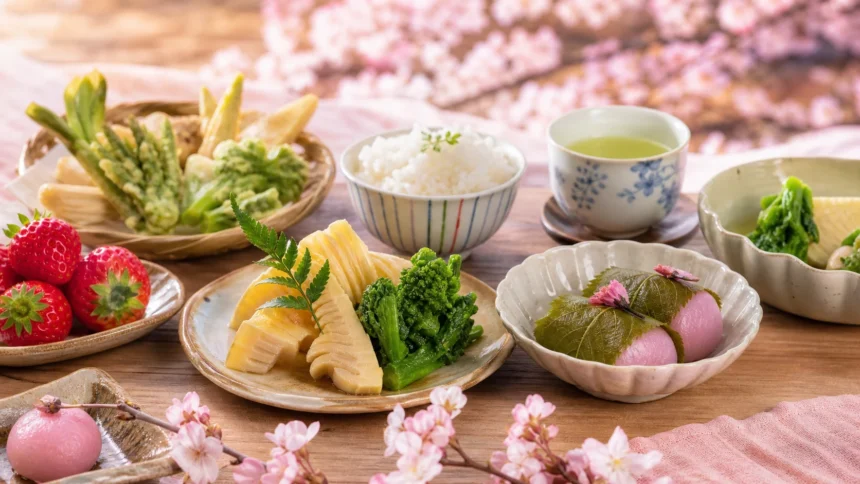
Some foods signal spring without belonging exclusively to one ceremony. These are seasonal ingredients and sweets rather than mandatory event foods.
- Take-no-ko: bamboo shoots
- A spring vegetable used in dishes such as bamboo shoot rice and simmered foods. Fresh shoots require preparation; pre-boiled or canned versions are practical outside Japan.
- Nanohana: rapeseed blossoms
- A slightly bitter spring green often served dressed or blanched. Spinach or broccolini may play a similar local role, but they are not the same ingredient.
- Strawberries
- A familiar spring fruit that appears in Japanese sweets such as ichigo daifuku. It is seasonal inspiration, not a required traditional event food.
- Green tea and hojicha
- Common Japanese drinks that pair naturally with seasonal sweets. They are not exclusive to hanami.
What should not be confused with a traditional spring festival?
Golden Week is a group of public holidays from late April to early May, not one traditional food ceremony. The new school and work year begins in April and creates many welcome meals and bento occasions, but it is a modern social calendar moment. Both are important to understand when visiting Japan in spring, but they should be labelled separately from Hinamatsuri, Higan, hanami, and Children’s Day.
FAQ
What are Japan’s main traditional spring events?
The clearest starting list is Hinamatsuri on March 3, Spring Higan around the March equinox, hanami during the cherry blossom season, and Children’s Day on May 5. Local festivals add regional traditions.
Is hanami a religious festival?
Modern hanami is best understood as a seasonal flower-viewing custom and social gathering. It has older cultural and agricultural associations, but today’s hanami can be as simple as looking at blossoms or sharing a picnic.
Is Hinamatsuri a national holiday?
March 3 is a widely recognized cultural occasion, but it is not one of Japan’s national public holidays. Many families observe it at home, while some public venues hold hina-doll displays or local events.
Are the listed foods eaten by every Japanese family?
No. Regional traditions, family habits, age, religion, and availability all affect what people eat. The foods in this guide are common associations, not a compulsory menu.
What is the difference between botamochi and ohagi?
They are closely related sweets made with glutinous rice and red bean paste. Botamochi is the spring name in the common seasonal pairing, while ohagi is commonly used for the autumn version.
Why are koinobori displayed on Children’s Day?
Carp are admired for their strength and ability to swim upstream. Koinobori express a wish that children will grow healthy, resilient, and successful.
Where can I learn about regional differences?
Start with a local prefecture, shrine, temple, museum, or tourism association. Spring customs often change in their decorations, sweets, festival dates, and public displays from one region to another.
Sources and further reading
- Ministry of Agriculture, Forestry and Fisheries: Japanese event foods
- Japan National Tourism Organization: Japan in March
- Japan National Tourism Organization: Hinamatsuri and Girl’s Day
- Japan National Tourism Organization: Tango no Sekku and Children’s Day
- Japan National Tourism Organization: Hanami meaning, timing, and manners
- Japan National Tourism Organization: Spring in Japan
For travel context, see our first-time Japan food travel guide. For a broader seasonal overview, see our Japan seasonal food calendar and spring foods in Japan guide. For food etiquette, see our Japanese food etiquette guide.
Editorial disclosure: Kuroneko Aji Meguri creates English food and culture guides as independent editorial pages. This guide describes common cultural associations, not a single rule for every family or region. Check local official information for specific festivals, public displays, travel dates, and venue requirements.