Short answer: Good food etiquette in Japan is less about memorizing a long taboo list and more about reading the room. Follow signs and floor markers, keep lines and aisles clear, ask before photographing people or a preparation area, use shared utensils when they are provided, return rubbish where the venue tells you, and do not add a tip unless a clearly identified situation calls for one. If you are unsure, observe for a moment or ask staff.
Many rules described online as “Japanese etiquette” are actually rules of one restaurant, market, railway, festival, or service format. Eating while walking is restricted at Kyoto’s Nishiki Market, for example, while that does not create a nationwide ban. Tokyo Metro allows food and drink if it does not disturb other passengers; JR Central explicitly welcomes food on the Tokaido Shinkansen. The useful skill is recognizing which setting you are in.
A small mistake rarely needs a dramatic apology. Stop, say “sumimasen”, ask what to do, and follow the answer. That recovery pattern is more useful than worrying about whether you held a bowl at exactly the right angle.
Last checked: August 16, 2026. Restaurant queues, photo policies, cover charges, smoking areas, transport rules, rubbish points, reservation conditions, and dietary accommodation can change. Follow the current sign, booking terms, and staff instructions at the exact venue.
For the wider practical planning map, start with Practical Food Guides in Japan. Etiquette works best when it is connected with reservations, payment, ticket machines, allergies, dietary needs, and fallback meal choices.
Five Habits That Work Across Most Food Stops
| Habit | What to do | What not to assume |
|---|---|---|
| Observe first | Look for a line, name sheet, ticket machine, reserved counter, photo notice, or tray-return station. | The process is the same as the previous restaurant. |
| Keep shared space moving | Keep doorways, stairs, narrow market lanes, counter edges, and staff paths clear. | Your suitcase, stroller, tripod, or takeaway cup can occupy any open-looking space. |
| Ask narrowly | Ask one practical question: where to wait, where to put a bag, whether a photo is allowed, or where to return a tray. | You need fluent Japanese or a long explanation. |
| Treat posted rules as local | Follow the exact venue’s instructions, even if another branch or city handled it differently. | A market, railway, chain, or izakaya policy applies throughout Japan. |
| Recover calmly | Stop the action, apologize briefly, and correct it. | A minor mistake has ruined the meal or requires a performance of embarrassment. |
JNTO’s current customs guidance supports this low-pressure approach: join orderly lines, follow signs or floor markers, be punctual for reservations, and ask when uncertain. It also notes that regional and venue differences exist. That is a better foundation than a viral list claiming that every sound, utensil, or hand movement has one national meaning.
Before You Arrive: Reservations, Timing, And Your Whole Party
If you booked, keep the confirmation, restaurant name in Japanese, booking time, party size, and any stated course or cancellation condition available offline. Arrive when the restaurant asks. JNTO advises contacting the establishment if you will be late; smaller restaurants may buy and prepare ingredients for a reservation.
Do not assume every venue will seat part of a group. Some restaurants seat only when everyone is present; others do not. The booking page or host decides. If one person is late, say so before your table is assigned. If you cannot meet a cancellation deadline, contact the venue or booking service rather than silently abandoning the reservation. A booking guarantee, deposit, prepayment, and cancellation charge are different arrangements, as explained in the restaurant reservation guide.
Accessibility, children, luggage, allergies, vegan needs, halal requirements, or other constraints are easier to handle before arrival. Asking is not rude. A venue may still say it cannot provide safe or suitable service, especially in a small kitchen. Treat that answer as a capacity or safety limit, not a personal rejection.
How To Join A Restaurant Queue
First identify the system. A visible line may not be the only queue. The entrance may have a paper name sheet, a touch-screen ticket, a numbered slip, a QR waitlist, or a host checking reservations. Buying a meal ticket can also happen before joining the seating line. Follow this sequence:
- Pause without blocking the door. Look for signs, floor arrows, a clipboard, ticket machine, or waiting screen.
- Check whether registration is required. If there is a name sheet or ticket system, standing nearby may not put you in the queue.
- Join at the back. Follow the marked line and leave stairs, neighboring storefronts, and pedestrian space open.
- Stay able to hear or see the call. Keep the ticket and watch the display. Do not disappear on the assumption that your place is protected.
- If you miss the call, ask. Do not push past the next group or declare that your old place is still valid. Staff may seat you, re-register you, or tell you to wait.
No official nationwide rule determines whether a missed name, incomplete party, or toilet break keeps its place. That is precisely why a simple question—“Dō matteba ii desu ka?”, “How should I wait?”—is safer than copying only the closest person.
Venue Decoder: What Changes From Place To Place
| Setting | Observe | Ask if unclear | Common pressure point |
|---|---|---|---|
| Sushi or chef-facing counter | Bag space, chef’s work area, course pace, photo notice | Where to place luggage; whether food photos are allowed | A small counter leaves little room for devices, perfume, or bulky belongings |
| Ramen or ticket-machine shop | Order-before-line sequence, water, condiments, ticket handoff, dish return | Where to wait after buying the ticket | Fast turnover and a narrow entrance; use the ticket-machine guide |
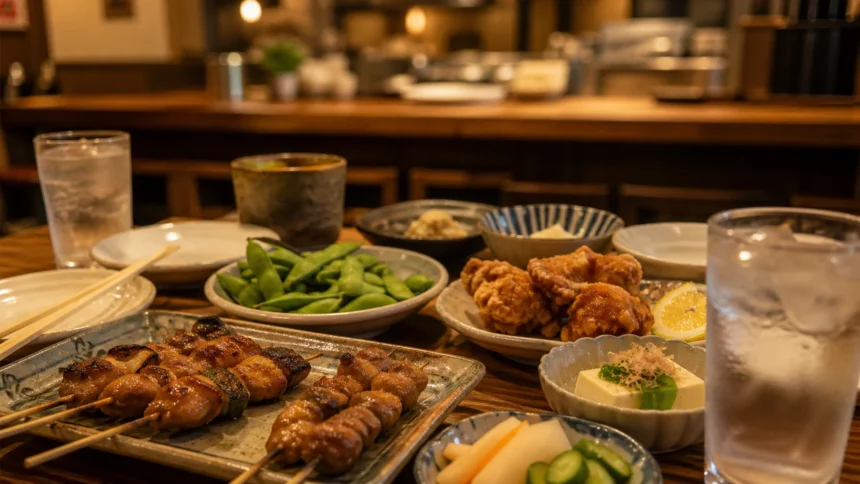
| Izakaya | Table charge or otoshi, shared plates, last order, smoking notice | What a bill line means; whether individual payment is possible | Automatic appetizer and group ordering are unfamiliar to some visitors |
| Cafe or kissaten | Seat-first or order-first process, time or laptop notices, tray return | Whether you may choose a seat or stay after finishing | One cafe may encourage lingering; another may limit busy-period use |
| Food court or buffet | Shared seating, pager, return point, sorting labels, tongs | Where the tray and rubbish go | Each tenant may handle orders while the mall controls cleanup |
| Market or festival stall | Designated eating space, vendor bin, crowd direction, skewer disposal | Where to eat and where to return the container | Rules can change stall by stall and event by event |
| Ryokan meal | Meal time, footwear, room or dining-room instructions | When to arrive and where shoes or slippers stop | Service sequence belongs to the property, not every ryokan in Japan |
| Reserved course restaurant | Arrival time, dress, scent, photo, cancellation, and payment terms | Any condition not shown clearly in the confirmation | Course timing and prepared ingredients make late changes harder |
Counter Seats, Bags, Phones, And Personal Space
A restaurant counter is both a dining surface and a work boundary. Keep bags, shopping, coats, and phones out of the area where staff set dishes or reach for plates. Use a basket, hook, shelf, locker, or the place staff indicates. Do not put luggage in an aisle because it seems briefly empty. At a small counter, asking “Nimotsu wa doko ni okeba ii desu ka?” is faster and safer than rearranging furniture.
Put your phone on silent. A quick food photo may be acceptable when no restriction is posted, but video calls, loud playback, repeated narration, lighting, or equipment that occupies counter space changes the situation. If the meal is chef-paced, receive the dish before setting up a photo. If food is meant to be eaten promptly, do not require staff or other diners to wait for a long shoot.
Strong fragrance can affect a compact dining room and delicate aromas. JNTO specifically advises avoiding strong fragrance for some dining experiences and notes that individual restaurants may have rules. Treat that as considerate preparation, not a claim that every restaurant enforces the same scent policy.
Chopsticks And Shared Food: The Reliable Basics
Current JNTO guidance gives a manageable avoid-list. Do not leave chopsticks standing upright in rice or pass food directly from one pair of chopsticks to another. Avoid pointing with them, waving them while talking, stabbing food, or dragging plates and bowls across the table with them. Rest them on the holder, wrapper, or the place provided when pausing.
If chopsticks are difficult because of practice, injury, disability, or the food itself, ask whether a fork or spoon is available. JNTO notes that many restaurants can provide cutlery, while a particular venue may not have it. Using a suitable utensil is better than turning the meal into a test.
For shared food, move your portion to your own small plate before eating it. Use communal chopsticks, tongs, or a serving spoon when supplied. Do not put a utensil that has been in your mouth back into a shared dish. “Reversing” personal chopsticks to use the handle ends is not a universal solution: the ends may have been touched by hands. When no serving utensil is visible, ask for one rather than improvising.
Hot pot, yakiniku, buffet, and cook-at-the-table venues may separate raw-food tongs from eating utensils. Follow the color, label, or staff explanation. This is food-safety behavior, not ceremony. If a utensil falls, becomes contaminated, or was used for an allergen, ask for a clean replacement.
Oshibori, Bowls, Soy Sauce, And The Myth Of One Perfect Technique
An oshibori is the wet towel often brought before a meal. JNTO describes it as a hand towel and advises folding it and setting it aside or returning it to the tray after use. Do not use it to wipe the table, shoes, or a spill unless staff specifically says to. Ask for a napkin or help with a spill.
Some dishes are comfortably eaten with a bowl held in the hand; others stay on the table. Sushi may be eaten with hands or chopsticks. Noodle soup may come with a spoon. A plate’s presentation may matter more in a formal course than at a food court. These differences make “always lift the bowl” or “never touch food with your hands” poor rules.
Use condiments in a small amount first. At a chef-led counter, the food may already be seasoned. At a casual chain, instructions may appear on the menu. Do not criticize another diner for slurping noodles: JNTO says it is accepted. You also do not have to slurp. Eat at a pace that is comfortable without turning silence or sound into a performance.
Meal Phrases Are Welcome, Not An Entrance Exam
Itadakimasu before eating and gochisōsama deshita after the meal express appreciation. JNTO’s FAQ explicitly says visitors are not required to say them. A sincere “arigatō gozaimashita” also works. If you are concentrating on communication, allergy safety, or children, silence is not an etiquette violation.
Group dining often starts when everyone has food, but a hot dish, individual course, or staff instruction can change the timing. Ask your companions. In an izakaya, ordering a few shared plates and adding more later can prevent crowding and waste, but it is not a law. Follow time limits or last-order notices attached to an all-you-can-drink or set plan.
Food Photography: A Permission Workflow
There is no reliable nationwide rule that says restaurant food photography is always allowed. Permission depends on the restaurant, people in frame, work area, equipment, safety, privacy, and whether the image is personal or commercial. Use this decision path:
- Read the door, menu, booking page, and counter notice for no-photo or no-video rules.
- Frame only your food and your own place setting where ordinary personal photography appears permitted.
- Ask before photographing staff, chefs, other guests, an open kitchen, a preparation technique, or a private-room performance.
- Avoid flash, lighting, tripods, selfie sticks, prolonged video, and livestreaming unless the venue explicitly approves them.
- If anyone asks you to stop, stop and put the device away. Do not debate the absence of a sign.
Tokyo Metro’s official station policy is a useful reminder about context: it restricts flash, lighting, tripods, selfie sticks, unsafe positions, and photography that troubles other passengers. That policy is not a restaurant rule, but the underlying decision is transferable—safety, privacy, space, and operator instructions matter more than “I only wanted a photo.”
Eating While Walking Is A Local Decision
“Never eat while walking in Japan” is too broad. JNTO says it is discouraged in some areas. Kyoto’s official Nishiki Market guidance is specific: do not walk through the narrow market while eating or drinking; eat at the shop or in its eating area, and return rubbish to the shop that sold the item.
That is a local rule with practical reasons—crowding, spills, hot liquids, sauces, skewers, and obstruction. It does not prove that every festival, park, shopping street, station approach, or food market uses the same system. At each place:
- look for a designated eating area or standing table;
- ask the vendor where the item should be eaten;
- do not stop directly in front of another shop, doorway, stairs, or a moving queue;
- keep skewers and hot containers controlled;
- finish before entering a shop that prohibits outside food.
If the route is congested and no eating area is clear, keep the food closed or carry it away. “Street food” describes what was sold, not automatic permission to eat it at every nearby spot.
Rubbish And Tray Return: Send It To The Right Place
Do not assume Japan has no public bins, but plan for a stretch without one. JNTO advises taking rubbish with you when bins are unavailable. Kyoto’s Nishiki guidance tells visitors to return the waste to the shop where they bought the food. A festival may provide sorting stations; a food court may have tray and waste lanes; a cafe may expect dishes left at the table.
Use the system belonging to your purchase. A convenience-store bin is not automatically a disposal service for a market meal bought elsewhere. Do not leave a cup on a vending machine, station ledge, planter, toilet shelf, or another vendor’s counter. Carry a small sealable bag for dry wrappers, while keeping hot liquid, sharp skewers, and leaking containers upright until you reach the correct return point.
If you spill something, tell staff quickly. Blocking others while secretly wiping it with an oshibori can make the situation worse. Staff may need a warning sign or cleaning tool.
Can You Eat On Trains? Check The Operator And Service
| Transport setting | Confirmed example | Safe traveler decision |
|---|---|---|
| Tokyo Metro subway | The operator’s live FAQ says there is no restriction on food or drink if it does not disturb other passengers. | Avoid meals in a crowded car, manage smell and spills, and follow current staff instructions. |
| Tokaido Shinkansen | JR Central says passengers may eat and drink and seats have tables; standard-class onboard sales are not available. | Buy before boarding, keep the area clean, control odors, and take your rubbish to the correct point. |
| Other local, limited-express, sightseeing, or dining train | No single rule covers every operator and service. | Check the operator page, seat setup, announcement, and signs. Keep food sealed when uncertain. |
| Bus | No nationwide bus rule was confirmed for this guide. | Follow the route operator’s rule; ask staff before opening food or alcohol. |
| Platform or station concourse | Space and safety rules belong to the operator and station. | Use a designated area, stay behind safety lines, and keep stairs, gates, and passenger flow clear. |
Choose food suitable for the setting. A sealed snack is easier to manage than soup in a packed car. Even where eating is allowed, a strong smell, spilled drink, loud group, or abandoned container can disturb others. Permission is not the same as good timing.
Tipping, Table Charges, And Otoshi Are Different
JNTO says tipping is not common or expected at restaurants, cafes, bars, taxis, and hotels. Pay the stated bill. A smile and “arigatō gozaimashita” are enough.
A table, seat, service, booking, or cancellation charge is not an optional tip. JNTO’s customs page says some restaurants have table charges shown on menus or signs and that an izakaya may automatically serve a small appetizer that is not complimentary. GO TOKYO describes this appetizer as otoshi, usually connected with a cover charge at places such as izakaya.
The amount, description, disclosure, and whether a venue will remove or refuse it are not governed by one visitor rule. Do not call it a scam simply because it was unfamiliar. Before ordering, read the menu or booking conditions. If the bill surprises you, ask “Kore wa nan no ryōkin desu ka?”—“What is this charge?” If the explanation does not match the displayed terms, ask for clarification calmly and keep the receipt.
Bill splitting also varies. Ask before staff begins payment. The cash, card, and IC payment guide explains how to check the payment rail and recover from a failed or unclear transaction.
Allergies And Dietary Needs Are Safety Questions
Do not stay silent about a serious allergy because you are afraid of being impolite. Japan’s Consumer Affairs Agency publishes specific material for consumers and restaurants about allergy information, unintended mixing or cross-contact, service, incidents, and emergency response. Ask before ordering, name the exact ingredient, and show a prepared communication sheet.
Restaurant food does not give you the same guarantee as a sealed packaged-food label. A kitchen may use shared oil, broth, grill, knives, tongs, or work surfaces. Staff may be unable to verify a sauce or seasoning. If they cannot confirm safety, leave without arguing and use a planned alternative. The Japan food allergy guide covers the current labeling limits, cross-contact, communication sheet, and emergency planning.
Use the same early communication for vegan, vegetarian, halal, kosher, gluten-free, alcohol-free, or religious needs, while recognizing that definitions and kitchen controls may differ. A polite request does not create a safe accommodation that the venue cannot deliver.
Twelve Useful Japanese Phrases
| Situation | Japanese and romanization | Meaning |
|---|---|---|
| Queue process | どう待てばいいですか? Dō matteba ii desu ka? |
How should I wait? |
| Correct line | この列で合っていますか? Kono retsu de atteimasu ka? |
Is this the correct line? |
| Party ready | 全員そろっています。 Zen’in sorotteimasu. |
The whole party is here. |
| Someone late | まだ一人来ていません。 Mada hitori kite imasen. |
One person has not arrived. |
| Luggage | 荷物はどこに置けばいいですか? Nimotsu wa doko ni okeba ii desu ka? |
Where should I put my luggage? |
| Photo | 料理の写真を撮ってもいいですか? Ryōri no shashin o totte mo ii desu ka? |
May I take a photo of the food? |
| Eating place | ここで食べてもいいですか? Koko de tabete mo ii desu ka? |
May I eat here? |
| Tray or rubbish | トレーとごみはどこに戻しますか? Torē to gomi wa doko ni modoshimasu ka? |
Where do I return the tray and rubbish? |
| Serving utensil | 取り分け用のスプーンはありますか? Toriwake-yō no supūn wa arimasu ka? |
Is there a serving spoon? |
| Allergy | 重い食物アレルギーがあります。 Omoi shokumotsu arerugī ga arimasu. |
I have a serious food allergy. |
| Bill item | これは何の料金ですか? Kore wa nan no ryōkin desu ka? |
What is this charge? |
| Correction | すみません、間違えました。どうすればいいですか? Sumimasen, machigaemashita. Dō sureba ii desu ka? |
Sorry, I made a mistake. What should I do? |
Five Realistic Etiquette Scenarios
1. A Name Sheet, A Line, And A Missing Friend
You see people standing outside but also find a clipboard. You ask how to wait, write the booking name only if instructed, and tell staff one person is still coming. You keep the doorway and neighboring shop clear. If your name is called before the party is complete, you let staff decide whether to seat, skip, or re-register you.
2. A Small Counter, A Suitcase, And A Food Photo
You do not rest the suitcase against the chef’s work path or place your phone where a plate will arrive. You ask where the bag belongs, then check for a no-photo notice. If a food photo is allowed, you frame your dish quickly without flash, other guests, or a long video. If staff says no, you put the phone away.
3. Market Food With No Obvious Bin
You ask the vendor where to eat. At Nishiki Market, you stay at the selling shop or its eating area rather than walking through the crowd. You return the skewer and wrapper to that shop’s bin as official local guidance requests. At a different market, you look for its own rule instead of applying Nishiki’s system automatically.
4. Food Before A Train Ride
You identify the service. For a Tokaido Shinkansen, JR Central confirms that eating is part of the journey, so you buy food before boarding and use the seat table. On a crowded subway, even though Tokyo Metro has no blanket food restriction, you keep the meal sealed because it would disturb others. On an unfamiliar bus, you check the operator rule.
5. An Unexpected Otoshi Charge
An appetizer arrives before your izakaya order and the bill later has an unfamiliar line. You do not leave an extra tip or immediately accuse staff. You compare the menu and booking terms, ask what the charge is, and listen to the explanation. If you need a no-charge venue next time, check table-charge terms before sitting down.
FAQ
What are the most important food manners in Japan?
Follow posted instructions, respect the queue, keep shared space clear, handle shared food hygienically, ask before photographing people or work areas, and use the venue’s rubbish system. Ask rather than guessing.
Is slurping noodles required?
No. JNTO says slurping is accepted and visitors should not criticize it, but you do not have to do it.
Must I say itadakimasu?
No. It is a welcome expression of appreciation, but JNTO’s FAQ says visitors are not required to say it.
Can I eat while walking?
It depends on the place. Some areas discourage or prohibit it. Nishiki Market specifically tells visitors to eat at the shop or eating area, not while walking. Check the local rule.
Can I eat on trains?
Check the operator and service. Tokyo Metro permits it if other passengers are not disturbed; JR Central permits it on the Tokaido Shinkansen. Those examples do not decide every local train, limited express, or bus.
May I photograph my food?
Only when the venue allows it. Read notices, avoid other people and work areas, ask when uncertain, skip flash or bulky equipment, and stop if requested.
Which chopstick actions should I avoid?
Do not leave chopsticks upright in rice, pass food directly chopstick-to-chopstick, point or wave with them, stab food, or drag dishes with them. Use the rest and shared utensils provided.
Should I finish everything?
Avoid ordering more than you can eat, but health, portion, allergy, and safety needs come first. Do not force yourself or treat one unfinished item as a crisis.
Do I clear my tray?
Return it where a cafe, food court, or fast-service venue provides a return point. Otherwise follow the local instruction; not every restaurant uses self-clear service.
Where do I put rubbish?
Use the vendor, event, food-court, station, or municipal system that applies. If no appropriate bin exists, keep it until you find one or take it back with you.
Should I tip?
No tip is normally expected. A table, service, cover, booking, or cancellation charge is a separate item and should be checked in the venue’s terms.
What is otoshi, and can I refuse it?
Otoshi is a small appetizer often served automatically at an izakaya and connected with a table or cover charge. There is no universal visitor rule guaranteeing refusal. Check before ordering and ask about an unfamiliar charge.
Is it rude to ask about an allergy or diet?
No. Ask early and specifically. The venue may be unable to confirm ingredients or prevent cross-contact, so keep a safe alternative and accept a refusal.
What if I make a mistake?
Stop, say “sumimasen”, and ask what to do. Correcting the action matters more than a long apology.
Continue Planning Your Food Trip
For the full first-visit workflow—restaurant types, ordering, payment, dietary communication, and trip structure—use the Japan food travel guide for first-time visitors. If you are choosing a food-focused route outside Tokyo, compare the best food day trips from Tokyo and the regional food guide. Each destination can still have its own queue, market, photography, transport, and rubbish rules.
Official And First-Party Sources
- JNTO: Japanese Customs And Etiquette
- JNTO: Japanese Food Etiquette Guide
- JNTO: Japanese Manners Do’s And Don’ts
- JNTO: Frequently Asked Questions
- JNTO: Tipping In Japan
- Kyoto City Official Travel Guide: Nishiki Market And Area Etiquette
- Tokyo Metro: Eating And Drinking On Trains FAQ
- Tokyo Metro: Things To Consider When Riding The Subway
- JR Central: Tokaido Shinkansen Perfect Guide
- GO TOKYO: Food And Drink In Tokyo
- GO TOKYO: Diverse Culinary Culture And Dining Etiquette
- Consumer Affairs Agency: Food Allergies When Eating Out
- Consumer Affairs Agency: English Eating-Out Allergy Materials
Editorial disclosure: This independently produced guide contains no affiliate restaurant booking, paid venue placement, sponsored etiquette product, or advertising relationship with the named organizations. The surrounding site may display advertising. Official and first-party pages were checked on July 20, 2026. Named markets and transport operators are examples of local rules, not endorsements or nationwide standards.