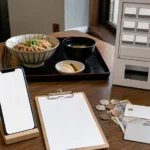
Short answer: Bring both a usable payment card and Japanese yen for food travel in Japan. Add a second card if you have one, and treat a Suica, PASMO, or another compatible transport IC card as a convenient extra—not as a universal restaurant card. Large chains and many restaurants accept major cards, but an independent counter, market stall, older ticket machine, rural stop, or temporarily offline terminal may still require cash. Check the exact signs before ordering.
The important question is not “Is Japan cashless?” It is “Which payment rail does this venue accept, and what will I do if my first method fails?” A credit-card tap, transport IC tap, phone wallet, and QR scan can look similar at the counter while using different systems. The logo on the terminal tells you which one to try; it does not guarantee that your particular overseas card, issuer, device, or app will approve the payment.
Last checked: August 16, 2026. Card networks, IC products, QR integrations, ATM limits, service hours, fees, restaurant acceptance, and branch policies can change. Check the current operator page and the exact sign at the venue. This guide explains travel workflows, not personalized banking, exchange-rate, tax, legal, or card-dispute advice.
For the wider practical planning map, start with Practical Food Guides in Japan. Payment planning connects naturally with reservations, ticket machines, etiquette, allergies, dietary needs, and backup meals.
Build A Payment Wallet With Two Real Fallbacks
JNTO gives the most useful starting point: most stores and restaurants accept cards such as Visa and Mastercard, but Japan still has cash-dependent places, particularly small operators. That means neither “carry only cash” nor “leave cash at the hotel” is a resilient plan.
- Primary layer: a physical chip card enabled for overseas use. A physical card gives you both contactless and chip-insert possibilities when supported.
- Independent fallback: Japanese yen. Cash still works when a venue is cash-only, a terminal is offline, your issuer declines the purchase, or the machine supports no suitable cashless rail.
- Optional redundancy: a second card from a different account or network. Keep it separately so one lost wallet or issuer block does not remove every card option.
- Convenience layer: transport IC stored value. Use it for small purchases at participating restaurants, convenience stores, vending machines, and station shops displaying the relevant mark.
Do not choose one universal daily cash figure from a blog. Your need depends on the day. A city route near convenience stores and ATMs requires less contingency cash than a rural food trip, festival evening, or market visit with vendor-by-vendor payment. The practical question is: Could I cover the next meal, the return journey, and a small unexpected purchase if card and phone payments both failed?
Payment Sign Decoder: Card, Contactless, IC, And QR Are Different
| Mark or control | What it suggests | What it does not prove |
|---|---|---|
| Visa, Mastercard, Amex, JCB, or another card-network logo | The merchant or ATM is configured for that network | Your overseas issuer, debit/prepaid product, or transaction will be approved |
| Contactless wave plus a card-network mark | An eligible card or tokenized phone credential may be tapped | Every phone wallet works, or chip/PIN will never be requested |
| Suica, PASMO, or nationwide transport IC mark | Participating stored-value IC cards may be accepted | This is a credit-card tap, every IC card supports shopping, or the balance can be topped up by your foreign card |
| iD or QUICPay | The terminal accepts that specific Japanese electronic-money rail | A generic overseas contactless card or transport IC card can use it |
| PayPay, Rakuten Pay, d払い, au PAY, or another QR logo | The merchant accepts the named app or a compatible partner flow | A short-term visitor can create and fund that domestic app on arrival |
| Alipay+, WeChat Pay, UnionPay QR, or another overseas-wallet mark | Eligible users of that specific wallet may use a cross-border QR route | Every QR wallet from the same country or every terminal at the chain participates |
| 現金のみ / cash only | Pay with yen cash | A nearby branch or stall follows the same policy |
| 完全キャッシュレス / cashless only | Cash may not be accepted; check the listed rails before ordering | Your preferred card or wallet is necessarily one of them |
Say the rail you intend to use. “Visa de” identifies Visa contactless more clearly than holding up a phone and saying “touch.” “Suica de” identifies transport IC stored value. This matters because one terminal can present several tap modes and staff may need to select the correct one first.
Check The Venue, Not The Venue Type
| Food situation | Check before committing | Useful fallback |
|---|---|---|
| Full-service or reserved restaurant | Door, booking page, or register logos; whether the booking card is only a guarantee; where the final bill is paid | Physical card plus cash; confirm a deposit or prepayment separately |
| National chain | The exact branch sign and terminal, not a chain-level memory | Another displayed rail or cash |
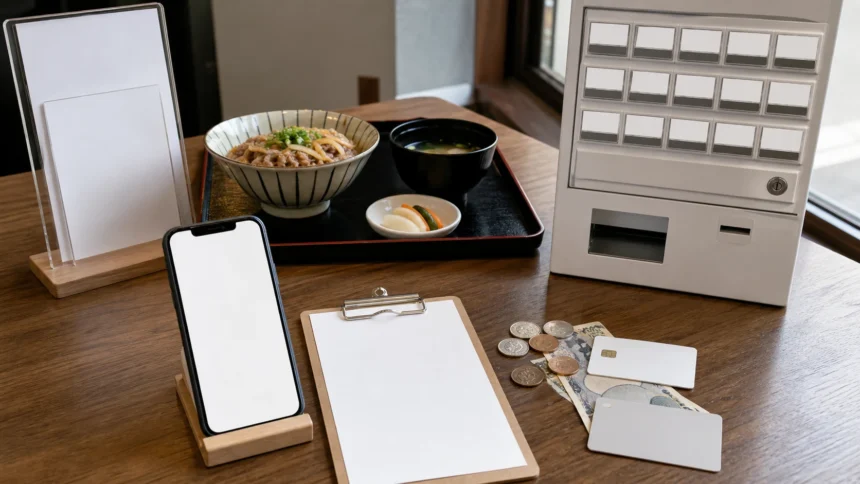
| Ticket-machine ramen, soba, curry, or rice-bowl shop | Cash slots, accepted denominations, and card/IC/QR marks on that machine | Yen cash; see the restaurant ticket-machine guide for the full ordering flow |
| Independent counter, kissaten, or small izakaya | Entrance/register stickers or a handwritten cash-only notice; ask before ordering if unclear | Cash, especially when no terminal is visible |
| Convenience store or station shop | Card, contactless, IC, and QR marks at the register | Cash; these locations can also be useful for cash IC top-ups where supported |
| Market, yatai, or festival stall | Each vendor’s own sign; do not extend one stall’s QR or IC acceptance to the next | Smaller notes and coins |
| Food hall, department-store basement, or rest-area counter | Whether payment is centralized or each tenant has its own register and policy | Card plus cash; inspect each counter |
| Drink or food vending machine | Coin/note slots and the exact IC, card, or QR reader marks | Coins or an accepted note; machines differ |
“Cities take cards; the countryside takes cash” is too crude. An urban family restaurant may be highly cashless while a popular city ramen machine is cash-only. A rural hotel restaurant may accept major cards while a temporary stall outside does not. The rule that travels well is simple: inspect the payment point before you order something you cannot easily cancel.
How To Pay By Foreign Card Or Contactless
- Confirm the network. Look for your card brand. If only another network is displayed, do not assume the card will route anyway.
- Tell staff the method. Say “Visa de onegaishimasu” or show the card without handing over your unlocked phone.
- Wait for the prompt. The cashier may need to select card, IC, or QR before the reader is active.
- Tap once or insert the chip. If contactless is refused or the screen requests insertion, follow the prompt. Visa Japan currently says a transaction above its stated threshold may require card insertion plus PIN or signature.
- Look for approval. A beep alone can be an error signal. Read the display, wait for staff confirmation, and collect the receipt.
- If it fails, change one variable. Try chip instead of tap if instructed, then another card or cash. Repeating the identical tap several times does not solve an issuer block.
A phone wallet can fail when the physical card works because provisioning, issuer policy, device settings, or the accepted token route differs. The reverse can also happen if a physical card is damaged. Carrying the physical card remains useful even when you normally pay by phone.
When a decline repeats at different merchants, contact the card issuer through a trusted number in its app or printed on the card. Restaurant staff can confirm their own terminal result, but they cannot lift an issuer security block, change your PIN, or explain the final timing of a pending authorization.
Using Suica, PASMO, And Other Transport IC For Food
Transport IC is prepaid stored value. JR East officially lists participating convenience stores, restaurants, beverage vending machines, station and airport shops, taxis, and lockers as Suica-use examples. The controlling word is participating: look for the Suica, PASMO, or nationwide IC mark at the exact register or machine.
- Check the IC acceptance mark before staff starts payment.
- Say “Suica de” or “IC card de.”
- Wait until the correct reader is active.
- Hold the card or device still until the terminal finishes.
- If the balance is insufficient, ask whether you can recharge or change payment method. Do not assume the restaurant can combine the remaining IC balance with cash.
Official JR East guidance highlights cash recharging at station ticket machines and participating convenience-store registers. Mobile top-up and foreign-card behavior depends on card product, phone, region, wallet, and issuer. Do not arrive with zero yen on the assumption that every overseas card can recharge every physical or mobile IC product.
Interoperability also has edges. PASMO’s visitor page says PiTaPa does not participate in nationwide electronic-money mutual use. A card working for transport in an area does not automatically prove that it works for shopping at a restaurant there. The merchant mark is decisive.
QR Payments: Use A Wallet You Already Know Is Eligible
A PayPay logo is not an invitation to create a PayPay account at the counter. PayPay’s own help system depends on a registered mobile number and SMS access, and balance types and funding routes have their own conditions. Other domestic QR systems have their own registration, identity, phone, card, bank, and funding rules.
Some inbound travelers can instead use an overseas wallet through a cross-border integration. PayPay announced that WeChat Pay became available at participating customer-scan PayPay merchants from mid-September 2025, alongside other overseas services. This does not mean every PayPay register accepts WeChat Pay: the official release limits that example to merchants using a compatible customer-scans-merchant-code flow.
Use QR when all three are true:
- you already have an eligible, funded wallet;
- the exact merchant displays that wallet or an explicitly compatible network; and
- you have mobile connectivity and understand whether you scan the merchant code or present your own code.
If any part is unclear, use card, IC, or cash. Do not hold up a queue while attempting domestic-app registration, identity verification, or funding at the payment point.
Plan Cash By Situation, Not One Daily Number
| Day pattern | Why cash matters | Preparation question |
|---|---|---|
| Urban chain-and-station day | Most planned stops may show card/IC marks, but one independent shop or failed terminal can break a cashless plan | Can my cash cover one meal and local transport if both card and phone fail? |
| Food day trip or rural route | Fewer convenient foreign-card ATMs and more independent operators may increase fallback need | Where is the last official foreign-card ATM before the less-connected part of the route? |
| Market, yatai, or festival | Acceptance changes vendor by vendor; small purchases are easier with smaller denominations | Do I have notes and coins that fit several small transactions? |
| Late evening | Some ATM locations or card-network service windows are not 24 hours, and maintenance can still interrupt 24-hour routes | Should I obtain yen before leaving the station or convenience-store area? |
Japan uses cash trays at many registers. Place notes and coins in the tray when offered, then count change before leaving. A ¥10,000 note is legal currency, but an automated machine may not accept it and a small stall may not have practical change for a very small purchase. Do not make a nationwide legal claim at the counter; ask politely or use a smaller denomination.
Getting Yen: Seven Bank And Japan Post Bank
| Official route | Current confirmed points | Do not assume |
|---|---|---|
| Seven Bank ATM | Multiple overseas networks; language selection; current overseas-card limit of ¥100,000 per withdrawal and ¥30,000 for magnetic-stripe transactions; network-specific service times; possible fees; DCC for eligible cards | Every marked card works, every network is available all day, or your issuer charges no fee |
| Japan Post Bank ATM | Listed overseas networks; current ¥50,000 maximum per transaction; location-dependent hours; some cards may incur a ¥220 ATM fee plus issuer charges; home-currency settlement may appear for some cards | Every ATM is accessible at the same hours, every card works, or the operator fee is the total cost |
At an ATM, the presence of your network mark means the operator supports that route; the card issuer still decides whether to authorize it. If a withdrawal exceeds the operator or issuer limit, reduce the amount once. If the PIN is rejected or smaller withdrawals continue to fail, stop and contact the issuer rather than risking repeated errors.
A DCC screen may ask whether the transaction should be calculated in your home currency or Japanese yen. Seven Bank explains that choosing home currency fixes that displayed home-currency amount at the ATM, while choosing yen leaves the home-currency amount to be determined later at billing. Japan Post Bank also says eligible cards may be offered a card-country-currency settlement. Review the displayed exchange information and your issuer terms. This article does not claim that either button is always cheaper.
Collect cash, card, and receipt before leaving. If the card is retained, cash is missing, or the receipt and dispensed amount disagree, use the operator contact shown on the ATM and keep the receipt. Do not let a stranger “help” by handling your card or PIN.
When A Payment Is Declined Or Looks Duplicated
- Stop before retrying. Ask whether the merchant terminal shows approved, canceled, or declined.
- Keep the receipt and note the amount. If no receipt printed, note the venue, date, approximate time, and terminal result.
- Change payment method if needed. Use chip after a failed tap when prompted, another card, IC only if clearly accepted and funded, or cash.
- Separate merchant status from issuer status. Staff can check whether their register recorded a completed sale. Your banking app may show a pending authorization that is not yet a final posted charge.
- Escalate to the right party. Ask the merchant about its receipt or transaction; ask the issuer about pending, posted, reversed, or disputed entries. Do not demand that restaurant staff promise an issuer posting date.
Do not immediately pay twice just because the first approval is unclear. At the same time, do not assume that one pending line proves a duplicate final charge. Preserve evidence, let the merchant confirm its side, and use the issuer’s formal support if the final account record remains wrong.
Reservations, Split Bills, Refunds, And Tips
A card used to make a reservation may serve as a guarantee, temporary authorization, deposit, prepayment, cancellation-fee route, or the final payment. These are not interchangeable. Before the booking deadline, read whether the restaurant will charge now, hold an amount, charge only for late cancellation or no-show, or ask you to pay again at the venue. The restaurant reservation guide explains that workflow in detail.
Split bills are a restaurant policy, not a national right. Ask before staff processes the payment: “Betsubetsu ni dekimasu ka?” A busy counter, set-menu restaurant, ticket machine, or large group may require one payment. Plan for one traveler to pay and settle privately if the venue cannot divide it.
Refund method and timing depend on the merchant, payment rail, acquirer, network, and issuer. A card purchase may be refunded to the original card rather than in cash, and a canceled authorization can remain visible as pending for an issuer-dependent period. Keep the receipt and do not publish or rely on one universal number of days.
JNTO says tipping is not common or expected at restaurants, cafes, bars, taxis, and hotels. Pay the displayed total. A separately disclosed service charge, booking deposit, cover charge, cancellation amount, or prepaid course is part of the bill or terms; it is not an optional tip.
Compact Japanese Payment Phrases
| Need | Japanese | Meaning |
|---|---|---|
| Ask what works | 支払い方法は何が使えますか? Shiharai hōhō wa nani ga tsukaemasu ka? |
What payment methods can I use? |
| Ask about card | クレジットカードは使えますか? Kurejitto kādo wa tsukaemasu ka? |
Can I use a credit card? |
| Ask about IC | SuicaやPASMOは使えますか? Suica ya PASMO wa tsukaemasu ka? |
Can I use Suica or PASMO? |
| Choose Visa | Visaでお願いします。 Visa de onegaishimasu. |
Visa, please. |
| Choose cash | 現金で払います。 Genkin de haraimasu. |
I will pay in cash. |
| Check completion | 支払いは完了しましたか? Shiharai wa kanryō shimashita ka? |
Has the payment completed? |
| Request receipt | レシートをいただけますか? Reshīto o itadakemasu ka? |
May I have a receipt? |
| Explain apparent duplicate | 二重請求のように見えます。 Nijū seikyū no yō ni miemasu. |
It looks like a duplicate charge. |
Five Payment Scenarios
1. Urban Day With Card, Cash, And Optional IC
You use a foreign Visa card at marked chain cafes and keep enough yen for one meal plus local movement. At a station vending machine, you use Suica only because the IC mark is present. Your first card fails at dinner; staff confirms the decline, so you use your second card or cash. You do not assume the phone version will solve an issuer problem.
2. Cash-Only Ramen Ticket Machine
The machine has note and coin slots but no card, IC, or QR mark. You use yen and collect the ticket and change. If you lack cash, you step away before selecting food, find a compatible official ATM, and return. You do not push a card into an unlabeled slot or assume staff can take card payment separately.
3. Market Or Yatai With Mixed Vendors
One stall displays an overseas QR wallet, the next has Suica, and the third has only a cash tray. You treat each stall as a new decision. You use a wallet only where its exact mark appears and keep small cash for the rest. One vendor’s terminal tells you nothing about the next vendor’s policy.
4. Phone Tap Beeps But Payment Is Unclear
You do not tap again immediately. You ask “Shiharai wa kanryō shimashita ka?” Staff checks the register and says the attempt failed. You then insert the physical card once or switch to cash. If your app later shows two final posted transactions, you keep the receipt and contact the merchant and issuer; you do not treat two pending lines as proof by themselves.
5. Rural Day Trip Needs More Yen
Before leaving the main station area, you locate a Seven Bank or Japan Post Bank ATM that lists your network. You check the operator’s current limit and hours, request an amount within the limit, and read any DCC choice before confirming. If authorization fails twice, including at a lower amount, you contact the issuer rather than searching random unlabeled machines.
FAQ
Do I need cash for restaurants in Japan?
Yes, as a fallback. JNTO says most stores and restaurants accept major cards while small operators may still accept cash only. Cash also protects you from terminal or issuer failure.
How much cash should I carry for food?
No official daily number fits every traveler. Carry enough for the next meal, transport contingency, and small purchase, then increase the reserve for rural, market, festival, or late-night plans with fewer ATM options.
Do Japanese restaurants accept foreign cards?
Many do, but check the exact network mark. Merchant acceptance and issuer authorization are separate, so keep another method.
Will my contactless card or phone wallet work?
It may work at a merchant displaying your network and contactless mark. It can still fail because of card, issuer, device, token, terminal, connection, amount, or merchant configuration. Carry the physical card and cash.
Can I use Suica or PASMO at restaurants?
At participating locations showing the relevant IC mark. They are stored-value products, not universal restaurant cards. Check balance and recharge options before relying on one.
Can I recharge transport IC with a foreign card?
Do not assume it. JR East’s general visitor guidance clearly supports cash recharge at station machines and participating registers. Mobile and card recharge depends on the product, phone, wallet, region, and issuer.
Can tourists use PayPay?
Do not build a plan around opening a domestic PayPay account at the counter. Account and SMS requirements apply. Some travelers can use a separately eligible overseas wallet at compatible PayPay merchant flows, but only when that exact wallet and flow are supported.
Can I split the restaurant bill?
Ask before payment. There is no nationwide rule, and some venues or service formats require one transaction.
Where can I withdraw yen with a foreign card?
Seven Bank and Japan Post Bank publish official overseas-card ATM services. Check your network, the current operator limit, hours, fees, and issuer conditions before relying on a specific machine.
Should I choose yen or my home currency at the ATM?
Read the displayed exchange and billing information plus your issuer terms. DCC and yen settlement fix or calculate the home-currency amount at different stages. One choice is not universally cheaper for every card.
Should I tip?
No tip is normally expected. Pay the displayed bill, including any clearly disclosed service charge or booking-related amount.
Continue Planning Your Food Trip
For the wider ordering and venue workflow, use the Japan food travel guide for first-time visitors. Travelers with a serious food allergy should confirm ingredients and kitchen controls before payment using the Japan food allergy guide. Route planners can compare the best food day trips from Tokyo and the regional food guide, then check payment signs at every individual venue.
Official And First-Party Sources
- JNTO: Credit Cards In Japan
- Seven Bank: Overseas Cards Usable At ATMs
- Seven Bank: How To Withdraw Cash With A Foreign Card
- Japan Post Bank: International ATM Service
- JR East: Suica E-Money
- PASMO: Visitor Guide And Mutual-Use Limits
- Visa Japan: Contactless Payment Use
- PayPay Help: Account Registration And Login
- PayPay Corporation: WeChat Pay Cross-Border Integration
- JNTO: Tipping In Japan
Editorial disclosure: This article is independently produced travel information. It contains no affiliate card link, ATM referral, paid restaurant placement, sponsored payment-provider recommendation, or QR-app promotion. The surrounding site may display advertising. Official and first-party sources were checked on July 20, 2026. Named payment services and operators explain current differences; they are not endorsements or guarantees that a particular card, wallet, branch, ATM, fee, exchange option, or transaction will work for every traveler.