Start with one area, not all 17 sites
Short answer: Kyoto World Heritage is best planned as a route choice, not a checklist. UNESCO’s Historic Monuments of Ancient Kyoto property includes 17 component parts across Kyoto, Uji, and Otsu. For a first visit, choose one compact area and give it enough time, instead of trying to collect every famous temple in one rushed loop.
Last checked: August 28, 2026. Hours, fees, reservations, repairs, photography rules, restricted areas, crowd-control measures, and transport conditions can change. Always confirm the current official site or local tourism page before travel.
What is included
UNESCO inscribed Historic Monuments of Ancient Kyoto in 1994 under cultural criteria (ii) and (iv). The listing covers temples, shrines, gardens, and Nijo-jo Castle in Kyoto and Uji Cities in Kyoto Prefecture and Otsu City in Shiga Prefecture. UNESCO emphasizes Kyoto’s role as Japan’s cultural center for more than 1,000 years, especially its wooden religious architecture and garden traditions.
That wide scope is the key travel lesson. “Kyoto World Heritage” is not one park with a single entrance. It is a group of living religious sites, historic buildings, gardens, and one castle spread across different neighborhoods and nearby cities.
Choose a first-visit pattern
| Pattern | Good for | Watch for |
|---|---|---|
| Central Kyoto | Nijo-jo Castle, Nishi Honganji, Toji, station-area planning | Urban transfers, indoor rules, and time left for meals |
| North and northwest Kyoto | Kinkakuji, Ryoanji, Ninnaji, Kamigamo, Shimogamo | Longer surface travel and the temptation to overpack |
| East and southeast Kyoto | Kiyomizudera, Ginkakuji, Daigoji, garden and temple routes | Steep streets, seasonal crowds, and photography rules |
| Arashiyama and west Kyoto | Tenryuji, Kozanji, Saihoji, nature-adjacent heritage | Reservation checks, bus timing, and crowd flow |
| Uji and Mt. Hiei | Byodoin, Ujigami, Enryakuji | Separate day planning, mountain access, and weather |
A realistic one-day approach
For a first-time traveler, two or three heritage stops in one day is usually enough. A temple visit is not only the time spent at the main building. You may need to walk from a station or bus stop, find the entrance, follow signs, remove shoes in some areas, wait for crowds to move, and leave time for a garden, museum room, or quiet view.
If you want a classic first Kyoto heritage day, choose one strong anchor and one nearby partner. For example, a northwestern route can pair Kinkakuji with Ryoanji or Ninnaji. A central route can pair Nijo-jo Castle with Nishi Honganji or Toji. A Uji route can focus on Byodoin and Ujigami, then leave time for the town rather than rushing back into Kyoto city.
Do not ignore Uji and Otsu
Many visitors hear “Kyoto World Heritage” and think only of Kyoto city temples. UNESCO’s property name explicitly includes Kyoto, Uji, and Otsu. Uji gives the route a different rhythm, with river scenery and heritage sites outside the central city. Mt. Hiei and Enryakuji require more attention to weather, access, and the physical effort of moving around a mountain temple area.
If your trip is short, it is fine to stay within Kyoto city. Just do not mistake that for the entire property. If your trip is longer, Uji or Mt. Hiei can make the heritage theme feel less crowded and more varied.
Respect the setting
Kyoto City and Kyoto City Tourism Association’s sustainable tourism guidance asks visitors to care for local communities, follow local rules and customs, protect the cityscape and environment, check photography restrictions, and plan in ways that reduce congestion. This is especially important around temples, shrines, narrow streets, and residential areas.
At religious sites, keep your voice low, follow signs, avoid blocking paths, and do not photograph people, ceremonies, interiors, or restricted areas without permission. A famous World Heritage name does not turn a temple or shrine into a theme park. Many places remain active spiritual, cultural, and community spaces.
Current rules to check
- Opening days, last entry time, repair closures, and special viewing periods
- Reservation requirements, especially for gardens or limited-capacity sites
- Photography, video, drone, tripod, and commercial-use restrictions
- Shoe removal, bag storage, food, drink, and smoking rules
- Barrier-free access, stairs, slopes, gravel paths, and restroom access
- Bus, train, taxi, bicycle, luggage, and congestion advice
How this fits the wider Japan route
Use Kyoto as the cultural anchor of a Kansai trip, then compare it with Japan World Heritage Guide for First-Time Visitors for the national picture. Nara works well as a separate ancient-capital day. Himeji can be a castle-focused extension toward western Japan. Nikko and Fujisan work better from Tokyo-based routes. Kyoto is dense enough that it deserves slow planning rather than being squeezed between unrelated day trips.
Use This With Related Guides
Use this Kyoto guide with Japan World Heritage Guide for First-Time Visitors and Classic Japan Guide for First-Time Visitors. For temple conduct before visiting active religious spaces, read Buddhist Temple Etiquette in Japan.
Photo credit
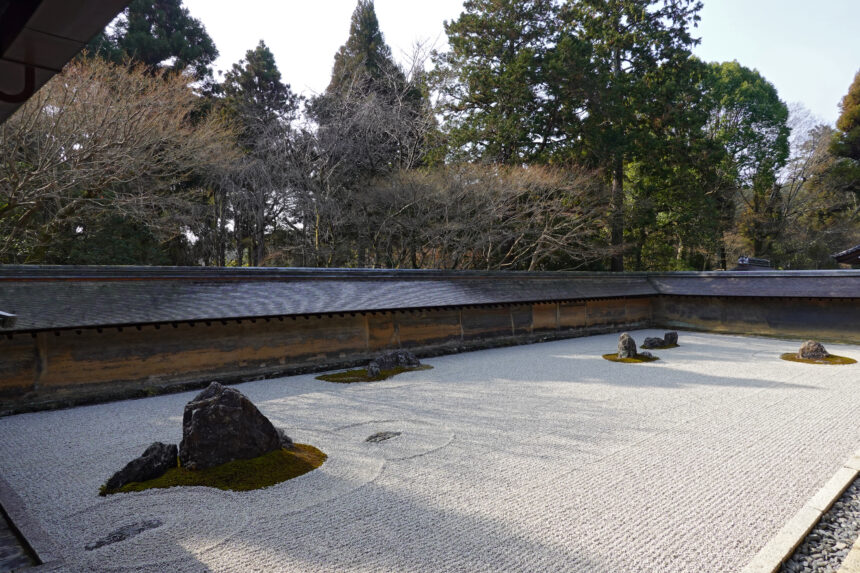
Featured image: Ryoan-ji in Kyoto by 663highland on Wikimedia Commons, CC BY-SA 4.0. Cropping or resizing may be applied for site display. This editorial use does not imply endorsement by Ryoan-ji, Wikimedia, the photographer, UNESCO, JNTO, Kyoto City, or site operators.
Sources
- UNESCO World Heritage Centre: Historic Monuments of Ancient Kyoto
- UNESCO World Heritage Centre: Japan
- JNTO: Historic Monuments of Ancient Kyoto
- Kyoto City Official Travel Guide: About Kyoto
- Kyoto City Official Travel Guide: Responsible Travel
- Kyoto City Tourism Association: Code of Conduct for Sustainable Tourism in Kyoto
Editorial disclosure: This is an independent planning guide. It is not affiliated with UNESCO, JNTO, Kyoto City, Kyoto City Tourism Association, temples, shrines, castle operators, transport companies, or site owners.