Plan Nikko as a sacred landscape
Short answer: Nikko is a strong Tokyo-based World Heritage choice, but it should not be treated as one quick shrine stop. UNESCO’s Shrines and Temples of Nikko property brings together Nikko Toshogu, Nikko Futarasan-jinja, Rinnoji, Shinkyo Bridge, many related buildings, and the surrounding sacred natural setting.
Last checked: August 28, 2026. Hours, fees, repairs, access routes, photography rules, bus services, weather, guided tours, and crowd-control measures can change. Confirm current official pages before travel.
What UNESCO lists
UNESCO inscribed Shrines and Temples of Nikko in 1999 under cultural criteria (i), (iv), and (vi). The property is described as a single complex of 103 religious buildings within two Shinto shrines, Toshogu and Futarasan-jinja, and one Buddhist temple, Rinnoji. UNESCO also emphasizes the sacred mountain and forest setting, the Edo-period architecture, the decorative achievement, and the association with Tokugawa Ieyasu.
That means Nikko Toshogu is central, but it is not the whole story. A better first visit sees the property as a network of sacred buildings, approaches, bridges, slopes, and forested paths.
Choose your visit style
| Style | Good for | Watch for |
|---|---|---|
| Core heritage loop | Toshogu, Futarasan-jinja, Rinnoji, Shinkyo in one focused day | Walking, stairs, entry rules, and site-to-site pacing |
| Slow sacred-site day | Travelers who want quiet time and better context | Fewer stops, more pauses, earlier start |
| Tokyo day trip | Visitors with limited time | Long transport day, weather, and return-train fatigue |
| Overnight Nikko | Travelers adding Okunikko, hot springs, or nature | More planning but less pressure on the shrine day |
| Architecture focus | People interested in carvings, gates, color, and Edo design | Photography rules, crowds near famous details, and slow looking |
Do not rush the route
JNTO describes Nikko as a place where architecture, deep history, and nature merge. That is exactly why a rushed visit can feel frustrating. The World Heritage area is walkable, but it is not flat museum space. You may move through slopes, stairs, forest edges, ticketed areas, bridge viewpoints, and busy paths.
If you are coming from Tokyo, start early and keep the plan tight. Choose a small number of sites, then leave room for lunch, weather, and the return journey. If you want both the World Heritage area and Okunikko nature, an overnight stay is usually more comfortable.
What to check before travel
- Current opening days, repair closures, entry rules, and special restrictions
- Whether each shrine, temple, bridge, or hall requires a separate ticket or route
- Bus, train, taxi, and walking options from Nikko Station or Tobu-Nikko Station
- Weather, footwear, stairs, slopes, and winter or rainy-day conditions
- Photography rules for gates, halls, interiors, carvings, ceremonies, and worship areas
- Guided-tour availability, language support, and whether tours enter paid areas
Respect active religious places
The UNESCO page notes that the shrines and temples remain in active religious use. Keep your voice low, follow signs, avoid blocking worshippers, and do not treat carvings, gates, or sacred bridges as props. Ask before photographing people, ceremonies, or restricted interiors.
Nikko is visually rich, so it is easy to look only for famous details. Slow down enough to notice the setting: the trees, river, slopes, and the way buildings sit within the mountain landscape. That relationship between architecture and nature is part of the reason the site matters.
Best first-time pattern
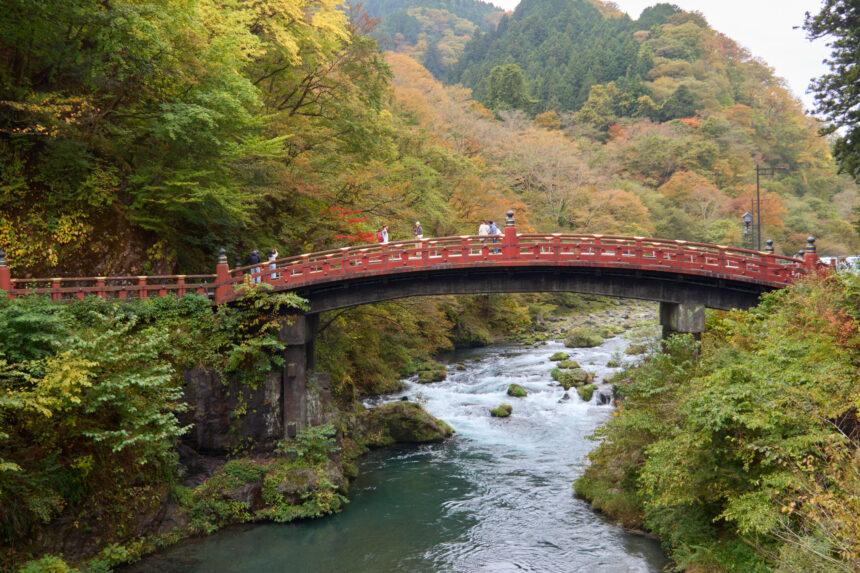
For a first visit, use Shinkyo Bridge as the symbolic entrance, then focus on the main shrine and temple area rather than trying to add every Nikko attraction. If your group wants a quieter day, reduce the number of paid interiors and spend more time walking between sites. If your group wants art and architecture, prioritize time to look closely at gates, carvings, and decorative surfaces where photography is allowed.
Use this guide with Japan World Heritage Guide for First-Time Visitors. Compared with Kyoto and Nara, Nikko works especially well as a Tokyo extension where culture and mountain atmosphere sit close together.
Photo credit
Featured image: Shinkyo Bridge in Nikko by lumoplank on Wikimedia Commons, CC0. Cropping or resizing may be applied for site display. This editorial use does not imply endorsement by Nikko shrines or temples, Wikimedia, the creator, UNESCO, JNTO, Nikko tourism bodies, or site operators.
Sources
- UNESCO World Heritage Centre: Shrines and Temples of Nikko
- Nikko Official Guide: Shrines and Temples of Nikko
- JNTO: The Shrines and Temples of Nikko
- JNTO: Nikko
- Japan Tourism Agency: World Heritage: Shrines and Temples of Nikko
Editorial disclosure: This is an independent planning guide. It is not affiliated with UNESCO, JNTO, Nikko Official Guide, Japan Tourism Agency, shrines, temples, transport operators, or site owners.