Short answer
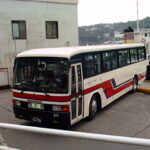
You can visit Izu Oshima’s Great Road Cut, often called Chiso Daisetsudanmen, by Oshima Bus from Motomachi. Use the Habu Port Line, check the official timetable PDF before travel, get off at Chiso Danmen-mae, and plan your return bus before you start taking photos.
Last checked: August 21, 2026. Bus timetables, fare tables, pass prices, road conditions, weather, access guidance, and safety restrictions can change. Always confirm current details with Oshima Bus, Oshima Town, Izu Oshima Geopark, UMISORA, and official local sources before travel.
What you are seeing
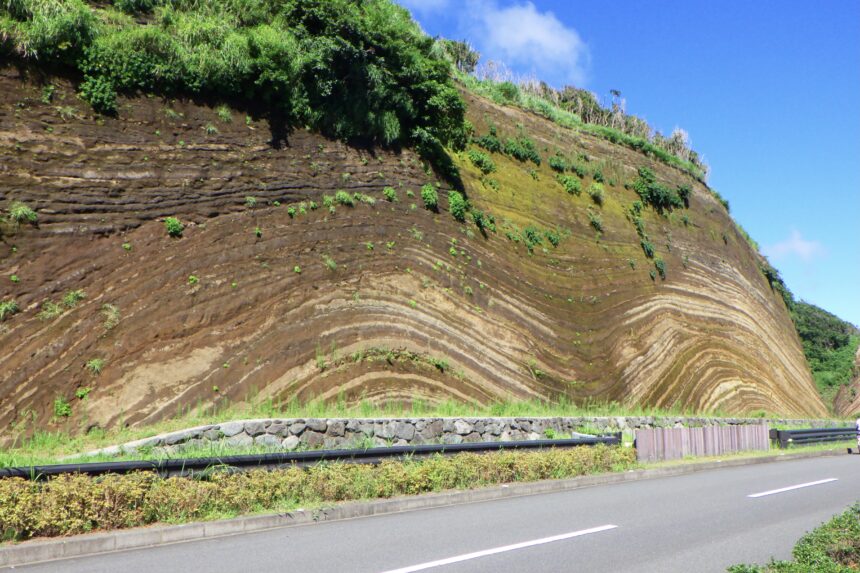
Izu Oshima Geopark gives this geosite the English name The Great Road Cut and places it in the Nomashi / Mabushi area. The town’s official page describes it as a roadside strata section on the island loop road on the south-west side of Oshima, on the way from Motomachi Port toward Habu Port.
Oshima Town says the section records Izu Oshima’s volcanic-eruption history. Layers of scoria and volcanic ash from large eruptions are stacked into a striped wall. The town page says the visible section is about 30 meters high and about 600 meters long, and that locals call it Baumkuchen because of the pattern.
The geology, in plain travel terms
The Geopark page says the stripes appeared during road construction in 1953. It explains that more than 100 eruptive deposits over roughly the past 18,000 years built the layers, with eruption intervals of about 100 to 200 years. The wavy look is not folded rock; it comes from deposits covering originally uneven volcanic terrain.
That is why the stop feels so different from a museum. You are looking at a roadside cut through the island’s volcanic archive. It is simple to visit, but it deserves the same respect as a protected natural site.
Bus access from Motomachi
Oshima Town says bus access is about 20 minutes from Motomachi Port on an Oshima Bus service bound for Oshima Town Athletic Stadium, getting off at Chiso Danmen-mae, with the site immediately nearby. The same page gives car access as about 15 minutes from Motomachi Port.
For bus travelers, connect that town guidance with Oshima Bus’s official route-bus page. The route page checked for this guide showed a timetable period from July 1, 2026 to September 30, 2026 and linked the Habu Line summary timetable PDF, island map PDF, route map PDF, and fare table PDF.
Why return timing matters
The Tokyo Sightseeing Accessibility Guide says the Habu Port Line runs from Motomachi toward the strata section and Habu Port. It also says the Habu Port Line and Oshima Park Line run about once per hour, and that route-bus schedules are determined the evening before use.
That means the bus is practical, but you should not treat it like a city metro. Check the return bus before you relax into photography. If you plan to continue toward Habu Port, check the onward bus and the final return toward Motomachi before committing.
Safe photo rules
Oshima Town’s official page gives a clear warning: the space inside the guardrail and fence is not a viewing space and is generally off limits because of collapse risk. Entry for construction or research purposes requires an application to the Tokyo Metropolitan Government.
So the easy rule is this: photograph from the public roadside/viewing side, do not cross barriers, and do not step into the buffer space for a cleaner angle. The point of this stop is scale and pattern, not proximity.
Fare and payment snapshot
As checked on August 21, 2026, Oshima Bus’s official fare section listed a one-day pass at 2,500 yen for adults and 1,250 yen for children, and a two-day pass at 3,800 yen for adults and 1,900 yen for children. The FAQ says one-day and two-day route-bus passes are sold on route buses.
The official FAQ says Suica, PASMO, and similar IC cards cannot be used. It says cash and PayPay are accepted, and that 50 to 500 yen coins and 1,000 yen notes can be changed on the bus. Carry small yen cash as a backup.
A simple bus plan
- Confirm the day’s ferry port and weather before choosing Motomachi as your base.
- Open Oshima Bus’s official route-bus page and the Habu Line summary timetable PDF.
- Find the bus toward Oshima Town Athletic Stadium or the Habu-side route that serves Chiso Danmen-mae.
- Write down the return bus before you board.
- At the site, stay outside the guardrail/fence area and photograph from the permitted side.
- Leave a buffer if you need to catch a ferry, flight, or another bus connection later.
Where to go next
Use this as the geosite-by-bus branch of the Japan Transport Fan Travel Guide. For the line itself, read the Oshima Habu Port Line Bus Guide. For the wider bus system, read the Oshima Bus for Ports and Airport Guide. For ferry-port uncertainty, use the Oshima Ferry Return Port Choice Guide.
Photo credit
Featured image: Great strata section in Izu Oshima by Madara-neko via Wikimedia Commons, licensed under CC BY-SA 4.0. The image may be resized by WordPress for site display; no editorial changes are intended. It is used in editorial geosite and transport-guide context and does not imply current site conditions, current bus service, or endorsement by the creator, Wikimedia, Oshima Town, Izu Oshima Geopark, Oshima Bus, Tokyo Metropolitan Government, UMISORA, Oshima Tourism Association, or island communities.
Sources
- Oshima Town official strata-section page
- Izu Oshima Geopark official Great Road Cut page
- Oshima Bus official route-bus page
- Oshima Bus Habu Line summary timetable PDF
- Oshima Bus route-bus timetable and island map PDF
- Oshima Bus route map PDF
- Oshima Bus fare table PDF
- Oshima Bus official FAQ
- Tokyo Sightseeing Accessibility Guide Oshima traffic page
- Oshima Tourism Association transportation page
- UMISORA English Oshima bus timetable FAQ
- Wikimedia Commons image file and license record
Editorial disclosure: This is an independent planning guide. It is not affiliated with Oshima Town, Izu Oshima Geopark, Oshima Bus, Tokyo Metropolitan Government, UMISORA, Oshima Tourism Association, Wikimedia, the image creator, or island communities.