How to communicate food allergies in Japanese restaurants
Short answer: do not rely on one phrase or an English menu title. For food allergies in Japanese restaurants, prepare a written allergy card, contact the restaurant before booking when possible, ask before ordering, confirm hidden stock and sauces, and walk away if the answer is unclear.
This guide is part of Practical Food Guides in Japan. For broader allergy planning, start with Japan Food Allergy Guide for Travelers. For reservation-stage checks, use How to Book Restaurants in Japan with Allergies, Vegetarian, Vegan, or Halal Needs.
Last checked: August 4, 2026. This article is not medical advice and cannot guarantee safety. Restaurant ingredients, cooking tools, sauces, stock, fryer use, staff knowledge, and allergy communication vary by venue. Travelers with severe allergies should prepare professional medical guidance, medication, emergency plans, and written communication before travel.
The safest mindset
A food allergy phrase is useful, but it is not a safety guarantee. The real goal is to create a clear decision: can this restaurant confidently explain the risk, or should you choose another meal? In Japan, as anywhere, a staff member may want to help but may not be able to verify every ingredient, sauce, broth, shared tool, or cross-contact risk.
Use written information, ask early, and keep a backup meal. If the allergy is serious and the answer is uncertain, do not eat the dish.
Use a written card, not speech alone
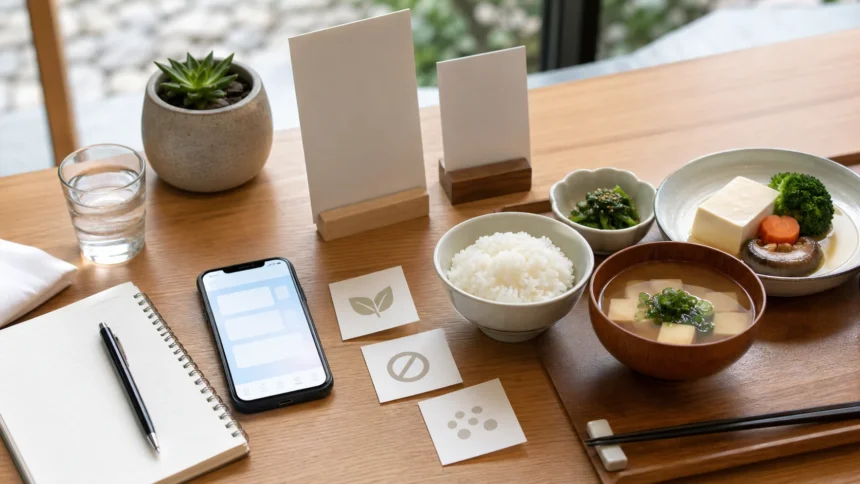
Spoken phrases can be misunderstood in a noisy restaurant or across languages. A written allergy card is usually better because staff can read it, show it to the kitchen, and compare it with ingredients. It should list the allergen, severity, cross-contact concern, and what happens if the allergen is present.
For serious allergies, do not improvise your own translation at the restaurant. Prepare a checked card before travel. If possible, have a native speaker or professional translator review it, especially for life-threatening allergies.
A simple restaurant workflow
- Before booking: contact the restaurant or hotel and explain the allergy in writing.
- Before entering: check whether staff can read or accept the card before you sit down.
- Before ordering: ask whether the dish contains the allergen, related ingredients, stock, sauce, or shared fryer risk.
- If staff is unsure: thank them and choose another restaurant or a safer backup.
- After ordering: keep the card visible if multiple staff members may serve the table.
Useful romaji prompts
These romanized prompts are only support. A written card in Japanese is safer than relying on romaji pronunciation alone.
| Situation | Romaji support | Meaning |
|---|---|---|
| Explain the allergy | Watashi wa ___ arerugi desu. | I am allergic to ___. |
| Ask whether it is included | Kore ni ___ wa haitte imasu ka? | Does this contain ___? |
| Ask about broth or sauce | Dashi ya sosu ni ___ wa haitte imasu ka? | Does the stock or sauce contain ___? |
| Ask about shared frying | Onaji abura de agete imasu ka? | Is it fried in the same oil? |
| Decline if uncertain | Fuan na node, yamete okimasu. | I am unsure, so I will not order it. |
Ask about hidden ingredients
Many allergy risks are not visible from the dish name. Ask about stock, sauce, seasoning, marinade, batter, noodles, toppings, garnish, soup base, and shared cooking tools. Japanese dishes may use fish stock, soy sauce, wheat, egg, sesame, dairy, shellfish, peanuts, tree nuts, pork, chicken, or alcohol-derived seasonings depending on the restaurant.
Packaged-food labels and restaurant meals are different problems. A packaged label may give structured information, while a restaurant dish may depend on recipes, suppliers, daily preparation, and staff knowledge.
When to contact the restaurant
Contact the restaurant before booking if the meal is important, the allergy is severe, the group is large, the restaurant serves set menus, or the venue is a ryokan, hotel, course restaurant, theme park restaurant, or special event. Ask before paying a cancellation fee or committing to a non-refundable plan.
For casual restaurants, you may still ask at the entrance. But if staff cannot confirm, choose another option. A polite refusal is better than forcing a restaurant to guess.
What not to assume
- Do not assume an English menu lists every ingredient.
- Do not assume “no meat” means no fish stock, chicken stock, pork extract, or shared tools.
- Do not assume a staff member can check all suppliers during a busy service.
- Do not assume a buffet is safer than a set meal.
- Do not assume a dish is safe because it was safe at another branch.
- Do not assume packaged-food labeling rules solve restaurant cross-contact risk.
Backup meals matter
Travelers with serious allergies should not make every meal depend on a new restaurant conversation. Keep safer backup foods, prechecked stores, hotel support, packaged items, or restaurants contacted in advance. For route-based backups, read Food Backup Planning in Japan by Route Type.
If you use packaged food as a backup, read labels carefully and use Japanese Ingredient Labels for Travelers. Translation apps can help, but they are not perfect for allergens, abbreviations, compound ingredients, or cross-contact warnings.
Common first-time mistakes
- Arriving at a busy restaurant and explaining a serious allergy only after sitting down.
- Using a phrase from the internet without a written card.
- Asking only about the visible ingredient and forgetting broth, sauces, fryer oil, and shared tools.
- Booking a course meal or ryokan dinner before confirming whether the allergy can be handled.
- Eating because staff seemed friendly even though the answer was unclear.
- Not carrying emergency medication or a professional emergency plan when needed.
FAQ
Can Japanese restaurants handle food allergies?
Some can, some cannot, and capacity varies by restaurant, menu, staff, supplier, and kitchen setup. Ask before booking or ordering, and do not eat if the answer is unclear for a serious allergy.
Is an allergy card enough?
No. An allergy card improves communication, but it does not guarantee ingredient control or prevent cross-contact. Use it as one part of a broader safety plan.
Should I use romaji phrases?
Romaji can help you begin the conversation, but written Japanese reviewed before travel is safer for important allergies. Show the card and ask staff to confirm with the kitchen.
Are packaged labels safer than restaurant meals?
Packaged labels can provide more structured information, but they still need careful reading. Restaurant meals require direct communication and may include hidden ingredients or cross-contact risk.
Related guides
Return to Practical Food Guides in Japan for the parent hub. For the broader safety plan, read Japan Food Allergy Guide for Travelers. For booking-stage checks, read How to Book Restaurants in Japan with Allergies, Vegetarian, Vegan, or Halal Needs. For packaged foods, read Japanese Ingredient Labels for Travelers.
Sources
- Consumer Affairs Agency: Food labeling
- Consumer Affairs Agency: Food Labeling System for Foreign Visitors
- Consumer Affairs Agency: Food allergy information
- Government of Japan: Food allergy labeling
- Consumer Hotline for Tourists
Editorial disclosure: This guide is independent, not medical advice, and does not certify restaurant safety, allergy handling, ingredient control, or emergency care. Confirm details with the venue and qualified professionals before relying on any meal.