Make Kobe Airport a sea-and-city aviation stop
Short answer: Kobe Airport works best for aviation fans as a compact airport-viewing stop: start with the official rooftop observation decks, use the 3F Skycourt when weather or timing is awkward, and connect to Kobe city by Port Liner when the schedule is comfortable.
Last checked: August 21, 2026. Observation-deck hours, Skycourt hours, terminal operations, international/domestic facilities, restaurants, shops, Port Liner timetables, buses, ferries, parking, events, and flight operations can change. Always confirm current details on official Kobe Airport and transport pages before you go.
Choose your first Kobe Airport plan
| Plan | Best fit | Check first |
|---|---|---|
| Rooftop decks only | First-time aviation fans who want official aircraft views with sea and city context | Deck hours, weather, terminal map, security notices |
| 3F Skycourt backup | Travelers who want a less weather-exposed aircraft view inside Terminal 1 | Skycourt hours, crowding, window position, current terminal notices |
| Deck plus terminal food | Visitors who want a light airport break before returning to Kobe city | Restaurant list, before-security or after-security area, Terminal 1 or Terminal 2 availability |
| Airport plus Port Liner | Travelers connecting airport time with Sannomiya or central Kobe | Port Liner timetable, fare, luggage comfort, last return |
Why Kobe Airport is a good aviation stop
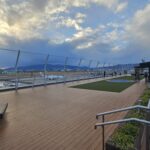
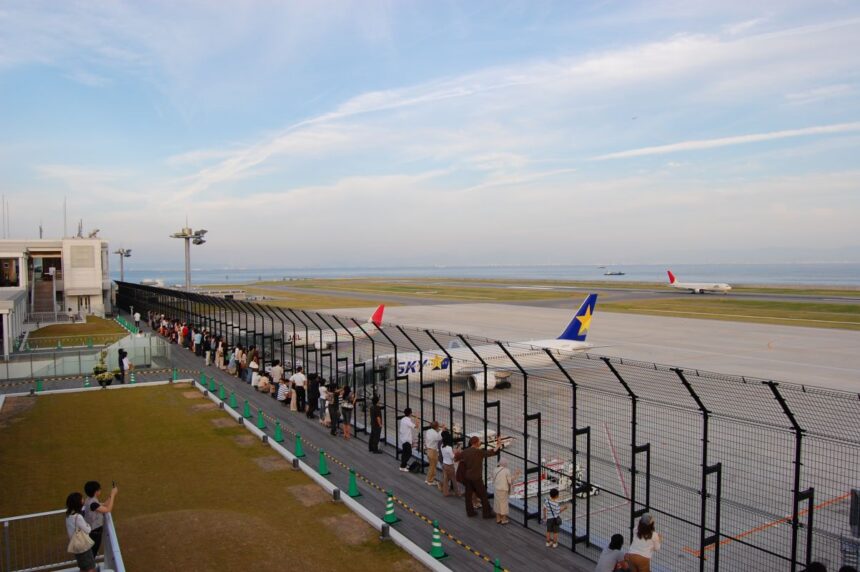
Kobe Airport is unusually easy to understand as an aviation-fan stop because the official viewing plan is clear. Kobe Airport’s official English observation page says rooftop views look north toward the city and south toward aircraft moving close by. It also describes the 3F Skycourt as a glass-walled place where visitors can see planes up close.
The airport sits on an artificial island in Osaka Bay, so the experience feels different from a dense inland airport. You are not just watching aircraft; you are seeing runways, sea, city, mountains, terminal movement, and Port Liner access in one compact setting.
Start with the official observation decks
Kobe Airport’s official page currently lists observation decks on the rooftops of Terminal 1 and Terminal 2, with business hours of 6:30-22:00. The official FAQ also says the rooftop observation decks are free and gives the same currently listed hours.
Use those official decks before considering any off-site viewing. They are designed for visitors, easier to explain to travel companions, and less likely to create trouble than fence-line wandering or roadside photography. Weather, events, security instructions, maintenance, and terminal operations can still change the experience, so check current notices before going up.
Use the 3F Skycourt as a flexible backup
The 3F Skycourt is useful when the rooftop is windy, rainy, crowded, or simply not the mood you want. Kobe Airport’s official page currently lists the Skycourt at Terminal 1 3F and says it is glass-walled, with business hours of 6:00-24:00.
This makes it a good plan B for travelers with luggage, families, or people who want to keep the visit short. You still need to be considerate: do not block windows, restaurant lines, escalators, signs, or passenger flow just to hold a photo angle.
Make Port Liner the city connection
Kobe Airport’s official access page organizes transport by Train / Port Liner, Bus, Car / Parking, High-Speed Ferry, and Taxi. Its Port Liner page currently says the Port Liner can reach Sannomiya from the airport in 18 minutes, with timetable and fare links provided by the operator pages.
For a simple aviation day, this is the cleanest structure: arrive by Port Liner, visit the rooftop deck, eat or drink if the current restaurant list works, then return to Sannomiya. If you have a flight, reverse the order and protect your check-in, baggage, security, immigration, and boarding buffer.
Terminal food is useful, but check the exact area
Kobe Airport’s official restaurant list shows current restaurants with terminal, floor, business-hour, and before-security or after-security information. This matters because a shop that looks close on a map may still be unavailable if it is past security or in a different terminal flow.
The airport’s official search/notices page also flags current practical details, including Terminal 2 store limitations and safety-related notices. Before you promise yourself a specific meal, cafe, souvenir, or international-terminal stop, check the official list for the day you travel.
Keep plane watching low impact
Stay in official public areas: rooftop observation decks, 3F Skycourt, terminal spaces, signed transport areas, and ordinary pedestrian routes. Avoid fences, service roads, staff-only doors, cargo areas, parking edges, seawalls without clear public access, and any place where photography makes passengers, staff, drivers, or residents uncomfortable.
Do not use drones, bright lights toward aircraft, ladders, rail climbing, or gear setups that block movement. If airport, airline, railway, ferry, bus, security, restaurant, or shop staff give instructions, follow them immediately.
Simple first itinerary
For a light visit, take the Port Liner to Kobe Airport, confirm current airport notices, visit the Terminal 1 or Terminal 2 rooftop deck, use the 3F Skycourt if needed, then return indoors for food or your next transport step. Keep the plan short if you are carrying luggage.
For a slower visit, connect the airport with central Kobe. Use the airport as a calm aviation-viewing anchor, then return by Port Liner for Sannomiya, waterfront sightseeing, or your hotel. Do not turn the day into a race across multiple terminals, shops, and city stops unless the timetable leaves room for delays.
For the wider transport branch, start with Japan Transport Fan Travel Guide. For related airport planning, see Japan Airports Guide and Nearby Travel Ideas, Plane Spotting in Japan Airports for First-Time Visitors, Kansai Airport Area Guide for Aviation Fans, Itami Airport Area Guide for Aviation Fans, and Naha Airport Area Guide for Aviation Fans.
Photo credit
Featured image: KobeAirportObservationDeck.jpg by Geofrog on Wikimedia Commons, CC BY-SA 2.5. Cropping or resizing may be applied for site display. The image is used in editorial Kobe Airport aviation-travel-guide context and does not imply endorsement by Kobe Airport, Kansai Airports, Skymark, JAL, airlines, aircraft operators, Wikimedia, or the creator.
Sources
- Kobe Airport official English site
- Kobe Airport: Information & Sightseeing / Observation Deck
- Kobe Airport FAQ: Is there an observation deck?
- Kobe Airport: Access
- Kobe Airport: Port Liner
- Kobe Airport: Restaurants
- Kobe Airport: Shop / Dine
- Kobe Airport: Search / Notices
- Wikimedia Commons image file and license record
Editorial disclosure: This is an independent planning guide. It is not affiliated with Kobe Airport, Kansai Airports, airlines, aircraft operators, Port Liner / Kobe New Transit, ferry or bus operators, Wikimedia, or the creator.