Make Oita Airport a sea-and-onsen aviation stop
Short answer: Oita Airport works well for aviation fans who want an airport stop with runway views, sea scenery, and a distinctly Oita terminal experience. Build the plan around the official 3F observation deck and 1F onsen footbath, then choose airport bus, hovercraft, taxi, rental car, or a Beppu / Oita / Yufuin route only after checking current operation details.
Last checked: August 21, 2026. Observation-deck access, terminal hours, flight status, bus timetables, fares, hovercraft operation and reservations, taxi availability, parking, rental cars, footbath hours, shops, restaurants, road conditions, weather, and events can change. Always confirm current details on official Oita Airport, airline, bus, hovercraft, taxi, rental-car, and destination pages before you go.
Choose your first Oita Airport plan
| Plan | Best for | How to keep it practical |
|---|---|---|
| Observation-deck stop | Aviation fans with an arrival, departure, or spare airport hour | Use the official 3F deck first, then return indoors before baggage, boarding, bus, hovercraft, or taxi timing becomes tight. |
| Footbath and terminal reset | Travelers who want an airport experience tied to Oita’s onsen identity | Confirm current footbath hours, towel needs, luggage timing, and terminal flow before making it the center of the stop. |
| Oita / Beppu bus plan | Visitors heading toward Oita Station, Beppu, or central hotel areas | Check the official airport-bus page, ticket machine rules, service status, aircraft-delay handling, and last return. |
| Hovercraft comparison | Transport fans who specifically want the sea-access option | Check the airport page and Oita Daiichi Hover Drive operation / reservation information close to travel. |
Why Oita Airport works for aviation fans
The official facilities page gives Oita Airport two strong anchors. The first is the 3F observation deck, described as a place with sea, mountain, and sky scenery, aircraft takeoff and landing views, and the ocean beyond the runway. The page also notes benches, tables, toilets, binoculars, and slope access for wheelchair and stroller users.
The second anchor is the 1F arrival-lobby footbath. Oita is strongly associated with hot springs, and the airport’s official page lists a free natural-source footbath with hinoki seating. For a traveler, that creates a useful airport rhythm: watch aircraft and the sea, return indoors, reset at the terminal, then move toward the next transport only when timing is clear.
Keep the aviation part official
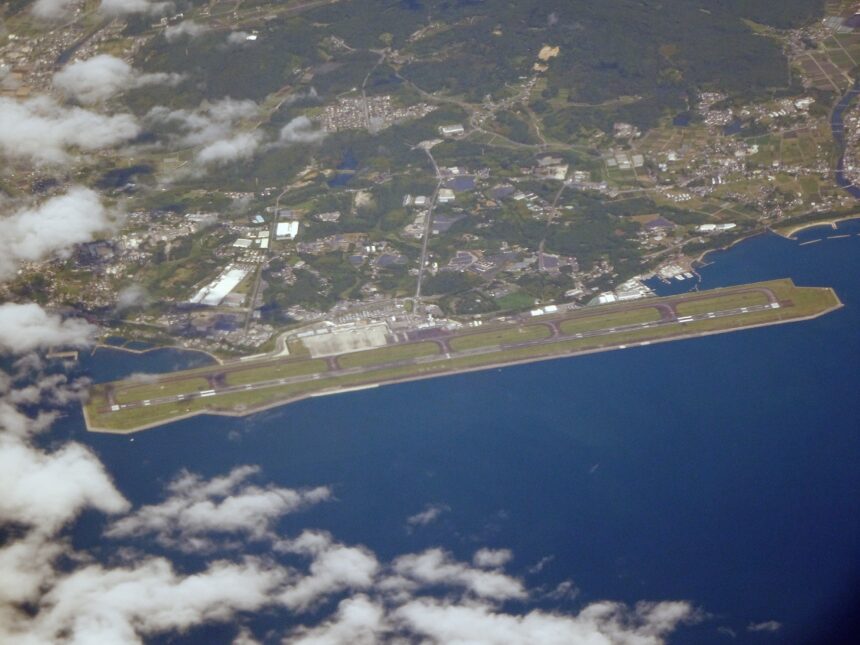
For this guide, the recommended aviation area is the terminal and official observation deck. Do not build the day around perimeter roads, private shoreline, port work areas, service roads, restricted zones, or drones. The aerial view of Oita Airport is useful for understanding the runway, coast, and access pattern, but it is not permission to wander into operational or private spaces.
A good Oita airport day should feel calm: official deck, terminal facilities, confirmed transport, and one onward plan. If weather is poor or the deck timing does not work, let the airport become a smooth transfer point instead of forcing aircraft photography.
Use airport buses with current checks
The official bus page is practical because it explains the airport-bus counter and ticket machines. It says the bus information counter is in the arrival lobby, tickets can be bought beside the counter or at the bus-stop vending machine, only the counter-side machine accepts credit cards on the current page, reservations are not required, and boarding is first-come, first-served. It also says transportation IC cards can be used onboard, while discount fares are not supported.
The same page warns that route-diagram times are approximate, airport departures can change because of delayed aircraft, and road congestion can delay trips to the airport. Treat Oita, Beppu, Yufuin, Nakatsu, Usuki, Saiki, and other bus branches as current-check choices, not permanent promises.
Compare hovercraft, taxi, and car without overcommitting
The hovercraft page is one of the reasons Oita Airport is especially interesting for transport fans, but it is also high-update. Oita Airport’s official page points readers to Oita Daiichi Hover Drive for the timetable, operation status, and reservations. If hovercraft is the reason for your visit, check operation status before you leave for the airport and keep a backup route.
The taxi page lists companies serving the airport and recommends advance reservation after evening hours. It also includes fare examples to places such as JR Oita Station, JR Yufuin Station, Beppu, Nakatsu, and Saiki, with a current revision date and a note that highway tolls are not included in the fare column. The car page gives driving-time examples and parking information, but road conditions, tolls, fuel stops, and parking rules should always be checked again before travel.
Add Beppu, Oita city, or Yufuin only when the timing works
Oita Airport can naturally connect to Beppu hot springs, Oita city, Yufuin, Kunisaki, or wider north and south Oita routes. The danger is trying to make every attractive name fit one arrival day. For a first aviation-focused visit, choose one branch: airport deck and footbath, airport bus to Beppu, hovercraft comparison toward Oita, or rental car toward a wider route.
If the aircraft arrives late, luggage takes time, or the transport option changes, shrink the plan. Oita’s best travel days often need road, weather, and relaxation space; the airport does not need to carry the whole itinerary by itself.
What to check before you go
- Official Oita Airport notices, flight status, terminal hours, and 3F observation-deck access.
- 1F footbath hours, availability, towel needs, luggage timing, and terminal rules.
- Airport-bus route, timetable, fare, payment method, counter / machine rules, service status, and last return.
- Hovercraft timetable, operation status, reservation rules, boarding place, cancellation handling, and backup transport.
- Taxi reservations, fare and toll assumptions, rental-car office rules, parking, fuel, road conditions, weather, and events.
Where this fits in the transport hub
Oita Airport belongs in the airport-area branch of the Japan Transport Fan Travel Guide. If you are comparing Kyushu airport days, also see Fukuoka Airport Area Guide for Aviation Fans, Kitakyushu Airport Area Guide for Aviation Fans, Plane Spotting in Japan Airports for First-Time Visitors, and Japan Airports Guide and Nearby Travel Ideas.
Photo credit
Featured image: Oita Airport aerial photograph by Wikimedia Commons user Bruno Plus, CC BY 4.0. Cropping or resizing may be applied for site display. The image is used in editorial Oita Airport aviation-travel-guide context and does not imply endorsement by the creator, Wikimedia, Oita Airport, Oita Air Terminal Co., Ltd., airlines, bus operators, hovercraft operators, taxi companies, or rental-car companies.
Sources
- Oita Airport: facilities and observation deck
- Oita Airport: bus access
- Oita Airport: hovercraft access
- Oita Airport: taxi access
- Oita Airport: car access
- Oita Airport: telephone guide
- Wikimedia Commons image file and license record
Editorial disclosure: This is an independent planning guide. It is not affiliated with Oita Airport, Oita Air Terminal Co., Ltd., airlines, bus operators, hovercraft operators, taxi companies, rental-car companies, nearby destinations, Wikimedia, or the creator.