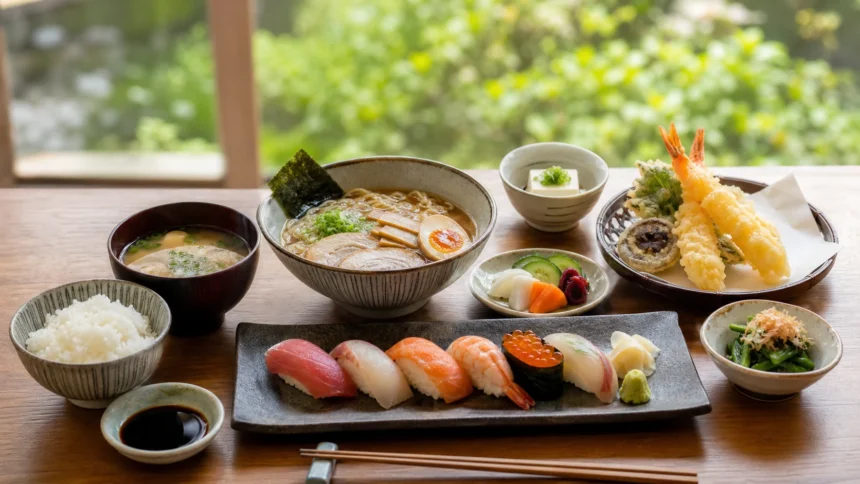
Short answer: Your first sushi meal in Japan is easier when you choose the service format before choosing the fish. A conveyor-belt or tablet-order restaurant offers the clearest control over quantity and pace. A casual set meal reduces ordering decisions. A reservation-led counter course offers more chef guidance but creates a larger commitment to time, price, cancellation terms, and dietary communication.
Before ordering, identify what one displayed price buys: one piece, two pieces, one plate, a set, or a course. Tell the venue about a serious allergy before seating, booking, or prepayment. Hands and chopsticks are both acceptable for sushi. Follow the restaurant’s instructions for plates, photos, payment, and pace rather than treating online etiquette lists as national law.
If you are still choosing the right food format for your trip, start with Japanese Food Basics, then return here for sushi-specific ordering details.
Last checked: July 21, 2026. Menus, fish availability, prices, units, pieces per order, hours, queues, reservations, cancellation terms, payment, tablet interfaces, language support, accessibility, child policies, luggage rules, photography, and dietary accommodation can change. Recheck the exact venue and its current official information.
Choose The Sushi Experience Before The Sushi
“I want sushi in Japan” still leaves several very different travel decisions. The best first meal is the format whose uncertainty you can manage.
| Format | What you control | Main commitment | Best first check |
|---|---|---|---|
| Conveyor-belt / tablet order | Items, quantity, pace, and often a running order view | Queue and venue-specific screen/plate system | Is the price per plate or per item, and how do special orders arrive? |
| Casual set meal | Set size and sometimes a few additions | Less choice, but an easier total | What is included, and are drinks or additions separate? |
| Casual counter, à la carte | Piece-by-piece choice and stopping point | Repeated unit decisions and chef communication | Is each listing one piece, a pair, or another unit? |
| Standing sushi | A short, focused meal | Limited space and a faster rhythm | Will the setup work for your luggage, children, mobility, and group? |
| Reservation-led course / omakase | Dietary notice and any permitted additions | Fixed time, cancellation exposure, and a larger unknown total if extras are added | What exactly is booked, charged, included, and cancellable? |
| Takeaway / department-store sushi | Label, pack size, time, and eating location | Cold-chain timing, rubbish, and no restaurant explanation | Can you read the current package label and eat it promptly in an appropriate place? |
JNTO’s official sushi guide describes conveyor-belt, standing, and omakase dining as distinct choices. Use those labels to compare commitment, not status. A traveler with a tight train connection may get more value from a clear set near the station than from a stressful counter course. A solo diner with time and no dietary constraints may enjoy an à la carte counter. A family may prefer a venue that confirms table seating and child access.
Do not use price alone as a safety or quality guarantee. An expensive course can still have a strict cancellation policy, limited language support, raw-seafood risk, or a kitchen that cannot accommodate an allergy. A casual chain can have a detailed allergen page yet still warn about shared handling and changing ingredients.
Decode The Main Sushi Forms
Sushi is defined by seasoned rice and its topping, filling, or presentation. Raw fish is common, but it is not the definition. Sashimi is sliced seafood without sushi rice, so it is a separate menu category.
| Label | What it usually tells you | What remains unknown | Useful question |
|---|---|---|---|
| Nigiri / nigirizushi | A hand-formed portion of seasoned rice with a topping | Raw, cooked, seared, marinated, glazed, wasabi, and number of pieces | “Is this price for one piece or two?” |
| Maki / makizushi | Rice and fillings rolled, often with nori | Number and size of cuts, sauces, mayonnaise, sesame, fish, egg, or vegetables | “What fillings and sauce are inside?” |
| Gunkan-maki | Rice wrapped with a raised nori wall for a loose topping | Mixed seafood, mayonnaise, yolk, seasoning, and garnish | “Is the topping mixed with egg, soy, wheat, or shellfish?” |
| Temaki | A hand roll, commonly cone-shaped | Serving count, filling mix, sauce, and whether it is meant to be eaten immediately | “Is this one hand roll?” |
| Chirashizushi | Seasoned rice with assorted toppings arranged over or mixed through it | Exact assortment, raw/cooked balance, garnish, and hidden seasoning | “Can the restaurant confirm every topping today?” |
| Inarizushi | Seasoned rice in a sweet-savory fried tofu pouch | Soy, wheat, stock, sesame, garnish, and shared preparation | “What is used to season the pouch and rice?” |
| Pressed / regional sushi | Rice and topping shaped in a mold or local style | Curing, vinegar, fish, sauce, fermentation, and regional recipe | “Is it raw, cured, cooked, or fermented, and what sauce is used?” |
| Sashimi | Sliced seafood without sushi rice | Species, raw treatment, garnish, sauce, and cross-contact | “Which fish is this, and is it served raw?” |
A visible vegetable does not prove a vegetarian item. A roll may include dashi, mayonnaise, fish flakes, imitation crab, eel sauce, or shared tools. A cooked topping does not prove the sauce, rice seasoning, or work surface fits your diet. Treat the form as a map for questions, not an ingredient declaration.
Read The Price Unit Before You Point
Japan’s total-price display rule requires consumer-facing displayed prices to show the tax-inclusive total. That helps with tax, but it does not answer the most important sushi question: what is the unit?
| Price unit | What to verify | Common mistake to avoid |
|---|---|---|
| One piece / one kan | Whether the menu picture shows more than the actual order | Assuming every nigiri order comes as a pair |
| Pair or stated piece count | The exact count beside the Japanese or English label | Reading one line price as per piece and doubling it mentally |
| One plate | How many pieces are on that plate and whether plate colors have different totals | Assuming every plate color or item has one flat price |
| Set | Pieces, soup, side dishes, drink, and whether substitutions are allowed | Adding the photo’s optional items to the included list |
| Course | Number or sequence of dishes, drinks, tax, additions, and final payment | Assuming a booking-card charge is the full meal price |
| Market price / seasonal item | The current price before placing the order | Ordering from a label that does not show a final number |
Use the menu, tablet cart, or a written confirmation. Ask before the kitchen starts: “Kore wa ikkan no nedan desu ka?” means “Is this the price for one piece?” For a course, save the booking screen showing the branch, date, time, party size, course, total or price unit, cancellation deadline, and contact route.
Do not build your budget from a national “cheap, midrange, luxury” table. Location, fish, season, serving count, format, drinks, and venue policy move independently. Decide the maximum commitment you are comfortable with, then confirm the exact unit at the exact venue.
Conveyor-Belt And Tablet Ordering: A Branching Workflow
A modern conveyor-belt restaurant may have almost no freely circulating food. It can use a reception terminal, seat ticket, tablet or phone ordering, a dedicated delivery lane, a plate counter, and a self-checkout. Another venue may use a belt and staff payment. The category does not guarantee the system.
- Join or register correctly. Look for a physical line, reception terminal, app queue, party-size screen, counter/table choice, or staff instruction.
- Keep the issued number or seat slip. It may be required for seating or checkout.
- Read the instructions at the seat. Identify the tablet language, order lane, plate colors, condiments, hot-water tap, plate-return slot, call button, and checkout control.
- Confirm the first item’s unit. Check price, pieces, quantity in the cart, raw/cooked status, wasabi, and sauce before submitting.
- Watch how the special order arrives. A screen, sound, lane, color, label, or seat number may identify it. Do not take another table’s order.
- Handle finished plates only as instructed. Some remain stacked for counting; some go into a slot; some are counted electronically. Never put a taken plate back on the belt.
- Close the order and check the total. Use the tablet’s checkout command, call staff, or take the seat slip to the register as directed.
- Pay through the stated rail. A branch may support cash, card, electronic money, or QR payment, but the exact terminal decides.
Kura Sushi’s official first-use guide is a useful named example: it describes booking, terminal check-in, a printed seat number, phone or touch-panel ordering, an order lane, a plate slot, self-check, and self-payment. That is Kura’s documented system, not a national template. If your venue uses a different screen or asks you to stack plates, follow that venue.
If the interface is unclear, stop before submitting duplicates. Use the call button or say “Sumimasen, chūmon dekite imasu ka?”—“Excuse me, did the order go through?” A photo of a dish can help identify it, but it cannot answer a serious allergen question.
Casual Counter And Set-Meal Workflow
A set is often the simplest bridge between tablet dining and an open-ended counter. You know the named package and can decide whether to add anything later.
- Read the unit before sitting if possible. Look for a set menu, à la carte list, standing arrangement, minimum order, or sold-out notice.
- Tell staff about non-negotiable restrictions first. Do this before tea, appetizers, or food begins—not after the first piece arrives.
- Choose set or individual orders. A set reduces decisions. Individual pieces provide control only when the unit and ingredients are clear.
- Let the chef or server set the handoff. Sushi may arrive on a plate, counter surface, leaf, or dish. Eat it before it dries or warms unnecessarily, without racing other guests.
- Order additions with a stopping point. Ask the current price of seasonal items and confirm whether each order is one piece or more.
- Request the bill through the venue’s method. Say “O-kaikei onegaishimasu”, use the table control, or pay at the register.
At a narrow counter, keep luggage, shopping bags, coats, and phones out of service space. Do not assume storage exists. If the setup cannot safely fit your group or belongings, choose a table-format venue. That is a practical match decision, not a judgment about the restaurant.
Omakase Is A Booking Contract As Well As A Meal
Omakase means entrusting the selection to the chef. It does not, by itself, tell you price, number of pieces, drinks, duration, reservation requirement, dress, photo policy, or whether a dietary change is possible.
Before confirming, save answers to these questions:
- Which branch and counter did you book?
- Is the charge a reservation fee, card guarantee, deposit, prepayment, cancellation route, or full course payment?
- What does the course include, and are drinks or extra pieces separate?
- What is the cancellation and no-show deadline in the restaurant’s current time zone?
- What happens if the train or flight is late?
- Must the whole party arrive together?
- When must allergies, disliked ingredients, pregnancy-related choices, religious boundaries, or other restrictions be disclosed?
- Can the kitchen accept those restrictions without changing the identity or safety of the course?
- What is the restaurant or booking channel’s contact route?
JNTO advises travelers to show up on time, notify the establishment when late, and cancel in advance. It also notes that smaller or specialized venues may prepare ingredients around bookings. The exact restaurant still controls the deadline, fee, arrival rule, and modification boundary.
A third-party booking page is not permission to ignore the restaurant’s terms. Read both and save the confirmation. If your itinerary includes an uncertain airport transfer, long rail connection, or weather-sensitive trip, do not place a strict, non-refundable counter meal immediately after it. Our Japan restaurant reservation guide explains card guarantees, hotel help, late arrival, cancellation, and fallback planning.
Sushi Etiquette That Helps Without Turning Into A Test
| Situation | Useful guidance | Do not turn it into |
|---|---|---|
| Hands or chopsticks | JNTO says both are acceptable for sushi | A claim that one method proves expertise |
| Soy sauce | Dip lightly; JNTO recommends the topping side for nigiri | A public correction of another diner’s technique |
| Pickled ginger | Use it between pieces as a palate cleanser | A topping piled onto every piece |
| Wasabi | Check whether it is already applied; request no wasabi early | A guarantee that removing visible wasabi removes every ingredient concern |
| Conveyor plates | Take only the plate you intend to keep; never return it to the belt | An assumption that every venue wants plates stacked or inserted |
| Photos | Ask when a chef, staff, other guest, kitchen, or intimate counter could be included | A national permission or ban |
| Fragrance | JNTO recommends avoiding strong scents in delicate dining settings | A claim that every restaurant has one written perfume rule |
| Tipping | JNTO says tipping is not customary | An assumption that there can never be a disclosed charge or booking fee |
| Chopsticks | Do not pass food chopstick-to-chopstick or leave chopsticks upright in rice | A long performance that makes the meal tense |
You do not need to say itadakimasu to be served. If you want to use it, say it quietly before eating. Gochisōsama deshita is a warm way to thank the restaurant after the meal. Clear attention, punctuality, a short apology after a mistake, and following staff matter more than perfect ritual.
Do not move seats, pass plates across service space, make a phone call at a small counter, or photograph people without checking. If you misunderstand the plate system or queue, say “Sumimasen” and follow the correction. Our Japanese food etiquette guide covers queues, photography, chopsticks, tipping, and mistake recovery across venue types.
Payment And Queue Decisions
Look for payment logos at the exact register, tablet, machine, or booking page. JNTO notes that card acceptance has expanded while smaller businesses may still require cash. Carry a reasonable yen fallback without labeling sushi restaurants “cash-only.” A transit IC card is not automatically accepted because the restaurant sits inside a station.
A queue can involve a physical line, numbered ticket, app registration, terminal check-in, time window, or call notification. Register the party honestly, remain where the system requires, and do not join multiple incompatible queues. A long line does not establish a predictable wait.
| Travel constraint | Safer sushi decision | Reason to leave |
|---|---|---|
| Train or flight later | Choose a clear set or tablet venue with time margin | The wait has no reliable cutoff or the bill process is unclear |
| Family with children | Confirm table seating, party registration, and current child policy | Only a narrow standing/counter setup remains |
| Large luggage | Use station storage or choose a spacious venue | Bags block service, exits, or other guests |
| Serious allergy | Contact a venue able to confirm controls before the visit | Staff cannot verify ingredients or cross-contact |
| Strict reservation | Arrive early in the area, not necessarily at the counter | Your transport delay already makes the booking terms impossible |
Our cash, cards, and IC payment guide explains payment logos, ATMs, foreign-card failure, DCC, and duplicate-looking authorizations.
Allergy Risk Starts Before The Fish
A plain-looking piece can have several invisible layers: seasoned rice, wasabi, marinade, glaze, soy sauce, stock, mayonnaise, garnish, and shared preparation. The Consumer Affairs Agency’s mandatory allergen labeling applies to packaged processed food. It does not turn restaurant-made sushi into a fully labeled product.
| Concern | Possible exposure points | Question before ordering |
|---|---|---|
| Fish | Raw/cooked topping, minced mix, dashi, sauce, garnish, shared knife | Can the venue identify every fish-derived component and shared step? |
| Crustaceans / mollusks | Shrimp, crab, shellfish, squid, octopus, mixed salad, broth, shared board | Is the exact species present or handled on the same surface? |
| Wheat | Regular soy sauce, glaze, imitation seafood, tempura, processed topping | Which soy sauce and prepared sauces are used, and is there shared handling? |
| Soy | Soy sauce, tofu pouch, miso, seasoning, glaze, processed filling | Does the rice, topping, sauce, or garnish use soy? |
| Egg | Tamago, mayonnaise, mixed salad, batter, sauce, processed topping | Is egg used in the item or on shared tools? |
| Sesame | Seeds, oil, sauce, garnish, rolls, shared condiment area | Is sesame in the recipe or handled nearby? |
| Other named allergen | Seasonal sauces, processed products, desserts, side dishes, supplier changes | Can the current product specification and kitchen process be confirmed? |
As of April 2026, CAA’s current Japanese material lists nine mandatory specified ingredients and twenty recommended ingredients for packaged processed foods; cashew joined the mandatory group. Older English cards or operator PDFs can lag. Read the date and current package instead of relying on a saved chart alone.
Removing a topping does not remove stock, sauce, rice seasoning, residue, or shared handling. A staff member may honestly say the kitchen cannot guarantee control. Treat that answer as useful safety information and use a verified alternative. Tell the venue before prepayment or seating whenever possible. Our Japan food allergy guide for travelers covers preparation, communication sheets, packaged labels, cross-contact, and emergency planning.
Raw Seafood And Anisakis: The Official Boundary
Japan’s Ministry of Health, Labour and Welfare identifies Anisakis as a food-poisoning risk from raw or insufficiently heated seafood. Its guidance gives food-business controls based on freezing, heating, rapid gut removal, and visual inspection. Most importantly for diners, MHLW explicitly says ordinary vinegar treatment, salting, soy sauce, and wasabi do not kill Anisakis larvae.
This means:
- wasabi and soy sauce are flavor choices, not parasite controls;
- vinegar-cured or salted does not automatically mean Anisakis-safe;
- fresh, famous, expensive, seared, marinated, or high-end does not prove zero risk;
- a diner cannot verify the restaurant’s full freezing/heating history by looking at the piece;
- “cooked seafood only” still requires checking whether the center is fully cooked and whether raw seafood shares tools or surfaces.
This guide does not diagnose illness or give personal medical advice. If you develop severe or concerning symptoms after raw seafood, seek medical care. Travelers who are pregnant, immunocompromised, or managing another medical risk should get individualized advice from their clinician rather than using a restaurant label or travel article as clearance.
No Raw Fish Is Not The Same As A Dietary Guarantee
| Request | What it may solve | What it does not solve |
|---|---|---|
| No raw fish | Removes selected raw-fish pieces | Shellfish, raw egg, shared tools, fish stock, sauces, or undercooked toppings |
| Cooked items only | Narrows topping preparation | Exact internal cooking, raw cross-contact, animal/fish stock, wheat, soy, egg, sesame |
| Vegetarian | Signals no meat/fish as understood by the diner | Dashi, bonito, seafood sauce, egg, dairy, shared handling, or venue definition |
| Vegan | Adds avoidance of egg/dairy and other animal products | Fish stock, honey, processing aids, cross-contact, or verified control |
| Halal-conscious | Starts a discussion about pork and alcohol | Certification, slaughter, mirin/sake, sauces, shared tools, or the traveler’s own standard |
| Gluten-free | Signals avoidance of wheat/barley/rye | Regular soy sauce, processed fillings, tempura, shared equipment, certified thresholds |
| Allergy-safe | Nothing by itself | It requires exact ingredient and process control for the named allergy |
Choose a venue that makes a scoped promise you can verify. Do not ask a busy chef to convert an unknown course after arrival. If your boundary is strict, contact the restaurant in advance, receive a clear answer, and keep a backup meal. A cucumber roll is an ingredient clue, not certification.
Useful Japanese Phrases—And Their Limits
| Japanese | Romanization | Use | Limitation |
|---|---|---|---|
| ひとりです / ふたりです | Hitori desu / Futari desu | One person / two people | Does not state seating preference or reservation |
| 予約しています | Yoyaku shiteimasu | I have a reservation | Show the exact confirmation and branch |
| これは一貫の値段ですか | Kore wa ikkan no nedan desu ka? | Is this the price for one piece? | Point to the exact menu line |
| 合計を見せてください | Gōkei o misete kudasai | Please show me the total | Extras may still be added later |
| わさび抜きでお願いします | Wasabi nuki de onegaishimasu | No wasabi, please | Not an allergy or cross-contact guarantee |
| 生ものは食べられません | Namamono wa taberaremasen | I cannot eat raw foods | Clarify fish, shellfish, egg, and cooking requirement |
| [食材]に重いアレルギーがあります | [Shokuzai] ni omoi arerugī ga arimasu | I have a serious allergy to [ingredient] | A phrase cannot prove kitchen control |
| 同じ器具を使いますか | Onaji kigu o tsukaimasu ka? | Do you use the same utensils/equipment? | Ask about the relevant surface or tool specifically |
| 写真を撮ってもいいですか | Shashin o totte mo ii desu ka? | May I take a photo? | Permission can exclude people or kitchen areas |
| お会計お願いします | O-kaikei onegaishimasu | The check, please | The venue may direct you to a register or terminal |
| ごちそうさまでした | Gochisōsama deshita | Thank you for the meal | Warm courtesy, not a required ritual |
Use plain English, a current allergen card, and pointing together when helpful. For a serious allergy, ask a closed question about a named ingredient and process. If the response is uncertain, do not interpret politeness as confirmation.
Six First-Visit Decisions
1. The tablet price is unclear
Do not submit several items to test the system. Open one item, identify piece count, plate/unit, quantity, and cart subtotal. If the screen still does not show the unit, call staff and point to the line. Your fallback is a clearly priced set. Do not promise that all tablet pictures equal one plate or two pieces.
2. A solo diner is choosing a set or individual counter orders
Choose the set when you want a known bundle and minimal language. Choose individual pieces when the unit is clear and you want to stop gradually. Ask whether one order means one or two pieces. Your fallback is the smallest clear set plus a later addition. Do not assume à la carte is cheaper.
3. A couple sees an omakase card guarantee
Identify whether the card is a guarantee, deposit, prepayment, fee, or final charge. Save the cancellation deadline and contact route. Place the booking away from an uncertain arrival. Your fallback is a flexible casual meal after check-in. Do not promise that a delayed flight waives the fee.
4. A traveler wants cooked seafood only
Define “cooked” before ordering: fully heated fish/shellfish, no raw garnish, and whether shared raw-seafood tools matter. Ask about sauces and stock. Your fallback is a venue with a documented cooked menu and usable process answers. Do not label seared or marinated as fully cooked.
5. A traveler has a serious fish, shellfish, wheat, soy, or egg allergy
Contact the venue before booking or seating. Name the allergen, reaction severity, and cross-contact need. Ask about rice seasoning, soy sauce, mixed toppings, stock, sauces, knives, boards, gloves, and other relevant equipment. If the venue cannot confirm, leave and use a verified alternative. Do not rely on removing the visible topping or an old English PDF.
6. A family has children and luggage
Check party registration, table availability, stroller/luggage space, current child policy, queue, and checkout method before joining. Store large bags when possible. Your fallback is a table-format branch or takeaway eaten in an appropriate place. Do not assume every conveyor venue is automatically family-friendly.
Frequently Asked Questions
Is sushi in Japan always expensive?
No. The more useful question is what the displayed price buys and what commitment the format creates. Sushi may be sold per piece, pair, plate, set, or course. Confirm the unit, inclusions, extras, and current total instead of relying on a national price band.
Do I need a reservation?
Not for every sushi meal. Many casual venues accept walk-ins or use queues. A small, popular, or course-led counter may require or strongly depend on reservations. Check the exact venue and save its current cancellation and arrival terms.
Is all sushi raw?
No. Sushi is seasoned rice paired with a topping, filling, or presentation. Toppings may be raw, cooked, seared, marinated, pickled, fried, egg-based, vegetable-based, or processed. Ask about the exact item; “not raw” does not answer allergy or dietary questions.
Can I eat nigiri with my hands?
Yes. JNTO says hands and chopsticks are both acceptable. Use the method you can control cleanly and follow a specific venue’s presentation.
Should I mix wasabi into soy sauce?
At a careful counter, follow the chef’s seasoning and ask if unsure. At casual venues, use condiments lightly. More important: wasabi and soy sauce do not kill Anisakis, according to MHLW.
Can a vegetarian or gluten-free traveler eat sushi?
It may be possible at a venue that can confirm ingredients and process, but the label “sushi” provides no guarantee. Check dashi, rice seasoning, soy sauce, sauces, processed fillings, garnish, and shared equipment. Keep a verified alternative.
Is a conveyor-belt restaurant easier for allergies?
The interface may make menu comparison easier, and a chain may publish allergen information. That does not eliminate recipe changes or shared handling. Read the update date, speak to staff, and leave if the required control cannot be confirmed.
Build Sushi Into A Resilient Food Trip
Plan one high-commitment sushi meal at most until you understand your route. Keep the other meal flexible. Protect airport, rail, museum, and hotel constraints before a queue or counter course. When a restaurant is full, the menu is unclear, or dietary communication fails, using the backup is successful planning.
Start with our Japan food travel guide for first-time visitors for restaurant formats, ordering, routes, and meal pacing. Use the reservation, payment, etiquette, and allergy guides linked above for the higher-risk branches.
Official Sources
- JNTO: Sushi in Japan Guide
- JNTO: Japanese Customs and Etiquette
- JNTO: Making Reservations
- National Tax Agency: total-price display obligation
- MHLW: Preventing Anisakis food poisoning
- Consumer Affairs Agency: food-allergen labeling information
- Consumer Affairs Agency: eating-out allergen communication guidance
- Kura Sushi: first-use guide (operator example)
Editorial disclosure: This guide was independently researched. It contains no affiliate, sponsored, PR, or paid restaurant placement. Perplexity was used to map questions and possible sources; material claims were checked against government, JNTO, or named-operator sources. Named operators illustrate only their own systems. Menus, prices, units, hours, queues, reservations, cancellation terms, payment, language support, and dietary accommodation can change, so verify the exact venue before travel.