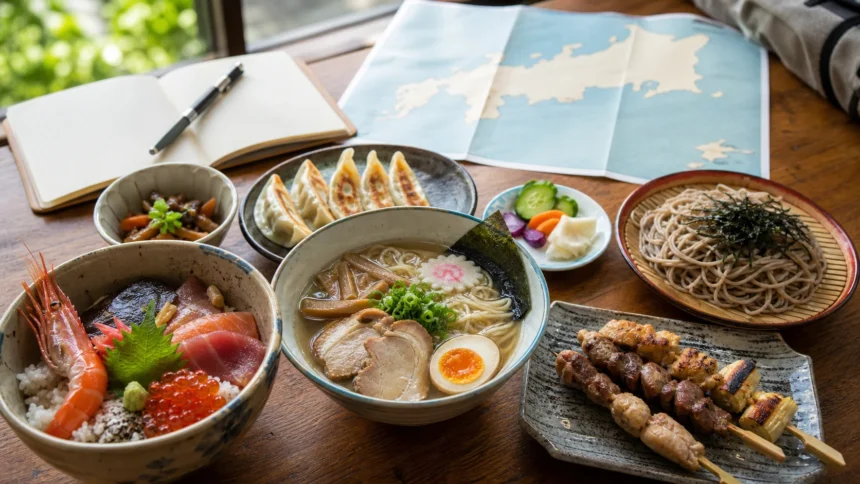
Short answer: Udon is a wheat-noodle category; soba is a buckwheat-associated noodle category that can also contain wheat or another binder. Choose the noodle, hot/cold serving format, broth or dipping sauce, and topping as four separate decisions. Then follow the exact shop’s ordering system instead of assuming every ticket machine, standing counter, or self-service line works alike.
For a serious wheat or buckwheat allergy, the noodle name is not enough. Ask about the current flour blend and about shared boiling water, baskets, strainers, surfaces, utensils, flour dust, and fryers before ordering or paying. A plain-looking bowl may also contain fish-based dashi, soy sauce, egg, meat, or other ingredients, so vegetarian, vegan, halal, gluten-free, and allergy-safe are separate questions.
If you are still deciding how noodles fit into your wider Japan itinerary, start with Japanese Food Basics and our Japan food travel guide for first-time visitors, then return here for udon and soba ordering details.
Last checked: July 21, 2026. Flour blends, recipes, broth, toppings, menus, prices, hours, queues, ticket interfaces, order flow, payment, seating, language support, accessibility, luggage rules, and dietary accommodation can change. Recheck the exact branch or venue on the day.
Udon Or Soba? Start With The Decision, Not The Reputation
A traveler does not need to decide which noodle is “better.” The useful question is which category, format, shop system, and risk level fit this meal.
| Decision | Udon | Soba | What still needs checking |
|---|---|---|---|
| Main flour signal | Wheat-based noodle | Buckwheat-associated noodle; wheat or another binder may be used | Exact current flour composition and shared preparation |
| Texture expectation | Can be thick, thin, flat, firm, smooth, or very soft by region and maker | Can differ in color, aroma, texture, milling, and binder | The shop’s current style; appearance does not prove composition |
| Serving choice | Hot broth, chilled, dipping, poured sauce, or region/shop-specific formats | Hot broth, chilled dipping, direct-pour, or regional formats | What “hot” or “cold” means on this menu |
| Easy travel use | Self-service, counter, food-court, station, or seated specialist formats may exist | Ticket-machine, standing, counter, station, or seated specialist formats may exist | Queue, inside/outside gates, last order, seating, luggage, and payment |
| Serious allergy boundary | Contains wheat unless a competent current source proves a specific exception; may share a kitchen with soba | Contains buckwheat and can contain wheat; shared equipment may add further uncertainty | Ingredients and controls both need confirmation |
JNTO describes udon as a flour-and-salt noodle and soba as a buckwheat noodle for which flour is also used in some areas. MAFF likewise describes soba made by kneading buckwheat flour, water, and binding agents such as flour or egg. That is why “soba is gluten-free” and “udon is safe for buckwheat allergy” are unsafe shortcuts.
Do not use color as a percentage meter. Dark soba is not proof of 100% buckwheat; pale soba is not proof of more wheat. A shop label such as juwari or nihachi may communicate a formulation—commonly all buckwheat or an 80:20 buckwheat-to-binder idea—but it remains the operator’s recipe claim. It does not prove separate water, equipment, surfaces, or an allergy-safe meal.
Read The Menu As Four Separate Layers
Long noodle names become easier when you stop translating them as one block. Read them as a sentence:
noodle + temperature/serving format + broth or sauce + topping
| Menu signal | What it often helps predict | What it does not settle |
|---|---|---|
| Udon / soba | The noodle category | Flour ratio, stock, sauce, topping, cross-contact, or serving temperature |
| Kake | Noodles and hot broth together in a bowl | The exact dashi, soy sauce, garnish, or protein |
| Mori / zaru | Chilled noodles with a separate dipping sauce; presentation or garnish can differ | Whether the sauce contains fish, wheat, soy, alcohol-derived seasoning, or other ingredients |
| Bukkake | A more concentrated sauce poured over the noodles in operator/regional usage | A universal recipe, temperature, garnish, or salt level |
| Kamaage | A warm, straight-from-the-pot style; the exact liquid and dipping method vary by noodle and region | Ingredients, side sauce, or whether cooking water is shared |
| Kamatama | On udon menus, a warm noodle-and-egg format | Raw/cooked egg handling, sauce, toppings, or dietary suitability |
| Kitsune / tanuki | A topping label that can point to fried tofu or tempura-related elements | A dependable nationwide meaning; regional and operator usage varies |
| Tempura | A fried topping or side | Batter ingredients, frying oil, shared fryer, seafood, egg, wheat, or serving count |
| Tororo | Grated yam as a topping or sauce component | Other stock, seasoning, garnish, egg, or cross-contact |
| Niku / kamo-nanban | A meat topping; kamo points to duck in the named dish | The full stock, sauce, vegetables, and current recipe |
| Curry | Curry-flavored broth or sauce with noodles | Thickener, meat/fish stock, dairy, soy, wheat, or other allergens |
| Tsukimi | An egg-associated topping presentation | The egg’s preparation, other toppings, broth, and allergens |
When a word is unclear, use the photo and point to each layer: “soba, cold, dipping sauce, no tempura.” A photo helps identify format; it cannot prove ingredients. For a serious restriction, ask before buying the ticket because the machine may send the order immediately.
Hot, Cold, Dipping, Or Direct-Pour?
Hot noodles in broth
A kake-style bowl places noodles and broth together. It is simple to carry and eat, but “plain” does not mean ingredient-free. JNTO notes that Japanese stocks and sauces can contain animal ingredients, while its food-etiquette guide describes dashi made from ingredients such as bonito, kelp, or dried fish. Ask what the specific broth contains rather than declaring all dashi fish-based or all kelp stock vegan.
Chilled noodles with separate dipping sauce
Mori and zaru usually help a traveler identify chilled noodles and a separate sauce cup. Take a small portion with chopsticks and dip it to your taste. There is no need to perform a strict “correct” depth or angle. The important travel decision is whether you want a separate, concentrated sauce and whether its ingredients fit you.
Sauce poured over the noodles
Bukkake and some regional styles use sauce poured directly onto the noodles rather than a separate dip. Do not assume the same sauce concentration, temperature, toppings, or garnish at every shop. If the menu offers both hot and cold, confirm both the noodle temperature and how the sauce is served.
Kamaage and sobayu are different decisions
Kamaage can describe noodles served warm from cooking water, but the presentation differs. MAFF’s Izumo soba page documents a regional kamaage style in which noodles sit in sobayu and the diner adds sauce. That does not define every kamaage udon or soba shop.
Sobayu is the hot water used to cook soba. Some specialist venues offer it near the end of a chilled-soba meal, often for mixing with remaining dipping sauce. It is optional and not guaranteed. For wheat or buckwheat allergy, cooking water is a control question, not a cultural treat: do not consume it unless the venue’s ingredients and process fit your safety needs.
Choose The Shop Format Before Entering The Queue
| Format | Likely strength | Main uncertainty | Best first check |
|---|---|---|---|
| Ticket-machine standing/counter shop | Compact decision and limited seating commitment | Pay/select order, ticket handoff, automatic transmission, cashless support, pickup | Does buying send the order, and where does the ticket go? |
| Self-service line | You can see the sequence and choose sides individually | Where to order noodles, take tempura, pay, add condiments, and return dishes | Join the noodle counter, not the register end |
| Staff-order casual shop | Questions can be asked before the kitchen starts | Pay before/after, set contents, hot/cold terminology, current ingredients | Can staff confirm your four-layer order? |
| Specialist soba/udon restaurant | More explanation, regional forms, or courses may be available | Reservation, wait, serving sequence, dietary limits, time commitment | Walk-in or booking, and can restrictions be accepted? |
| Station/airport/food-court venue | Useful location and clear travel context | Inside or outside gates, terminal/concourse, last order, queue, seating, luggage | Can you reach, order, eat, and return with a safe buffer? |
“Standing soba” describes space, not a complete service system. One venue may use cash at a ticket machine; another may accept IC payment; another may have staff ordering. A ticket can be handed to staff, retained for number display, or split into slips. Our restaurant ticket-machine guide explains those branches and mistake recovery.
Ticket-Machine And Standing-Counter Workflow
- Check space before buying. Can your party, mobility needs, child, suitcase, and shopping bags fit without blocking the counter or aisle?
- Find the language and payment controls. Read the exact machine. A physical button is not proof of cash-only, and a touchscreen is not proof of foreign-card acceptance.
- Build the four-layer order. Confirm udon/soba, hot/cold or dipping, broth/sauce, and topping. Check portion and takeaway/dine-in if shown.
- Ask allergy questions before purchase. A translated button or allergen icon cannot confirm all ingredients and controls.
- Keep every slip. Look for a sign, number display, counter tray, or staff gesture. Do not assume the ticket must be handed over.
- Wait without blocking pickup. Listen for a number, watch the screen, or follow the queue. Ask when uncertain.
- Collect only your order. Check the noodle and topping before leaving the counter.
- Return dishes only where instructed. Look for a return shelf, tray station, or staff service.
If you press the wrong item, stop and ask immediately before food preparation or consumption where possible. Do not promise yourself a refund or remake; policy varies. Say “Sumimasen, machigaemashita”—“Excuse me, I made a mistake”—and show the ticket.
Self-Service Udon: One Operator Example, Not A National Rule
Marugame Seimen’s current first-customer page documents its own sequence: choose the udon type, size, and hot/cold format; receive the bowl; select tempura or rice sides; pay; then use the drink and condiment area. The company also warns that some locations or takeout counters use different procedures.
Use that example to recognize a line, not to memorize Japan:
- Join at the noodle-order end.
- State the noodle, size, and hot/cold choice.
- Receive the bowl before moving forward.
- Take only the sides you intend to buy.
- Place everything where the cashier can see it and pay.
- Add optional condiments after payment if that branch’s layout directs you there.
- After eating, follow the branch’s tray/dish-return sign.
At another cafeteria, payment may occur earlier, the noodle may be called by number, or condiments may be before the register. If the line’s direction is unclear, pause at the entrance and watch one complete customer rather than entering from the register end.
Staff-Order And Specialist-Restaurant Workflow
A seated restaurant is not necessarily slower, more expensive, or easier for dietary needs. It simply creates a better moment for a conversation before the order.
- Ask whether you may sit or must write a name/collect a number.
- Read set contents and identify the four order layers.
- State serious allergies or non-negotiable restrictions before water, condiments, or sides create confusion.
- Ask whether payment is at the table, counter, or register.
- For a regional specialty, ask how the sauce is used rather than copying another table.
- Allow enough time for cooking, queue, questions, and payment.
A specialist venue may offer sobayu, a multi-dish soba meal, regional condiments, or a reservation-led experience. None is automatic. If your restriction would require a different stock, flour, water, fryer, or work area, ask before booking. Our restaurant reservation guide explains confirmation records, late arrival, cancellation, and dietary notice.
Can A Noodle Stop Fit A Train Or Flight Connection?
Do not use a national “ten-minute noodle meal” promise. The kitchen can be fast while the queue, gate location, payment, or luggage problem is slow. Use a buffer decision:
| Check | Green signal | Warning signal | Fallback |
|---|---|---|---|
| Location | You have confirmed the floor and whether it is inside/outside gates | “At the station” without a concourse/gate check | Choose a known option on your current side of the gate |
| Queue | Short visible line and clear ordering point | Hidden seated wait list or unclear pickup crowd | Leave before ordering |
| Menu | Your choice and restrictions are already resolved | You need a long ingredient conversation | Use a preverified backup meal |
| Payment | Accepted method is visible and you have a cash fallback | One failing card/phone and no yen | Do not enter a retry loop |
| Space | Luggage fits without blocking service | Narrow standing counter and large suitcase | Choose a table/food-court format |
| Time | You preserve walking, gate, security, platform, and disruption buffer | The plan works only if every step is immediate | Skip the stop |
For a 35-minute rail transfer with luggage, confirm the next platform first. If the shop is not clearly on the route, the queue is not visible, or you cannot leave a comfortable margin, choose a packaged or previously verified alternative. Buying a ticket is a commitment: do not abandon an order without telling staff.
Seven Regional Noodle Decisions Worth Planning Around
Regional names should help build an itinerary, not a ranking. The examples below describe traditions documented by MAFF or official tourism bodies. Each shop still controls its recipe and service.
| Region/base | Noodle decision | Officially supported distinction | Useful itinerary pairing |
|---|---|---|---|
| Kagawa / Takamatsu and beyond | Sanuki udon | MAFF documents a deep wheat-and-udon food culture with multiple serving and dashi traditions | Build one or two confirmed shops into a Kagawa day; verify transport and branch hours |
| Akita / Yuzawa-Inaniwa area | Inaniwa udon | Official Tohoku tourism highlights the glossy, smooth regional udon | Pair with an Akita route rather than expecting it at every generic udon shop |
| Gunma / Mizusawa-Ikaho | Mizusawa udon | MAFF and Gunma tourism connect the wheat-noodle tradition with Mizusawa Kannon and Ikaho | Temple/onsen food stop; check the individual shop and bus plan |
| Mie / Ise | Ise udon | MAFF documents extra-thick, very soft noodles with a small amount of dark tamari-based sauce and shop variation | A practical contrast to firm-udon expectations during an Ise visit |
| Shimane / Izumo-Matsue | Izumo soba | MAFF documents hikigurumi milling plus cold stacked warigo/wariko and hot kamaage forms | Choose the service format as part of an Izumo/Matsue cultural route |
| Nagano / Togakushi | Togakushi soba | MAFF documents Nagano soba areas and the small-portion bocchi-zakari presentation | Pair with Togakushi only after seasonal transport and venue checks |
| Iwate / Morioka-Hanamaki | Wanko soba | Official Tohoku tourism describes repeated small-bowl service | Treat it as a time/participation experience; ask the specific venue about booking and stopping signals |
MAFF’s own Izumo page uses “three great soba” language, while Gunma tourism uses a similar “three great udon” description. These are useful cultural framings, not a reason to exclude other traditions or declare an official quality podium. Our regional food guide helps match food ambitions to travel geography.
Buckwheat And Wheat Allergy: Ask Two Different Questions
Japan’s Consumer Affairs Agency lists wheat and buckwheat among the mandatory specified allergens for packaged processed foods. As of April 2026, the current national packaged-food system has nine mandatory and twenty recommended items. Restaurant meals, unpackaged food, and food served by an establishment do not carry the same mandatory packaged-food allergen disclosure.
Ask an ingredient question and a control question:
| Risk | Ingredient question | Control question | Unsafe shortcut |
|---|---|---|---|
| Buckwheat allergy | Does this noodle, flour, garnish, or side contain soba/buckwheat? | Are soba and udon flour, water, baskets, strainers, surfaces, or utensils shared? | “I ordered udon, so buckwheat is impossible.” |
| Wheat allergy / celiac or gluten restriction | Does the noodle, binder, sauce, soy sauce, tempura, curry, or topping contain wheat? | Is boiling water, flour handling, fryer, equipment, or preparation space shared? | “Soba means gluten-free.” |
| Egg | Is egg used in noodles, binder, topping, tempura, or side? | Are batter, utensils, surfaces, or frying equipment shared? | Removing a visible egg proves safety |
| Fish/seafood | What is used in dashi, dipping sauce, garnish, tempura, and processed toppings? | Are stock containers, strainers, fryers, or serving tools shared? | A bowl with no visible fish is fish-free |
| Soy/sesame/other | Check sauce, tofu, garnish, oil, condiments, and packaged sides | Check current kitchen handling relevant to your condition | A plain noodle name answers the whole meal |
The CAA’s eating-out materials warn about unintended mixing. Marugame Seimen’s own allergen page similarly says kitchens and manufacturing sites may share utensils and equipment, ingredients can change, and customers should check the current information each visit. That is one operator’s disclosure, not proof that another shop shares the same equipment—or that any published chart removes risk.
For a serious allergy, ask before joining a nonrefundable line, using the machine, or accepting the bowl. If staff cannot confirm both the intended ingredients and the relevant controls, leave and use a backup that fits your clinician-provided plan. Our Japan food-allergy guide explains the current labeling scope, communication sheet, cross-contact questions, and emergency planning.
Vegetarian, Vegan, Halal, And Gluten-Free Are Separate
| Traveler need | What to ask | Why the noodle name is insufficient |
|---|---|---|
| Vegetarian | Dashi/stock, sauce, meat, fish, seafood, garnish, tempura, egg if excluded | Udon and soba describe noodles, not the whole bowl |
| Vegan | All animal ingredients, including stock, sauce, topping, egg, and processed sides | “Vegetable” or “no meat” may not cover fish stock or egg |
| Halal | Current ingredients, alcohol-related seasoning policy, meat sourcing, and preparation standard important to you | A seafood/vegetable appearance is not certification |
| Gluten-free / celiac | Wheat in noodles, binder, sauce, tempura, sides, plus preparation controls | Soba can contain wheat; juwari does not establish a separate kitchen |
| Wheat or buckwheat allergy | Specific ingredient plus relevant cross-contact controls | Diet preference labels do not equal allergy control |
JNTO advises vegetarian and vegan travelers to state specific exclusions and check dashi and base ingredients. Do not ask only “Is this vegetarian?” if your definition excludes fish stock, egg, or other animal products. A written card can improve communication, but it cannot force a kitchen to accommodate or prove that shared processes are safe.
Payment, Condiments, And Etiquette Without Folklore
- Payment: read the exact machine/register logos. Carry a reasonable yen fallback. Card, IC, and QR acceptance can vary by branch and terminal.
- Tipping: JNTO says tipping is not common or expected in restaurants. Pay the displayed total; a disclosed service, booking, or course charge is separate.
- Slurping: it is accepted, not required. Eat in a way you can manage without splashing nearby guests.
- Condiments: scallion, ginger, wasabi, shichimi, tempura flakes, or sesame may be offered. They are choices, not a test. For allergies, treat the open condiment area as another ingredient/control question.
- Broth and dipping sauce: you may drink, dilute, or leave them according to the dish and your preference. Do not assume sobayu will be offered.
- Space: keep luggage, bags, phones, and coats away from pickup lanes, condiment counters, and neighboring seats.
- Trays: return them only to the place indicated. A self-service order does not always mean self-return.
Our Japan food-payment guide covers cash, cards, IC marks, failures, and DCC. The food-etiquette guide covers queues, photography, chopsticks, rubbish, trains, and mistake recovery.
A Compact Noodle-Shop Phrase Kit
| Japanese | Romanization | Use | Limit |
|---|---|---|---|
| うどんを一つお願いします | Udon o hitotsu onegaishimasu | One udon, please | Still specify format, size, and topping |
| そばを一つお願いします | Soba o hitotsu onegaishimasu | One soba, please | Does not confirm flour blend |
| 温かいですか、冷たいですか | Atatakai desu ka, tsumetai desu ka | Is it hot or cold? | Does not distinguish dipping from direct-pour |
| つけ汁ですか | Tsukejiru desu ka | Is it dipping sauce? | Does not identify ingredients |
| セルフサービスですか | Serufu sābisu desu ka | Is it self-service? | Ask/observe the actual sequence |
| トレーはどこに返しますか | Torē wa doko ni kaeshimasu ka | Where do I return the tray? | Use only after confirming return is expected |
| カードは使えますか | Kādo wa tsukaemasu ka | Can I use a card? | Does not guarantee your card will complete |
| そばは入っていますか | Soba wa haitte imasu ka | Does this contain buckwheat/soba? | Ask separately about shared preparation |
| 小麦は入っていますか | Komugi wa haitte imasu ka | Does this contain wheat? | Ask about sauce, batter, and shared equipment |
| 魚のだしは入っていますか | Sakana no dashi wa haitte imasu ka | Does it contain fish stock? | One phrase cannot define all animal ingredients |
| 重いアレルギーがあります | Omoi arerugī ga arimasu | I have a serious allergy | State the exact allergen and required controls |
| お会計をお願いします | O-kaikei o onegaishimasu | The check, please | The venue may direct you to a register |
Romanization is a bridge, not a safety system. Show the exact ingredient in Japanese, use the CAA communication sheet where useful, and accept that a venue may responsibly decline.
Seven Real Traveler Decisions
1. First ticket-machine soba stop
Check the machine’s language/payment signs, choose noodle and format, keep every slip, and watch whether staff want the ticket or a number appears. If the order seems duplicated, ask before pressing again. Do not assume the ticket reserves a seat.
2. Self-service udon line with tempura
Start at the noodle counter, receive the bowl, take sides once, and pay where the line directs. If you have an allergy, ask before touching the tray line or paying; removing tempura later does not answer batter/fryer questions.
3. Choosing hot versus cold
Decide whether you want broth, separate dipping sauce, or direct-pour sauce—not only temperature. Point to the picture and confirm. Do not call one format more authentic; multiple documented traditions coexist.
4. A 35-minute station transfer with luggage
Find the next platform, confirm whether the shop is inside the same gate area, inspect the queue and space, and preserve a disruption buffer. If the plan requires zero wait, skip it. “Station noodle” is not a time guarantee.
5. Serious buckwheat allergy at an udon shop
Ask whether soba flour is present and whether flour, boiling water, baskets, strainers, surfaces, or utensils are shared. If controls cannot be confirmed, choose a verified alternative. The visible udon itself answers only part of the risk.
6. Vegetarian or vegan traveler sees plain zaru soba
Ask about the dipping sauce, dashi, garnish, sides, and definition being used. If staff can confirm only “no meat” but not fish stock or egg, the answer does not match a vegan requirement. A bare noodle photo is not a full ingredient list.
7. One regional noodle detour
Choose geography before prestige. Kagawa offers an udon-centered route; Izumo adds distinct cold-stacked and hot kamaage soba formats; Mizusawa can pair with Ikaho. Select the one already aligned with your route, then verify the specific shop rather than crossing Japan for a ranking label.
Frequently Asked Questions
Is soba gluten-free?
Not by name alone. Soba can contain wheat or another binder. Even a shop’s all-buckwheat formulation claim does not establish separate water, equipment, surfaces, or sauce. Confirm the current product and controls.
Is udon safe for someone with buckwheat allergy?
Udon is wheat-based, but a shop may also prepare soba. Ask about flour handling, water, baskets, strainers, surfaces, and utensils. If the answer is incomplete for a serious allergy, do not order.
What is the difference between mori and zaru soba?
Both usually signal chilled noodles with separate dipping sauce; presentation or garnish can differ. Treat the menu photo and staff explanation as controlling rather than forcing a nationwide rule.
Do I have to slurp?
No. Slurping is accepted, not mandatory. Eat comfortably and avoid splashing or disturbing nearby diners.
Do all quick noodle shops use ticket machines?
No. You may encounter staff ordering, touchscreen or button machines, automatic order transmission, ticket handoff, self-service lines, or post-meal payment. Read the exact venue.
Are noodle shops cash-only?
No national rule applies. Acceptance varies by branch and terminal. Read the current payment logos and carry a yen fallback.
Can I rely on an English allergen icon?
Use it as one input, not proof of the whole meal. Ingredients, translation coverage, recipe changes, condiments, and cross-contact controls can remain outside the icon. Ask directly before purchase.
What does bukkake mean on a noodle menu?
In this dining context it generally points to sauce poured directly over the noodles, rather than noodles sitting in a full bowl of broth or being dipped into a separate cup. The word alone does not settle temperature, sauce concentration, garnish, portion, or ingredients. Read the photo or hot/cold marker, then confirm the sauce and topping. Do not assume a bukkake udon at one operator predicts a soba dish or another region’s recipe.
Should I reserve a soba or udon restaurant?
Many casual counters are designed for walk-ins, but a specialist meal, group visit, rural destination, noodle-making experience, or wanko-soba service may need or benefit from advance contact. Check the specific official booking channel, party size, arrival time, menu, cancellation terms, and dietary notice. Do not place a strict reservation immediately after a disruption-prone transfer. If a venue publishes no reservation route, do not assume a third-party listing can override its current policy.
Official And First-Party Sources
- JNTO: Udon / Soba
- JNTO: Dining in Japan
- JNTO: A Vegetarian and Vegan Guide to Japan
- Consumer Affairs Agency: Food Allergy Information
- Consumer Affairs Agency: Food Allergy When Eating Out or Buying Prepared Food
- MAFF: Grain Products / Traditional Foods in Japan
- MAFF: Ise Udon
- MAFF: Izumo Soba
- MAFF: Hand-made Soba / Nagano
- MAFF: Gunma Udon
- Official Tohoku Tourism: Regional Noodles
- Gunma Official Tourist Guide: Mizusawa Udon
Editorial disclosure: This guide was independently researched. Perplexity was used to map questions and possible sources; material claims were checked against government, official tourism, or named operator pages. No restaurant, tourism body, booking platform, or noodle company paid for inclusion. There are no affiliate links, sponsorships, PR placements, or paid recommendations in this article. Recipes, flour blends, prices, hours, queues, order flow, payment, language support, and dietary accommodation can change, so confirm the exact venue before travel and again before ordering.