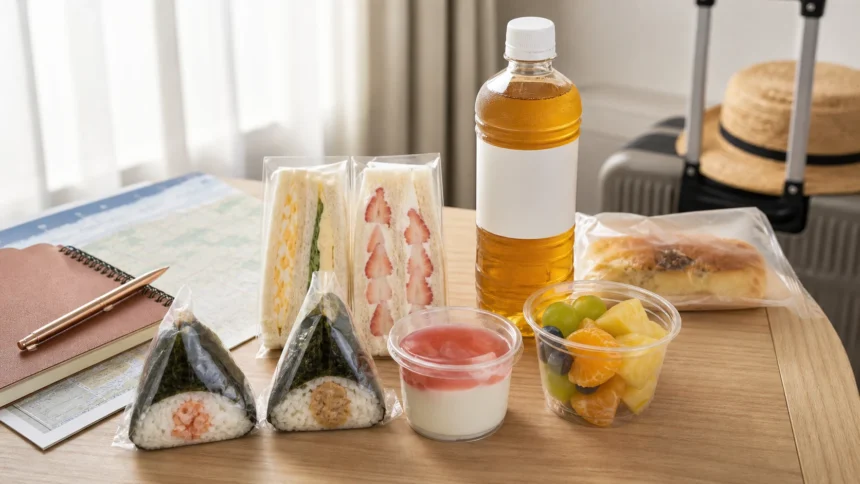
Short answer: A Japanese convenience store can be an excellent breakfast stop, late-arrival meal, sightseeing backup, or pre-train food source. Shop by where you will eat, whether you can keep the food cold, whether it needs heating or utensils, and how much rubbish it creates—not by a viral “must-buy” list. Read the exact package before paying, decide takeout versus eat-in, and check the exact branch for microwaves, seating, bins, payment, and other services.
For a serious food allergy or a non-negotiable dietary restriction, packaged food with a readable current label provides more evidence than an unwrapped hot snack or counter item, but a label still does not prove separate equipment or no cross-contact. As of April 2026, Japan’s current packaged-food system has nine mandatory and twenty recommended allergen items. A transition period means not every package on a shelf will look identical. If you cannot confirm the product and the controls you need, choose a safer preverified alternative.
If you are choosing between convenience stores, noodles, sushi, breakfast, markets, and hotel dining, start with Japanese Food Basics. For the practical side of payment, labels, allergies, dietary needs, eating locations, and backup meals, use Practical Food Guides in Japan.
Last checked: July 21, 2026. Products, recipes, suppliers, labels, prices, stock, hours, branch facilities, checkout screens, heating, utensils, payment methods, tax handling, rubbish rules, language support, accessibility, and dietary accommodation can change. Recheck the exact package, branch, operator, hotel, station, or transport service on the day.
Start With The Travel Problem, Not The Chain
The most useful convenience-store meal is the one that fits the next two hours. A refrigerated noodle bowl may be a poor choice before a crowded local train. A shelf-stable snack may be a weak dinner but a valuable disruption backup. A bento that looks easy may become inconvenient if you have no confirmed microwave, table, or rubbish plan.
| Travel situation | Useful starting point | Check before buying | Fallback |
|---|---|---|---|
| Early breakfast | Food that needs no heating and is easy to open | Branch hours, date, refrigeration, drink, utensils | Buy the night before only if storage instructions can be followed |
| Late hotel arrival | A simple meal matched to room equipment | Fridge, kettle, microwave, hotel eating and rubbish rules | Choose food ready to eat without room equipment |
| Short sightseeing gap | Compact food with a clear place to eat | Next reservation, queue, spill risk, authorized bin | Carry an unopened shelf-stable backup |
| Shinkansen day | Food that can be carried upright and opened at a seat | Train/operator guidance, platform time, smell, leakage, rubbish | Eat before boarding or choose a simpler item |
| Local or commuter train | Usually a drink or food saved for later | Operator signs, crowding, trip length, spill and smell risk | Wait for a designated eating area |
| Weather or delay backup | Unopened food that travels well | Storage, expiry, hydration, how long disruption may last | Do not depend on one branch retaining stock during disruption |
| Serious allergy | A package whose Japanese label can be confirmed | Exact unit, allergens, ingredients, storage, cross-contact limits | Use a preplanned safe option; decline uncertain counter food |
Do not assume that “convenience store” means 24 hours, an eat-in counter, a toilet, public rubbish bins, a customer microwave, hot water, English screens, or every payment method. Those are address-level questions. A chain’s official page can describe its policy, but the exact branch and item still control.
Build A Meal In Four Decisions
Instead of starting with a product name, make four decisions in order:
- Consumption place: branch eat-in space, hotel, park, station area, long-distance train, or later.
- Temperature and equipment: ready now, chilled, frozen, or needs heating, hot water, draining, mixing, chopsticks, spoon, or a table.
- Carrying: upright space, cold storage, time before eating, smell, leakage, and luggage.
- Evidence: date, storage, heating, ingredients, allergens, and any dietary claim on the exact package.
| Food format | Travel strength | Main friction | Inspect on the exact item |
|---|---|---|---|
| Onigiri / packaged rice item | Compact; often practical for breakfast or a short stop | Wrapper method and filling are not obvious from appearance | Opening diagram, filling, date, storage, allergens |
| Sandwich or chilled bread item | Minimal setup | Cold storage and a short consumption window | Use-by date, refrigeration, egg/milk/wheat and other ingredients |
| Bento or rice bowl | More complete meal format | Heating, flat surface, utensils, bulky container | Microwave directions, removable parts, date, storage |
| Chilled noodles | Useful in hot weather when facilities fit | Films, sauce, drainage, mixing, leakage, chopsticks | Numbered diagrams, packet order, refrigeration, allergens |
| Salad or side dish | Can add vegetables or variety | Dressing packet, fork/chopsticks, chilled storage | Dressing ingredients, date, storage, allergens |
| Bakery item | Easy to carry | Loose or store-bagged items may provide less label evidence | Whether it is individually packaged; ingredient/allergen source |
| Hot-counter item | Ready to eat soon | No standard packaged-food label, smell, oil, crumbs, short eating window | Operator’s current allergen information and staff confirmation |
| Frozen item | Can be useful where heating is confirmed | Not practical without the right microwave and instructions | Cooking method, packaging, time, storage, branch equipment |
| Drink / shelf-stable snack | Strong disruption or transfer backup | Not a balanced meal by itself | Seal, date where applicable, ingredients, caffeine/alcohol if relevant |
These are decision categories, not promises about what a branch stocks. Product ranges change by operator, region, season, delivery cycle, and time of day. A photograph online can help you recognize a format; it cannot confirm the package currently in your hand.
Read The Package Before You Join The Checkout Queue
Japan’s Consumer Affairs Agency provides an English visitor pamphlet explaining the food-label system. Use it to locate the Japanese label fields, but use the current April 2026 CAA allergy materials for the current allergen count. The English visitor pamphlet predates that change.
| Label field or signal | What it helps answer | What it does not prove |
|---|---|---|
| 名称 / product name | What the manufacturer calls the food | Dietary suitability or every preparation detail |
| 原材料名 / ingredients | Declared ingredients and additives under the applicable rules | That machine translation understood every term |
| アレルゲン information | Covered declared allergens on that package | No cross-contact, no recipe change, or coverage of every possible allergen |
| 消費期限 | Use-by boundary for a food that deteriorates relatively quickly | Safety when storage instructions were ignored |
| 賞味期限 | Best-before quality boundary for a less perishable product | Permission to ignore storage or package damage |
| 保存方法 / storage | Whether refrigeration, freezing, or another condition is required | That a hotel room or travel bag can maintain it |
| 加熱 / heating directions | Whether and how the manufacturer intends heating | That the branch will heat it or that every package component stays on |
| Numbered opening diagram | The order for films, lid, sauce, dressing, or seaweed | That a different product uses the same sequence |
| Nutrition panel | Energy and specified nutrients under the labeling rules | That one item forms a nutritionally complete meal |
Use-by is not the same as best-before. The CAA treats shōhi kigen (消費期限) as the date after which a food that deteriorates relatively quickly should not be eaten, and shōmi kigen (賞味期限) as the period during which expected quality is maintained for a less perishable food. Both assume the stated storage method. A date does not rescue food that has been carried warm when the package required refrigeration.
Do not buy a complicated package with the intention of “figuring it out later” during a tight transfer. If you cannot establish the opening, drainage, heating, or storage steps, choose a simpler product whose instructions you can follow.
Onigiri, Bento, And Chilled Noodles: Observe First
Onigiri wrappers are not one national puzzle
Many packaged rice balls use numbered tabs so the rice and seaweed stay separated until opening. The exact folds, pulls, shape, filling position, and seaweed arrangement vary. Hold the package upright, find the printed numbers, and follow that unit’s diagram. Do not force a sequence remembered from a video onto a different wrapper.
If the diagram is unreadable, ask staff only if the queue permits, or choose a package with a simpler opening. Opening it at the register can create crumbs, exposed food, and confusion about payment, so finish the purchase first unless staff direct otherwise.
Bento and rice bowls need an equipment plan
Before buying, inspect whether the package says to heat, whether any lid, sauce, condiment, divider, or oxygen absorber must be removed, and whether the container is designed for the microwave. Do not put an unknown component into a microwave. If the branch offers staff heating, present the package and ask; if the item cannot be heated in-store, accept that answer rather than improvising.
A heated meal should fit the next step. Carrying a hot, bulky tray through a station while pulling a suitcase is rarely the easiest plan. If you cannot eat soon at a stable surface, choose a smaller ready-to-eat item.
Chilled noodles and salads need table space
These can contain several films, separate toppings, dressing or sauce, and sometimes a drainage step. Read the printed sequence before opening. Keep the package level. If you have no table, no place to wash your hands, a crowded carriage, or a long walk, choose something with fewer moving parts.
Checkout: Expect Branches, Not One Script
You may meet a staffed register, a register where staff scan and you complete payment on a terminal, or a self-checkout. The sequence and screen vary. Our Japanese ticket-machine guide covers the same useful habit: read the current screen, keep the receipt, and do not repeat a payment merely because the first result was unclear.
- Decide takeout or eat-in. Confirm whether this branch has an eat-in space and decide before payment.
- Place all items where they can be scanned. Keep fragile, hot, cold, or leak-prone items visible.
- Respond to the actual prompt. Staff or a screen may ask about a bag, heating, utensils, membership, age confirmation, or payment. Not every checkout asks every question.
- Ask before heating. Show the exact product. Some items cannot be heated in-store.
- Request only the utensils you need. Availability and provision can differ by branch.
- Select or state payment. Follow the terminal; wait for the prompt before tapping, inserting, or presenting a code.
- Take the receipt and every item. Check heated food, small sides, drinks, change, card, phone, and utensils before leaving.
| Possible prompt | What it may mean | Safe response method |
|---|---|---|
| Bag? | A paid shopping bag may be offered | Say yes/no or point to your reusable bag |
| Heat this? | The item may be eligible for store heating | Answer for that item; do not assume the same for all food |
| Chopsticks, spoon, fork? | Cutlery may be offered or available on request | Ask for the one you will use; branch practice varies |
| Point or membership card? | A loyalty question, not a payment failure | Say no if you do not have one |
| Age confirmation | Required interaction for an age-restricted purchase | Follow the screen; do not ask staff to bypass it |
| Payment method? | The terminal needs cash/card/IC/code selection | Name or select the method shown as accepted |
Seven-Eleven Japan’s current English FAQ says customers can request cutlery and that staff may ask about it; its Japanese FAQ adds that final provision is a store-level judgment. The same English FAQ says most of its stores have microwaves but some items cannot be heated in-store. That is useful evidence for Seven-Eleven—not a promise about every Seven-Eleven branch, other operators, or every product.
Heating, Bags, And Utensils: Ask At The Right Time
If you want heating, tell staff while the item is at the register, before it is bagged. A compact request is “Atatamete moraemasu ka?”—“Could you heat this?” The answer can be no because of the item, packaging, store equipment, or branch procedure.
Plastic shopping bags are commonly charged, and the exact price and sizes are set by the retailer. If you use your own bag, protect it from sauce and condensation. A reusable bag does not solve food safety: chilled items still need the storage condition printed on the package.
Ask for chopsticks, a spoon, or a fork before leaving the register. Do not take a large handful “just in case.” If no utensil is available, choose a food you can reasonably eat later or return unopened if the store’s policy allows—never assume a refund.
Takeout Or Eat-In Changes The Tax Treatment
Japan’s consumption-tax system distinguishes food taken away from food consumed through an eat-in service. Food taken away generally falls under the 8% reduced rate; food eaten in a designated eat-in space is treated at the 10% standard rate. Decide before payment and follow the branch’s question, sign, or declaration process.
Some retailers may display the same tax-inclusive consumer price for takeout and eat-in even though the applicable tax rates differ. The National Tax Agency provides an example of that accounting treatment. Do not assume the price must visibly change, and do not treat an eat-in tax discussion as an invitation to argue with staff.
- Look for an eat-in area before choosing food.
- Check whether the seats are open, available, and governed by time or item rules.
- Tell staff or select the screen option that matches your intention at purchase.
- Keep the receipt.
- Follow the branch’s table, time, cleaning, and rubbish signs.
An indoor ledge, nearby station bench, hotel lobby, or mall seat is not automatically the store’s eat-in space. Each facility controls its own use. If the location is unclear, ask before opening the food.
Where Should You Eat?
| Place | Decision | What not to assume |
|---|---|---|
| Branch eat-in area | Declare eat-in before payment and follow posted rules | That every branch has seats or that a seat will be free |
| Hotel room | Check room-food, microwave, fridge, kettle, smell, and rubbish policies | That the lobby or room equipment is available to every guest |
| Park or public bench | Check local/facility signs and take every item of rubbish | That any bench is an eating area |
| Station concourse | Use a designated area where available | That ticket-gate space or a queue edge permits eating |
| Tokaido Shinkansen | JR Central explicitly permits food and drinks; be considerate and contain rubbish | That onboard food sales exist in Standard Class or that all trains share the same guidance |
| Local/commuter train | Check the operator and context; avoid a messy or strong-smelling meal in a crowded carriage | A nationwide legal ban or blanket permission |
| Airport/waiting area | Use signs and designated seating | That security-side and public-side rules/facilities are identical |
JR Central’s current Tokaido Shinkansen guide explicitly invites passengers to enjoy coffee or an ekiben at their seat and says Standard Class has no onboard food-and-drink sales, so buying before boarding can be useful. This is a named service example. Check your own operator and train instead of converting it into a rule for all rail travel.
Rubbish: Make A Plan Before Opening The Food
A travel meal is not finished when you take the last bite. The container, lid, sauce packet, chopsticks, napkin, drink bottle, receipt, and bag may remain. Before opening the product, identify an authorized bin or be prepared to keep everything contained.
- Use a store bin only when the branch provides one and follow its sign and store rules.
- Do not assume a convenience-store bin is a public disposal point for unrelated hotel, street, or another business’s waste.
- Sort by the labels on the exact bin; colors and categories are not one national traveler code.
- Seal wet sauce, soup, or food remains so they do not leak.
- Keep a small clean bag available for your own wrappers until an authorized bin is found.
- Ask the hotel how guest-food waste should be handled rather than filling a lobby bin.
- Never leave food waste on a train, platform, bench, table, curb, or beside a full bin.
Seven-Eleven’s English FAQ tells eat-in users to dispose of rubbish according to store rules. That careful wording is the right model: local signs control. Our Japanese food-etiquette guide covers queues, public eating, trains, photography, tipping, and mistake recovery.
Payment: Read The Logos And Keep A Fallback
Convenience stores can accept more payment types than many visitors expect, but acceptance is not universal. Seven-Eleven Japan currently lists major cards, transport IC cards, contactless and several code-payment services. It also states that cash payments are unavailable at its fully self-service checkouts without a cashier and that cash means Japanese yen. These are operator-specific facts.
- Check the entrance, register, or terminal for current payment logos.
- Say or select the method before presenting the card, phone, IC card, or code.
- Follow the exact screen; do not tap, insert, or show a code repeatedly.
- If rejected, confirm whether another accepted method can be tried.
- Keep a reasonable Japanese-yen fallback.
- Collect the receipt and check for a completed charge before attempting again.
- For a duplicate or disputed charge, keep the receipt and contact the store/operator and issuer.
A payment logo does not guarantee that your specific foreign card, wallet region, device, network connection, or authentication will work. Our cash, cards, and IC payment guide explains ATMs, DCC, terminal failures, duplicate-charge concerns, and cash fallback planning.
Food Allergies: Packaged And Counter Food Are Different
Japan’s April 2026 CAA handbook identifies nine mandatory specified allergens for covered packaged food: shrimp, cashew, crab, walnut, wheat, buckwheat, egg, milk, and peanut. It identifies twenty further recommended items, including pistachio. Cashew moved into the mandatory group on April 1, 2026, with a transition period through March 31, 2028. That means a traveler may encounter packages produced under different transition timing.
The same current handbook is equally important for what it excludes from mandatory allergen labeling: food sold without packaging, such as loose or by-weight sales, and food served through an eating facility. A counter fried item, bakery-case item, machine drink, or store-prepared loose food therefore cannot be treated like a sealed package with a current label.
| Evidence question | Covered packaged product | Loose/counter/store-served product |
|---|---|---|
| Mandatory allergen label | Applies within the current covered scope | Not the same mandatory packaged-food coverage |
| Ingredient list | Read the exact current unit | May require operator information or staff inquiry |
| Recipe/supplier change | Possible; recheck every purchase | Possible and often harder for a traveler to verify |
| Shared fryer/equipment | Not settled merely by the ingredient label | Requires current operator controls; may remain unknown |
| Serious-allergy decision | Buy only when the needed label and controls are confirmed | Decline when ingredients or relevant controls cannot be confirmed |
Do not rely on front photography, a familiar color, last week’s purchase, machine translation alone, or a product with a similar English name. Read the package in your hand. If the outside multipack carries the legally relevant information but an inner wrapper does not, keep the outer packaging with the food.
A label answers declared-ingredient questions within its scope. It does not automatically answer shared manufacturing lines, store utensils, fryers, tongs, display cases, heating equipment, or staff handling. Ask the control question separately. The CAA provides an English allergy communication sheet, but a sheet improves communication; it does not certify a product or force a store to accommodate.
For serious allergy planning, see our Japan food-allergy guide, which covers the current 2026 system, the CAA sheet, cross-contact questions, emergency contacts, and when to decline.
Vegetarian, Vegan, Halal, And Gluten-Free Need Separate Checks
| Need | Questions to resolve | Unsafe shortcut |
|---|---|---|
| Vegetarian | Meat, fish, seafood, dashi/extract, sauce, dressing, garnish, gelatin, egg if excluded | “Vegetable” means no animal-derived ingredient |
| Vegan | All animal-derived ingredients plus the standard important to the traveler | Rice, salad, or plain bread is automatically vegan |
| Halal | Certification claimed, meat source, alcohol-related seasonings, ingredients, preparation standard | No visible pork means halal |
| Gluten-free / celiac | Wheat, barley and other relevant ingredients; soy sauce; batter; cross-contact | Rice-based appearance means gluten-free |
| Allergy | Exact allergen plus relevant manufacturing/store controls | A preference label equals medical safety |
Do not combine these into one “special diet” question. A product may satisfy one definition and fail another. A plant-based claim is not a gluten-free claim; a gluten-free claim is not an allergy-safe environment; a halal claim is not a vegan claim. If the exact package, certification, or operator information does not answer your non-negotiable requirement, choose another product.
A Compact Checkout And Label Phrase Kit
| Japanese | Romanization | Use | Limit |
|---|---|---|---|
| これを温めてもらえますか | Kore o atatamete moraemasu ka | Could you heat this? | Staff/package may not permit heating |
| 温めなくて大丈夫です | Atatamenakute daijōbu desu | No heating is needed | Does not change storage requirements |
| 袋をお願いします | Fukuro o onegaishimasu | A bag, please | A fee may apply |
| 袋はいりません | Fukuro wa irimasen | No bag, thank you | Protect your own bag from leaks |
| お箸をお願いします | O-hashi o onegaishimasu | Chopsticks, please | Provision varies |
| スプーンをお願いします | Supūn o onegaishimasu | A spoon, please | Provision varies |
| 持ち帰りです | Mochikaeri desu | It is takeout | Use before payment |
| ここで食べます | Koko de tabemasu | I will eat here | Only if the branch has an eat-in space |
| カードで払います | Kādo de haraimasu | I will pay by card | Your card can still fail |
| ICカードで払えますか | IC kādo de haraemasu ka | Can I pay by IC card? | Acceptance is branch/register specific |
| 原材料表示はどこですか | Genzairyō hyōji wa doko desu ka | Where is the ingredient label? | Loose food may not have the same label |
| 卵は入っていますか | Tamago wa haitte imasu ka | Does this contain egg? | Ask about controls separately |
| 重いアレルギーがあります | Omoi arerugī ga arimasu | I have a serious allergy | Name the exact allergen; no guarantee of accommodation |
| ゴミ箱はどこですか | Gomibako wa doko desu ka | Where is the rubbish bin? | The branch may not provide one for your waste |
| レシートをお願いします | Reshīto o onegaishimasu | The receipt, please | Keep it with the purchase |
Several phrases above are functional editorial translations, not a government phrasebook. Use pointing, the package, the terminal screen, and the CAA communication sheet when needed. A successful conversation does not prove cross-contact control.
Eight Real Traveler Decisions
1. You arrive at a hotel after restaurants have closed
Check the room equipment before buying a meal that needs heating or refrigeration. If there is no confirmed microwave, choose something ready to eat. If the room has no reliable refrigerator, do not buy chilled food for tomorrow morning. Confirm where hotel guests should dispose of containers.
2. You need breakfast before an early train
Check the exact branch hours instead of assuming all-night operation. Choose food that can be opened and eaten without a microwave or table. Buy the night before only when the printed storage method can be followed. Keep the receipt and packaging with allergy information.
3. Staff ask several questions quickly
Look at what staff are holding or the register screen. The sequence may cover bag, heating, utensils, points, or payment. Use short answers and pointing. If you miss a non-safety question, pause and say “Mō ichido onegaishimasu”—“One more time, please.” Do not pretend to understand an allergy question.
4. A self-checkout will not accept cash
Read the payment options before scanning everything. Seven-Eleven states that its fully self-service cashierless checkouts do not accept cash; another operator can differ. Ask for a staffed lane or use another displayed accepted method. Check that the first attempt was not charged before trying again.
5. You want to eat at the branch
First confirm that the branch actually has an open eat-in area. Tell staff or select eat-in before paying so the correct tax treatment can be applied. Follow the branch’s time, noise, cleaning, and rubbish rules. If seats are unavailable, do not stand in an aisle and open a full meal.
6. You have a serious egg or wheat allergy
Prefer a sealed product whose exact current label can be confirmed. Read the Japanese ingredient and allergen information, not only a front image or machine translation. For a hot-counter or loose bakery item, ask for the operator’s current information and relevant controls. If the answer is incomplete, decline.
7. You need vegetarian, vegan, halal, or gluten-free food
Define the requirement ingredient by ingredient. Check stock or extracts, sauces, gelatin, egg/milk, wheat, and any certification important to you. A rice ball, vegetable salad, or plain-looking bread is not proof. If translation obscures a term, use a preverified alternative.
8. You bought chilled noodles for a train
Check the train type and operator guidance, then consider crowding, table space, films, sauce, drainage, smell, leakage, and rubbish. JR Central allows food on the Tokaido Shinkansen, but that does not make a multi-step chilled meal practical on a crowded commuter train. Wait for a designated eating area when the setup does not fit.
Frequently Asked Questions
Are Japanese convenience stores open 24 hours?
Do not treat that as a guarantee. Hours vary by branch, location, operator, holidays, staffing, building access, and disruption. Check the official branch listing and the sign on the day.
Will staff heat my bento?
Some branches and eligible products support heating, but not every branch or product does. Seven-Eleven’s official English FAQ says most of its stores have microwaves and some items cannot be heated in-store. Ask with the exact package at checkout.
Are chopsticks and spoons free?
Do not assume automatic provision. Seven-Eleven says customers can ask and may be asked at checkout; its Japanese FAQ says handling varies by store. Request only what you need before leaving.
Why did staff ask whether I would eat here?
Takeout food generally uses the 8% reduced tax rate, while food consumed in a designated eat-in area uses the 10% rate. State your intention before payment and follow the branch process.
Can I eat convenience-store food on a train?
There is no useful all-trains answer. JR Central explicitly permits food on the Tokaido Shinkansen. Other operators, commuter trains, station areas, and crowded conditions differ. Check signs and operator guidance, then consider smell, leakage, space, and rubbish.
Can I throw rubbish away at any convenience store?
No. Use a branch bin only when it is provided and your disposal fits the store’s signs and rules. Do not bring unrelated rubbish to another business. Carry your waste contained until an authorized bin is available.
Does a Japanese allergen label cover restaurant-style counter food?
Not in the same way. The current CAA handbook excludes unpackaged/loose sales and food served through eating facilities from the mandatory packaged-food allergy-label scope. Named operators may voluntarily publish information, but serious-allergy decisions still require current ingredient and control checks.
Is a rice-based item gluten-free?
Not automatically. Filling, sauce, soy sauce, seasoning, batter, or manufacturing controls can introduce wheat or other gluten sources. Read the exact label and confirm the relevant controls.
Which convenience-store chain is best?
This guide does not rank chains. The best choice is the branch with the food, label evidence, facilities, payment, and location that fit your current trip. Stock and services vary even within one operator.
Can I rely on a translated label app?
Use translation as a navigation aid, not final proof. Ingredient names, compound ingredients, exemptions, transition-period labels, and warnings can be mistranslated or missed. For a serious restriction, confirm the Japanese text and controls through a reliable method or decline.
For the wider restaurant, ordering, payment, reservation, etiquette, and allergy context, start with our Japan food travel guide for first-time visitors.
Official And First-Party Sources
- Consumer Affairs Agency: Food Allergy Label Information
- Consumer Affairs Agency: Processed Food Allergen Labeling Handbook, April 2026
- Consumer Affairs Agency: Expiration-Date Information
- Consumer Affairs Agency: Food Labeling Pamphlets and Multilingual Tools
- Consumer Affairs Agency: Allergy Measures for Eating Out and Prepared Food
- National Tax Agency: Reduced Consumption-Tax System
- Seven-Eleven Japan: English FAQ
- Seven-Eleven Japan: In-Store Payment
- JR Central: Tokaido Shinkansen Guide
Editorial disclosure: This guide was independently researched. Perplexity Deep Research was used to map reader questions and possible sources; material claims were rechecked against current government and named-operator pages. Seven-Eleven and JR Central appear only as clearly bounded examples of their own systems. No convenience-store operator, food manufacturer, tourism body, payment provider, booking platform, or transport company paid for inclusion. There are no affiliate links, sponsorships, PR placements, paid recommendations, or chain rankings in this article. Products, labels, suppliers, prices, hours, stock, facilities, checkout flow, heating, payment, rubbish rules, and dietary accommodation can change, so check the exact package and branch before purchase.