Short answer
Chofu Aerodrome is the mainland gateway for aviation fans who want to understand Tokyo’s Izu Islands propeller routes. Tokyo Metropolitan Government records an 800m x 30m runway, no ILS, 78 small-aircraft apron berths, an official observation deck, paid parking, and regular New Central Airservice routes from Chofu to Oshima, Niijima, Kozushima, and Miyakejima. Use it as a short terminal-and-deck visit, a flight departure point, or a western Tokyo airport-and-park side trip.
Last checked: August 21, 2026. Flight operations, aircraft type, fares, reservations, baggage rules, observation-deck access, terminal services, parking fees, bus schedules, weather, sunset limits, route status, and airport-use restrictions can change. Always confirm current details on official airport, airline, transport, and weather pages before travel.
Why Chofu works for aviation fans
Chofu Aerodrome is not a giant airport. That is the point. It is a compact Tokyo aerodrome where small aircraft link the mainland with Oshima, Niijima, Kozushima, and Miyakejima. Tokyo Metropolitan Government’s regular-route page lists Chofu-Oshima at three flights daily, Chofu-Niijima at four flights daily, Chofu-Kozushima at three flights daily, and Chofu-Miyakejima at three flights daily. MLIT Tokyo Civil Aviation Bureau identifies New Central Airservice’s aircraft on these routes as the 19-seat Dornier 228-212.
The official airport-use rules record an 800m x 30m runway, 2.9-ton single-wheel load, 78 small-aircraft apron berths, and no ILS. That makes Chofu a useful starting point for travelers who have already read the Oshima, Niijima, Kozushima, or Miyakejima airport guides and want to understand the mainland end of those flights.
Use the official deck and terminal
Tokyo Metropolitan Government’s airport-services page says Chofu Aerodrome has an observation deck, but no general information desk, tourist information center, lounge, baggage storage, wheelchair rental, rental-car desk, food shop, or retail shop. It also lists a smoking area, step-free movement from the terminal entrance to the boarding gate, a multipurpose toilet, an ostomate facility, a baby bed, and one AED.
Plan the airport portion as a focused visit. Check in, use the terminal, use the official deck when open, and keep photography inside public areas. Do not use fence lines, service roads, private land, unauthorized roadside stopping, or drones. Tokyo Metropolitan Government’s metropolitan-airport page warns that drone and radio-controlled aircraft use around airports is regulated because it can affect aircraft navigation safety, and Tokyo Civil Aviation Bureau permission may be required.
Understand the operating limits
Chofu’s airport-use rules include details that matter for aviation fans. Operating hours are generally 8:30-17:00 on weekdays, 10:00-17:00 on Sundays, national holidays, January 2, and January 3, and 8:30-18:00 for air-transport-business aircraft from April 1 to August 31, with a sunset caveat if sunset comes earlier. The same rules restrict sightseeing flights, experience flights, surrounding-area training flights, formation flights, jet landings and takeoffs, and most visiting-aircraft use.
Those limits help explain the airport’s character. Chofu is mainly a working commuter-airport gateway for island routes and essential aviation activity, not a place to improvise casual flightseeing or private-aircraft tourism. For current flights, reservations, fares, baggage, and conditional-operation rules, use New Central Airservice directly.
Plan access before you go
The official traffic-access page gives several bus choices. From Keio Line Chofu Station North Exit, Odakyu Bus route Cho 40 goes to Chofu Aerodrome, with the airport stop at the terminal. From Chofu Station, travelers can also use Osawa Community Center and walk about 15 minutes via routes such as Taka 51, Sakai 91, or Mu 91. From Mitaka Station South Exit, the official page lists Osawa Community Center, Nogawa Park Entrance, and Chofu Aerodrome bus options, with Taka 58 to Chofu Aerodrome noted as infrequent. Musashi-Sakai and Musashi-Koganei options also use Osawa Community Center with a walk.
Parking is possible, but it should not be the default assumption. Tokyo Metropolitan Government lists 25 spaces in the first parking lot in front of the terminal, including one accessible space, and 200 spaces in the second parking lot. The listed fee is 100 yen per hour with a daily maximum of 1,000 yen. Check current parking and event conditions, especially when nearby Musashinonomori Park, Musashino Forest Sport Plaza, or Ajinomoto Stadium has a major event.
Add one western Tokyo branch
For a short aviation day, keep the add-on simple. The official airport overview places Chofu Aerodrome at 290-3 Nishimachi, Chofu, with a reference point at 35 degrees 40 minutes 18 seconds north and 139 degrees 31 minutes 41 seconds east, and an elevation of 42.30m. Nearby public-area branches can include Musashinonomori Park, Nogawa Park, Ajinomoto Stadium event context, or a return to Chofu Station for food and onward rail movement.
Do not treat nearby parks as substitutes for official airport rules. Use public paths, respect signs, avoid lingering near restricted airport edges, and keep the flight part of the day anchored to the terminal and official observation deck.
Simple first-time plan
| Step | What to do | Why it works |
|---|---|---|
| 1 | Check Tokyo Metropolitan Government airport pages, New Central Airservice, current operation status, weather, sunset, bus times, and parking conditions | Chofu depends on small-aircraft routes, weather, and local access |
| 2 | Use the terminal and official observation deck as the aviation anchor | The official public areas keep the visit simple and respectful |
| 3 | Connect the airport to Oshima, Niijima, Kozushima, or Miyakejima plans | Chofu is most meaningful as the mainland end of the Izu Islands routes |
| 4 | Choose one local branch: Musashinonomori Park, Nogawa Park, Chofu Station food, or an event-aware stadium walk | A single branch keeps the day resilient |
| 5 | Leave buffers for check-in, bus frequency, parking, weather, sunset, and conditional operation | Small-aircraft travel rewards spare time |
Where this fits in the transport hub
Use this as the Chofu branch of the Japan Transport Fan Travel Guide. It pairs directly with the Japan Island and Remote Airports Guide for Aviation Fans, which covers the Oshima, Niijima, Kozushima, and Miyakejima airports, and with the Chofu Island Flights Guide for Aviation Fans, which compares the routes themselves. Chofu explains the mainland side: the observation deck, compact runway, small-aircraft operation, bus access, parking, and safety rules that frame those island flights.
Photo credit
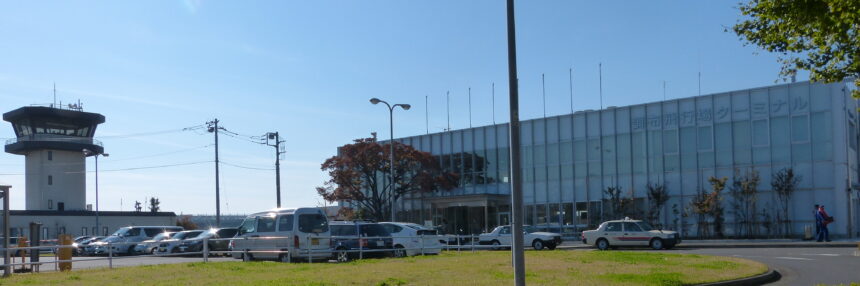
Featured image: Chofu Airport by Aratsuku on Wikimedia Commons, CC BY-SA 4.0. Cropping or resizing may be applied for site display. The image is used in editorial transport-travel-guide context and does not imply endorsement by the photographer, Tokyo Metropolitan Government, Chofu Aerodrome, New Central Airservice, airport operators, nearby facilities, or Wikimedia.
Sources
- Tokyo Metropolitan Government: Chofu Aerodrome top page
- Tokyo Metropolitan Government: Chofu Aerodrome services
- Tokyo Metropolitan Government: Chofu Aerodrome use rules
- Tokyo Metropolitan Government: Chofu Aerodrome overview
- Tokyo Metropolitan Government: Chofu Aerodrome terminal access
- Tokyo Metropolitan Government: Chofu Aerodrome terminal facility guide
- Tokyo Metropolitan Government: Chofu regular air routes
- Tokyo Metropolitan Government: metropolitan airports and drone notice
- New Central Airservice official site
- New Central Airservice: timetable and fare page
- MLIT Tokyo Civil Aviation Bureau: commuter air routes
- Wikimedia Commons image file and license record
Editorial disclosure: This is an independent planning guide. It is not affiliated with Tokyo Metropolitan Government, Chofu Aerodrome, New Central Airservice, MLIT, Tokyo Civil Aviation Bureau, bus operators, nearby facilities, Wikimedia, or the photographer.