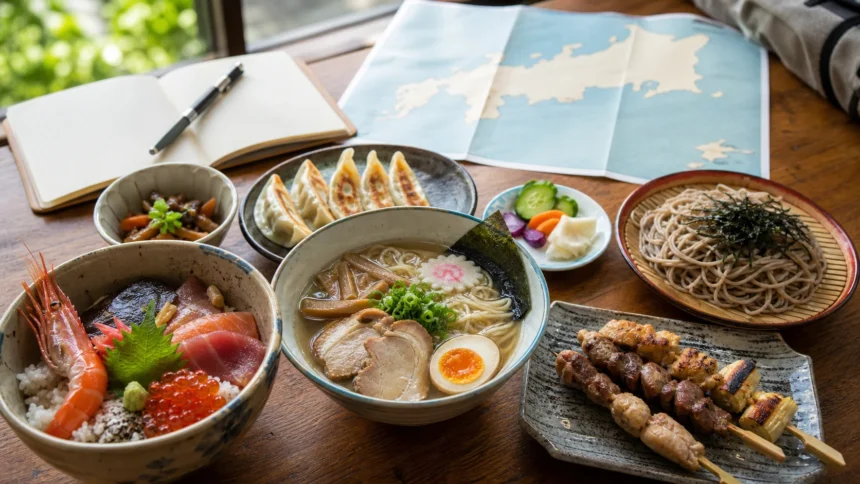
Short answer: For a first Okinawa food trip, decide which island and transport pattern you are actually visiting before building a dish list. Naha is the lowest-friction base for Okinawa soba, market shopping, casual local dishes, taco rice, sweets, and an evening meal without a rental car. Southern, central, and northern Okinawa Island add rural or destination restaurants but require more transport planning. Miyako and Ishigaki are not Naha food detours: they are separate flight-and-stay decisions with their own island context.
Plan one high-commitment meal and one flexible taste per day. Check the exact restaurant, market, distillery, airline, ferry, bus, monorail, and weather information that applies on the travel date. A regional dish name does not prove its broth, meat, allergens, alcohol, payment method, reservation policy, or suitability for vegetarian, halal, kosher, gluten-free, or allergy-sensitive dining.
Last checked: July 21, 2026. Weather alerts, flights, ferries, roads, buses, monorail service, restaurant hours, market operations, menus, prices, reservations, payment, ingredients, tours, and accessibility can change. Recheck the responsible official source and venue before travel.
Choose Naha, Okinawa Island, Or An Outer Island First
| Area | Best first-trip role | Useful food focus | Main planning friction | Lower-commitment fallback |
|---|---|---|---|---|
| Naha | Main base for a short or car-free visit | Okinawa soba, market food, Ryukyu/Okinawan dishes, taco rice, sweets, awamori without driving | Market and restaurant hours vary; popular evenings can fill | Monorail-accessible indoor restaurant, hotel, or airport meal |
| Southern Okinawa Island | Half- or full-day cultural extension from Naha | Local set meals, vegetables, tofu, seafood, café or facility dining | Bus or car timing; attraction and restaurant hours may not align | Return to Naha before the meal becomes a transport risk |
| Central Okinawa Island | Postwar-food and mixed-format day | Taco rice, casual diners, local and American-influenced formats | Wide area, parking or bus dependence, restaurant-specific origins | Choose a Naha version without claiming it replaces the area context |
| Northern Okinawa Island | Deliberate excursion or overnight | Roadside soba, island produce, local seafood and rural dining | Longer return, sparse alternatives, early closure, driver cannot drink | Keep the north as sightseeing and eat after returning south |
| Miyako Islands | Separate flight and stay | Miyako soba, island fruit, Miyako beef and local products where current | Flight commitment, island transport, seasonal supply, weather | Do not imitate a Miyako trip with a single Naha restaurant |
| Ishigaki / Yaeyama | Separate flight and multi-island gateway | Yaeyama-area food only where the exact island or producer supports it | About 400 km from Okinawa Island; port and flight connections matter | Keep the article route-focused if a dish’s island boundary is unclear |
Okinawa Prefecture is an archipelago. “Okinawa” in a restaurant list may mean the prefecture, Okinawa Island, or a style promoted across several islands. Naha Airport publishes separate air links to Miyako, Ishigaki, and other islands. Official Okinawa tourism describes Ishigaki as the Yaeyama gateway far southwest of the main island and Miyako as a plane-access destination. That geography should control the itinerary.
Use Naha when time is short or the trip is car-free. Add one Main Island zone when the transport effort improves the whole day, not just one plate. Add Miyako or Ishigaki only when the island itself belongs in the trip. For the wider first-visit workflow, see our Japan food travel guide for first-time visitors.
Okinawan Food Culture Is A Living History, Not One Fusion Slogan
Okinawa Prefecture describes traditional food culture as a living culture grounded in Ryukyu cuisine, climate, ingredients, methods, customs, family and community life, and long contact with other places. Official material distinguishes court cuisine, common-people’s cuisine, and foods connected with events and hospitality. The story includes exchange with China, mainland Japan, Southeast Asia, and later postwar influences, but it should not be compressed into “Chinese plus Japanese plus American fusion.”
That shortcut hides three important facts. First, court service and household food are not interchangeable. Second, island environments and routes differ. Third, current restaurants adapt dishes. A tourism page can explain why a category matters without proving that every serving follows a traditional recipe.
Ask four questions when a menu says “traditional,” “local,” or “Okinawan”:
- Is the claim about the prefecture, one island, a municipality, a producer, or one restaurant?
- Is it a documented cultural context, a protected production rule, a named-business history, or promotional language?
- Which ingredients and preparation choices belong to this serving rather than the category?
- What is the fallback if the dish, venue, ferry, or route is unavailable?
Our Japanese regional food guide uses the same discipline: a regional association can guide a trip without becoming an authenticity or safety guarantee.
Okinawa Food Decoder For First-Time Visitors
| Food or drink | What the name usefully signals | What can vary | Questions that matter |
|---|---|---|---|
| Okinawa soba | A wheat-noodle category, not buckwheat soba | Broth, meat, fish stock, toppings, noodle shape, egg, ordering and payment | Wheat, pork/chicken/fish/shellfish stock, egg, soy, sesame, alcohol |
| Soki soba | Okinawa soba served with pork ribs in a common format | Rib style, sweetness, broth, garnish, portion | Pork, bones, stock, soy/wheat, alcohol/mirin, full cooking |
| Rafute / tebichi / mimiga | Different pork preparations: belly, pig’s feet, and pig’s ear contexts | Seasoning, alcohol, soy, sugar, stock and texture | Cut, cooking method, sauce, alcohol/mirin, soy/wheat, shared equipment |
| Goya or tofu champuru | A stir-fry format associated with Okinawan home-style cooking | Egg, pork, fish flakes, stock, tofu, seasoning and oil | Meat, egg, dashi, soy/wheat, shared pan; “vegetable” is not enough |
| Jimami tofu | A peanut-based preparation despite the word “tofu” | Sauce, sweetener, soy/wheat, serving and shared equipment | Peanut is central; also ask about sauce and cross-contact |
| Mozuku / umi-budo | Okinawan seaweed or aquatic-plant food themes | Dressing, soy, fish stock, shellfish contact, seasonal supply | Dressing ingredients, shared prep, exact origin and availability |
| Taco rice | A recognized Okinawan postwar-influenced comfort-food category | Beef/pork, cheese, egg, sauce, spice, soy/wheat and portion | Meat, dairy, egg, sauce, wheat/soy and shared grill |
| Sata andagi / chinsuko / beni-imo sweets | Useful snack or souvenir categories | Wheat, egg, dairy, lard/shortening, nuts, sesame, flavorings and facility | Read the exact package or ask the producer; check storage and import rules |
| Awamori / GI Ryukyu | Okinawan distilled-spirit context; GI has defined production boundaries | Strength, aging, flavor, serving, additions, tour and tasting access | Exact bottle, alcohol percentage, serving size, driver, tour reservation |
Okinawa Soba: Wheat Noodles, Variable Bowls
The first distinction is the most important: Okinawa soba is not Japanese buckwheat soba. Okinawa Prefecture’s food-culture material describes it as a wheat-flour noodle. That makes it unsuitable for a traveler avoiding wheat unless the exact venue offers and controls a documented alternative. The word soba does not make buckwheat the main concern here.
The rest of the bowl is not fixed. A shop may combine pork, chicken, bonito or other fish stock; it may use soy sauce, egg, sesame, alcohol or mirin; and it may prepare several bowls in shared equipment. Pork ribs in soki soba are a strong clue, but a vegetable-looking bowl can still use animal or fish stock. A clear broth is not a vegetarian signal.
Read the shop before ordering
- Look for a ticket machine, counter order, tablet, or table service.
- Identify the base bowl before adding toppings; photos can hide meat or garnish.
- Ask about the stock, not only the visible topping.
- Confirm the noodle and sauce allergens that matter to you.
- Ask whether payment is before or after the meal and keep cash as a backup.
Do not assume every soba shop offers the same sizes, noodle texture, extra noodles, English menu, children’s bowl, takeaway, reservation, or payment. If a machine is part of the visit, our restaurant ticket-machine guide explains the major order-and-payment branches.
Miyako and Yaeyama labels need geographic care
Official Okinawa tourism identifies Miyako soba as a Miyako food theme. That supports an island association, not a universal noodle arrangement or topping rule. Yaeyama food labels should be tied to Ishigaki or the named Yaeyama island and producer that actually supports them. Do not describe every outer-island bowl as available in Naha, and do not add a flight merely to complete a noodle checklist.
Pork Matters, But It Is Not The Whole Cuisine
Pork appears in many visible Okinawan categories. Rafute commonly points to braised pork belly; soki to ribs; tebichi to pig’s feet; mimiga to pig’s ear. Each format can carry soy, wheat, sugar, alcohol or mirin, stock, mustard, sesame, and shared-equipment questions. A braised dish may retain an alcohol-related concern even when the serving does not taste alcoholic.
The mistake is to move from “pork is important” to “every Okinawan dish contains pork.” Official prefectural food material also covers vegetables, tofu, seaweed, seafood, noodles, rice, sweets, and event foods. A traveler avoiding pork can build a useful trip—but cannot treat a meat-free-looking title as proof. Stock, lard, garnish, sauce, gelatin, fryers, pans, and serving utensils can matter.
A non-pork question should have two parts
Ask both “Does this contain pork?” and “Does the stock, sauce, or oil use pork?” If religious observance requires a certified process, ingredient questioning alone is insufficient; use a currently verified venue whose exact certification and kitchen scope match the need. A “Muslim-friendly” or “vegetarian-friendly” listing is not automatically a certification or cross-contact guarantee.
Vegetables, Tofu, Seaweed, And The Hidden-Ingredient Problem
Goya champuru is a helpful example of why menu nouns are incomplete. The bitter melon is visible. Tofu may be visible. Egg, pork, bonito flakes, stock, soy sauce, and the shared pan may not be. Fu champuru also raises wheat questions because fu is wheat gluten. Tofu champuru can still contain animal or fish components.
Jimami tofu deserves a separate warning: Okinawa Prefecture and official Okinawa tourism state that it is peanut-based. It is not a soy-tofu substitute for a traveler with a peanut allergy. The sauce and kitchen may introduce more risks, but peanut is already central to the food itself. If the menu translation says only “local tofu,” stop and ask.
Mozuku and umi-budo can be lower-commitment tastes, yet their dressings may contain soy, wheat, fish stock, alcohol, or other ingredients. Seafood and shellfish may share preparation surfaces. Packaged versions can be easier to audit because the exact label is available, but Japan’s packaged-food system still differs from other countries and Japanese-language labeling may require careful translation.
How To Use Makishi Public Market Without Guessing
First Makishi Public Market is useful because the operator publishes a clear workflow. It is not one restaurant and it does not have one universal menu or payment policy. Current operator information says hours vary by shop, and closure patterns and last orders should be checked again on the visit date.
The official purchase-and-cook workflow
- Choose an eligible ingredient on the first floor. Ask the seller whether that specific item can use the mochiage system.
- Pay the ingredient seller. Keep the purchase and its instructions clear.
- Move to a participating second-floor restaurant. Discuss how it can be cooked, the charge, allergens, time, and portion before agreeing.
- Pay the cooking restaurant separately. The official guide says cooking charges depend on preparation.
This is not permission to hand any purchase to any restaurant. Participation, eligible products, cooking method, waiting time, price, seating, payment, ingredients, and cross-contact vary. If the market is busy, the chosen ingredient is unsuitable, or the cooking restaurant cannot answer a safety question, buy a packaged item or choose a normal menu meal instead.
Market decision rules
- Do not treat today’s fish, fruit, tenant list, or price as permanent.
- Do not block aisles, counters, or stairs while comparing purchases.
- Ask before photographing people, products closely, or preparation.
- Keep luggage out of the workflow; check current storage options elsewhere.
- Dispose of rubbish where instructed or carry it until an appropriate bin is available.
- Protect the next transport connection; a second-floor wait is optional.
Taco Rice: Keep The Postwar Context, Drop The Origin Certainty
Official Okinawa tourism treats taco rice as a familiar local comfort food and places it naturally in a Main Island itinerary. That is enough for a traveler-facing guide. It does not require repeating a single inventor, exact date, or undisputed birthplace when the primary record is incomplete.
The format commonly combines seasoned meat, rice, lettuce, tomato, cheese, and sauce, but the word taco rice does not establish the meat, dairy, egg, soy, wheat, spice, or shared-grill details of a plate. An omelet-topped version adds an obvious egg question. A sauce can carry less visible allergens. Treat each restaurant’s version as its own recipe.
Central Okinawa Island can add valuable postwar and cultural context to the meal. If time is short, eating taco rice in Naha can still be enjoyable; simply do not claim that it reproduces a visit to the area or the history of a named business.
Awamori: Understand GI Ryukyu Before Ordering A Tasting
The National Tax Agency’s specification for geographical indication Ryukyu gives a precise boundary that general travel prose often lacks. Qualifying production uses rice koji made with specified black koji, Okinawa water, and fermentation and pot distillation in Okinawa; storage during production and final filling are also bounded to Okinawa. The NTA page explains that an expression aged for at least three years is called kusu.
Those rules do not make every bottle taste the same. They do not state one alcohol percentage, serving size, mixer, sweetness, allergen profile, or distillery-tour policy. Read the bottle or ask the venue. Water, ice, soda, cocktails, and straight service create different drinking experiences, but none creates a “safe amount” before driving.
Build the evening around the driver
Japan’s National Police Agency states the rule clearly: if you drink, do not drive. The designated driver should choose a non-alcoholic drink and should not use internet calculations to estimate a safe clearance time. A distillery visit may require a reservation, may restrict tasting, and may have limited access without a car. Confirm the exact operator before committing.
Travelers who avoid alcohol, are pregnant, take medication, manage a medical condition, or are uncertain about interactions should choose a non-alcoholic option and seek appropriate professional advice when needed. Participation in Okinawan food culture does not require drinking.
Six Okinawa Food Route Patterns
1. Naha-only day: market, soba, one evening anchor
Choose either Makishi’s purchase-and-cook experience or a normal soba lunch—not both as fixed queues. Use the afternoon for culture or rest. Reserve one evening meal only when it matters, and keep the other food tastes flexible. This pattern works well from the monorail corridor and limits weather exposure.
2. Car-free short stay: monorail first, bus only with a return plan
Build the core around Naha Airport, central Naha, Makishi, and other currently reachable monorail stops. Add a bus meal only after checking the operator’s outward and return service. A restaurant pin without a return route is not a plan. Taxi availability should not be assumed as the only fallback.
3. Naha plus south or central: one excursion, one flexible meal
Pair a cultural or sightseeing destination with one nearby food theme. Confirm whether the restaurant is open when the attraction is open and whether the party can return before the evening commitment. If the meal closes or fills, keep the destination and eat in Naha.
4. Northern Okinawa Island: protect the turnaround
A northern soba shop, produce stop, or rural restaurant should fit a whole-day route. Set a hard turnaround based on current roads, bus, accommodation, and weather. Do not add awamori tasting to a self-drive day. If the restaurant is closed, use another operating venue or return south; do not chase a replacement farther away.
5. Miyako or Ishigaki add-on: separate stay, separate margin
Fly because the island belongs in the trip, then research its transport and food separately. Miyako tourism supports Miyako soba, fruit, and Miyako beef as island themes. Ishigaki functions as a Yaeyama gateway, but this guide does not invent a complete Yaeyama menu from that geography. Keep a buffer before the flight home and check the exact airline, airport, port, and local operator.
6. Typhoon, heat, or transport disruption: shrink the radius
Check official weather and disaster information, then the responsible airline, ferry, bus, monorail, or road source. Protect the last connection. Cancel the optional food excursion before it becomes a safety or accommodation problem. Use an operating hotel, airport, or nearby indoor venue; do not assume taxis, delivery, restaurants, or convenience stores will operate normally.
When To Reserve, Queue, Or Change The Format
| Format | Reservation posture | Same-day check | Switch when |
|---|---|---|---|
| Soba shop / casual diner | Often walk-in, but shop policy controls | Open day, sell-out, queue, order method, cash | Queue threatens transport or staff cannot answer key ingredients |
| Makishi market meal | Usually a live market decision | Market/shop operation, eligible ingredient, cooking restaurant and charge | No participation, no seat, uncertain cross-contact or long wait |
| Izakaya or live-music venue | Check/reserve when it anchors the evening | Table/music/house-appetizer charge, start time, minimum order | Fee or timing is unclear, group cannot fit, driver plan is unresolved |
| Hotel / course / Ryukyu-cuisine meal | Advance booking can matter | Course, party size, cancellation, dietary notice, duration | Venue cannot confirm the requested accommodation in advance |
| Rural or seaside restaurant | Contact when the route depends on it | Current operation, access, parking/bus, sell-out and weather | It becomes the only fragile stop on a long return route |
| Distillery visit | Operator-specific; never assume walk-in | Tour, tasting, reservation, language, age, driver, access | Driver/tasting separation or return transport is not secure |
| Outer-island ferry day | Follow the village/operator booking system | Same-day sailing status, boarding cutoff, return service | Weather margin or return reservation is weak |
If a restaurant is the one non-negotiable meal, reserve it with enough route margin and confirm the cancellation and late-arrival rules. Our restaurant reservation guide for Japan covers hotel help, card guarantees, cancellation, and fallback planning.
Ordering And Payment: Follow The Venue, Not The Category
An Okinawa soba shop may use a ticket machine, table order, counter order, or QR menu. A market has separate sellers and restaurants. A hotel, airport, chain, rural diner, distillery, ferry, and beach-area kiosk can accept different payments. No prefecture-wide rule says that a local restaurant is cash-only or card-friendly.
- Look for payment logos and an order counter before joining a long queue.
- Ask whether payment is before or after eating.
- Keep enough yen for an independent shop, market purchase, ferry-side need, or failed foreign card.
- Do not assume transit IC works merely because a venue is near Yui Rail.
- If the terminal offers currency conversion, read the amount and currency before approval.
- If payment fails, ask once, try a clearly different supported method, and avoid repeated charges.
For a resilient wallet strategy, see our cash, cards, and IC payments guide. Payment acceptance, ATM operation, refund handling, and ferry counters remain current-operator questions.
Manners By Place: Observe, Ask, Recover
Official Okinawa tourism asks visitors to carry rubbish when no suitable bin is available, avoid waste, respect outside-food rules, and recognize that some izakaya have table charges and a small house appetizer. These are useful expectations, not permission to assume a fee or rule at every venue.
- Market: keep aisles open, ask before close photography, pay each counter correctly, and use the cooking workflow only after confirmation.
- Soba shop: follow the visible queue, do not hold seats while ordering unless directed, and return trays only when the shop indicates.
- Izakaya/live music: ask about table, music, or appetizer charges before sitting if they affect the decision.
- Beach or rural stop: change out of swimwear before entering an ordinary restaurant and keep sand/wet gear controlled.
- Ferry/transport: protect boarding time, keep luggage within the operator’s rules, and do not bring strong food or rubbish into a shared cabin without permission.
When unsure, pause and ask. If you misunderstand, apologize briefly and follow the staff’s direction. Our Japanese food etiquette guide covers queues, photography, chopsticks, trains, rubbish, tipping, and mistake recovery in more detail.
Allergies And Dietary Needs: Start With The Dish, Then The Process
Japan’s Consumer Affairs Agency updated the packaged processed-food allergen system in April 2026 to nine mandatory and twenty recommended items. That packaged-food rule is not a restaurant menu guarantee. Older English visitor material may still show the previous eight-plus-twenty system, so a traveler should not treat an old leaflet as the complete 2026 list.
Restaurant and market food require direct communication. Ask about the visible dish, the stock or sauce, and shared preparation. If the staff is uncertain, the correct fallback may be a different documented dish, sealed packaged food, a room with kitchen access, or leaving the venue. A phrase card helps communication but cannot control the kitchen.
| Food | High-priority checks | Do not assume |
|---|---|---|
| Okinawa / soki soba | Wheat, pork/chicken/fish/shellfish stock, egg, soy, sesame, alcohol, shared pot | Clear broth is meat-free; “soba” means buckwheat |
| Jimami tofu | Peanut, sauce, soy/wheat, cross-contact | It is ordinary soy tofu; a small taste is safe |
| Champuru | Egg, pork, bonito/fish stock, soy/wheat, shared pan | Vegetable or tofu in the name means vegetarian |
| Mozuku / umi-budo | Dressing, soy/wheat, fish stock, shellfish contact | Seaweed alone defines the prepared dish |
| Taco rice | Beef/pork, dairy, egg, sauce, wheat/soy, grill | Every version has the same meat or cheese |
| Sweets | Wheat, egg, dairy, peanut/tree nuts, sesame, lard, shared fryer/facility | A purple sweet-potato color gives the full ingredient list |
| Raw seafood | Exact item, raw/cooked state, health advice, facility controls | Local, fresh, popular, or market-bought means risk-free |
| Awamori / sauces | Alcohol percentage, alcohol/mirin use, personal restriction | Cooking or dilution always removes the concern |
Okinawa Prefecture specifically warns about jimami tofu and peanut allergy. MHLW explains that food poisoning can involve bacteria, viruses, toxins, and parasites; its Anisakis guidance applies to raw or inadequately frozen or heated seafood. Local reputation does not replace food-safety controls. For a full advance-contact and emergency workflow, see our Japan food allergy guide for travelers.
Typhoon And Heat Decision Sequence
Okinawa’s official tourism guidance says typhoons can affect flights, ships, buses, monorail, roads, taxis, facilities, and sightseeing. It tells travelers to use official alerts and the responsible operator. Okinawa Prefecture also publishes current heatstroke-prevention guidance and heat-alert links. Neither source can promise what will operate for your meal.
- Check Japan Meteorological Agency and official Okinawa disaster or heat information for the correct island group.
- Check the exact airline, airport, ferry, Yui Rail, bus, road, facility, and accommodation that applies.
- Protect the final connection and accommodation before a restaurant reservation.
- Keep at least one meal flexible when alerts or transport margins are weak.
- Shrink the travel radius and choose an operating indoor fallback.
- Do not assume a lull means the danger or service disruption has ended.
For heat, carry water, use shade and air-conditioned breaks, and avoid building a day around long exposed queues. Children, older travelers, and anyone who feels unwell need a conservative plan. Follow official medical and emergency guidance rather than treating a food itinerary as health advice.
Useful Japanese Phrases
These phrases are communication aids, not ingredient or safety guarantees.
| Japanese | Romanization | Meaning |
|---|---|---|
| 豚肉は入っていますか。 | Butaniku wa haitte imasu ka? | Does this contain pork? |
| だしは何から作っていますか。 | Dashi wa nani kara tsukutte imasu ka? | What is the stock made from? |
| 魚や甲殻類を使っていますか。 | Sakana ya kōkakurui o tsukatte imasu ka? | Does this use fish or crustacean shellfish? |
| ピーナッツが入っていますか。 | Pīnattsu ga haitte imasu ka? | Does this contain peanuts? |
| 小麦、卵、大豆、ごま、乳が入っていますか。 | Komugi, tamago, daizu, goma, nyū ga haitte imasu ka? | Does it contain wheat, egg, soy, sesame, or milk? |
| 同じ油や調理器具を使いますか。 | Onaji abura ya chōri kigu o tsukaimasu ka? | Do you use the same oil or equipment? |
| お酒やみりんを使っていますか。 | Osake ya mirin o tsukatte imasu ka? | Does this use alcohol or mirin? |
| これは生ですか、十分に加熱されていますか。 | Kore wa nama desu ka, jūbun ni kanetsu sarete imasu ka? | Is this raw, or fully cooked? |
| 持ち上げできますか。 | Mochiage dekimasu ka? | Can this use the market’s purchase-and-cook system? |
| 調理代はいくらですか。 | Chōridai wa ikura desu ka? | How much is the cooking charge? |
| 予約は必要ですか。 | Yoyaku wa hitsuyō desu ka? | Is a reservation required? |
| 使える支払い方法は何ですか。 | Tsukaeru shiharai hōhō wa nan desu ka? | Which payment methods can I use? |
| 最終便に間に合いますか。 | Saishūbin ni maniaimasu ka? | Will I make the last service? |
| 運航状況はどこで確認できますか。 | Unkō jōkyō wa doko de kakunin dekimasu ka? | Where can I check operating status? |
| すみません、ルールを勘違いしました。 | Sumimasen, rūru o kanchigai shimashita. | Sorry, I misunderstood the rule. |
Five Real Okinawa Food Decisions
A first-time Naha visitor wants soba, Makishi, and an izakaya
Do not turn all three into queues. Eat soba before or after the main lunch rush, choose either a market cooking experience or a lighter market purchase, and reserve the evening only if it is the priority. If Makishi is crowded or the cooking workflow is unclear, use a normal second-floor menu or leave. Keep cash and an indoor fallback.
A car-free traveler finds a famous northern restaurant
Check the full outward and return route before the menu. Notice bus frequency, the walk from the stop, current operation, and the last practical return. Do not assume a taxi will appear. If the restaurant creates a fragile day, choose Naha or a bus-friendly Main Island destination and save the north for a longer trip.
A traveler wants both Miyako and Ishigaki food in a Naha weekend
Recognize that these are separate island commitments, not neighboring food districts. Choose one island only when its beaches, culture, stay, and food justify the flight. Otherwise build a Naha/Main Island trip and do not describe a Naha restaurant as a complete substitute for Miyako or Yaeyama.
A family has luggage during a typhoon approach
Check official alerts, the airline or ferry, accommodation, and local transport. Cancel the market or rural food chase before the final connection becomes uncertain. Keep the group in an appropriate indoor location and use an operating hotel or airport meal. Do not rely on delivery, taxis, or saved restaurant hours.
A traveler avoids peanuts, pork, shellfish, wheat, or alcohol
Flag jimami tofu as peanut food immediately. Ask about soba noodles and stock, champuru ingredients, sauces, shared pans, and alcohol/mirin. Contact a suitable venue in advance when the restriction is serious or religiously bounded. Carry the relevant written information and a documented fallback. Leave if the answer is unclear.
Frequently Asked Questions
What food is Okinawa known for?
Useful first-trip categories include Okinawa soba and soki soba, several pork preparations, champuru dishes, tofu and vegetable foods, mozuku and umi-budo, seafood, taco rice, sata andagi and other sweets, and awamori. Recipes and availability vary by island, producer, market, and restaurant.
Is Naha enough for a first Okinawa food trip?
Yes for a short or car-free visit. Naha provides several useful formats with low hotel-changing friction. It does not replace a northern Main Island road trip, Miyako, Ishigaki, or the Yaeyama islands. Describe it honestly as a Naha-based trip.
Does Okinawa soba contain buckwheat?
Okinawa Prefecture describes the noodles as wheat-based rather than buckwheat soba. The bowl can still contain pork, chicken, fish or shellfish stock, egg, soy, sesame, alcohol, and other ingredients depending on the shop. Ask about the exact serving.
Is jimami tofu made from soy?
No. Official Okinawa sources identify jimami tofu as peanut-based. It is a high-priority warning for peanut-allergic travelers. Sauce ingredients and cross-contact also require confirmation.
How does the Makishi market cooking system work?
Ask whether the first-floor ingredient is eligible, buy it from that seller, then take it to a participating second-floor restaurant and agree on the preparation and cooking charge. Ingredient and cooking payments are separate. Not every item or restaurant participates.
Do I need a car for an Okinawa food trip?
Not for a Naha-focused visit. A car expands access to many Main Island areas but creates parking, traffic, return, and no-drinking responsibilities. Remote-island transport varies. Choose the vehicle after the itinerary, not because a restaurant list assumes one.
Can I visit Miyako or Ishigaki for lunch from Naha?
That is rarely a sensible food-only plan. Both are separate flight destinations with their own local transport and weather risk. Visit because the island belongs in the trip and give it appropriate stay and connection margin.
Can the designated driver taste awamori?
No. The National Police Agency’s guidance is direct: if you drink, do not drive. Choose a non-alcoholic drink and do not estimate a safe amount or clearance time.
Are vegetarian or halal meals easy to identify?
Some venues provide suitable options, but dish names such as vegetable, tofu, or seaweed do not prove the stock, sauce, meat, alcohol, certification, or shared-kitchen scope. Use a currently verified venue, ask precise questions, and keep a fallback.
How should I plan food during typhoon season?
Check official weather and disaster information and then the exact operator. Keep a flexible meal, avoid fragile non-refundable bookings, protect the last connection and accommodation, and shrink the route when conditions are uncertain. Do not predict transport from the weather alone.
Official And First-Party Sources
- Okinawa Prefecture — traditional Okinawan food culture preservation
- Okinawa Prefecture — Okinawan food culture
- VISIT OKINAWA JAPAN — Okinawan Food Culture
- VISIT OKINAWA JAPAN — Taste Okinawa
- First Makishi Public Market — facility and current operation
- First Makishi Public Market — purchase-and-cook guide
- VISIT OKINAWA JAPAN — Getting Around Okinawa
- Okinawa Urban Monorail — Yui Rail
- Naha Airport — List of cities
- VISIT OKINAWA JAPAN — Miyako Island
- VISIT OKINAWA JAPAN — Ishigaki Island
- Tokashiki Village — English ferry information and live-status workflow
- VISIT OKINAWA JAPAN — Typhoon Precautions
- Okinawa Prefecture — Heatstroke prevention
- National Tax Agency — GI Ryukyu specification
- National Police Agency — safe-driving rules
- Consumer Affairs Agency — April 2026 allergen-labeling information
- Consumer Affairs Agency — allergies when eating out
- Okinawa Prefecture — food safety, jimami tofu and seafood risks
- Ministry of Health, Labour and Welfare — Anisakis prevention
- VISIT OKINAWA JAPAN — Manners & Customs
Editorial disclosure: This independent first-phase guide contains no affiliate links, paid placements, sponsored restaurant rankings, or PR recommendations. Official tourism pages explain cultural and regional context but do not prove every venue’s current operation, recipe, provenance, payment, or dietary suitability. Verify mutable details with the responsible authority, operator, producer, facility, or restaurant before travel.